Jonathan Kellerman - Dr. Death
Здесь есть возможность читать онлайн «Jonathan Kellerman - Dr. Death» весь текст электронной книги совершенно бесплатно (целиком полную версию без сокращений). В некоторых случаях можно слушать аудио, скачать через торрент в формате fb2 и присутствует краткое содержание. Жанр: Триллер, на английском языке. Описание произведения, (предисловие) а так же отзывы посетителей доступны на портале библиотеки ЛибКат.
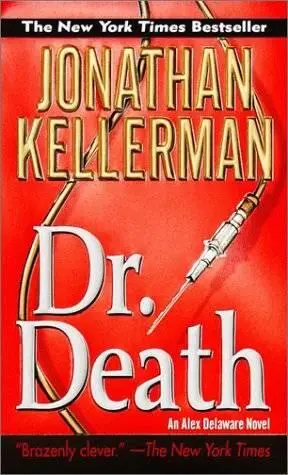
- Название:Dr. Death
- Автор:
- Жанр:
- Год:неизвестен
- ISBN:нет данных
- Рейтинг книги:5 / 5. Голосов: 1
-
Избранное:Добавить в избранное
- Отзывы:
-
Ваша оценка:
Dr. Death: краткое содержание, описание и аннотация
Предлагаем к чтению аннотацию, описание, краткое содержание или предисловие (зависит от того, что написал сам автор книги «Dr. Death»). Если вы не нашли необходимую информацию о книге — напишите в комментариях, мы постараемся отыскать её.
"More than satisfying… Kellerman delves deep into the psyche of his characters, peeling back the layers of secrets to uncover a stunning truth." -The Orlando Sentinel
"Kellerman uses bloody killings, psychological intrigue and a straight-ahead writing style to keep readers turning pages well into the night." -The Denver Post
"Often, mystery writers can either plot like devils or create believable characters. Kellerman stands out because he can do both. Masterfully." – USA Today
"[An] intriguing thriller… A heady blend of criminal profiling and police procedural and another surefire hit for the bestselling Kellerman." -Booklist
***
People are voluntarily dying before their time in California. Some call it assisted suicide when cancer or heart disease or painful old age make the quality of life unbearable. Others say it is murder, that no-one has the right to help others take their own life.
As the debate rages over whether euthanasia should be legalised or not the man at the centre of the row, nick-named Doctor Death, continues his work. Dr Alex Delaware joins in the argument, but when Detective Milo Sturgis comes to him with the suspicion that some of Doctor Death's patients are not willing collaborators, Delaware finds himself on the front line of the affair, and increasingly believes that euthanasia is not the prime motivation. So what is driving Doctor Death to kill so many?
Dr. Death — читать онлайн бесплатно полную книгу (весь текст) целиком
Ниже представлен текст книги, разбитый по страницам. Система сохранения места последней прочитанной страницы, позволяет с удобством читать онлайн бесплатно книгу «Dr. Death», без необходимости каждый раз заново искать на чём Вы остановились. Поставьте закладку, и сможете в любой момент перейти на страницу, на которой закончили чтение.
Интервал:
Закладка:
"Long body list for a twenty-two-year-old," I said. "A twenty-two-year-old smart enough to make it through pre-med and med school. He worked his way through by holding down a job as a lab assistant to a biology professor-basically a nighttime bottle washer, but he didn't need much income, lived in student housing. Had Grandma's dough. Pulled a 3.85 GPA-from what I can tell, he really earned those grades. Summers, he worked as an orderly at three public hospitals-New York Medical, Middle State General and Long Island General. He applied to ten med schools, got into four, chose the University of Washington in Seattle."
"Any coed murders during his pre-med period?" said Milo.
Fusco licked his lips. "No, I can't find any definite matches during that time. But there was no shortage of missing girls. All over the country, bodies that never showed up. I believe Rushton/Burke kept on killing but hid his handiwork better."
"You believe? This joker's a homicidal psychopath and he just changes his ways?"
"Not his ways," said Fusco. "His mode of expression. That's what sets him apart. He can let loose his impulses along with the bloodiest of them, but he also knows how to be careful. Exquisitely careful. Think about the patience it took to actually become a doctor. There's something else to consider. During his New York period, he may have diverted his attention from rape/murder to the parallel interest he'd developed in Michigan and continued in Bakersfield: putting hospital patients out of their misery. I know they seem like different patterns, but what they've got in common is a lust for power. Playing God. Once he learned all about hospital systems, playing ward games would've been a snap."
"How is he supposed to have killed all those patients?" said Milo.
"There are any number of ways that make detection nearly impossible. Pinching off the nose, smothering, fooling with med lines, injecting succinyl, insulin, potassium."
"Any funny stuff go down at the three hospitals where Burke spent his summers?"
"New York's the worst place to obtain information. Large institutions, lots of regulations. Let's just say I have learned of several questionable deaths that occurred on wards where Burke was assigned. Thirteen, to be exact."
Milo pointed down at the file folder. "All this is in here?"
Fusco shook his head. "I've limited my written material to data, no supposition. Police reports, autopsies, etcetera."
"Meaning some of your stuff was obtained illegally, so it can never be used in court." Fusco didn't reply.
"Pretty dedicated, Agent Fusco," said Milo. "Cowboy stuff's not exactly what I'm used to when dealing with Quantico."
Fusco flashed those big teeth of his. "Pleased to bust your stereotype, Detective Sturgis.
I didn't say that."
The agent leaned forward. "I can't stop you from being hostile and distrustful. But, really, what's the point of playing uptight-local-besieged-by-the-big-bad-Fed? How many times does someone offer you this level of information?"
"Exactly," said Milo. "When something seems to be too good to be true, it usually is."
"Fine," said Fusco. "If you don't want the file, give it back. Good luck chipping away at Dr. Mate. Who, by the way, began his own little death trip around the same time Michael Burke/Grant Rushton decided to seriously pursue a career in medicine. I believe Burke took note of Mate. I believe Mate's escapades and the resulting publicity played a role in Michael Burke's evolution as a ward killer. Though, of course, Michael had begun snuffing out patients earlier. Michael's main objective was killing people." To me: "Wouldn't you say that applied to Dr. Mate, as well?"
Calling Burke by his first name. The hateful intimacy born of futile investigation. Milo said, "You see Mate as a serial killer?"
Fusco's face went pleasantly bland. "You don't?"
"Some people consider Mate an angel of mercy."
"I'm sure Michael Burke could manipulate some people to say the same of him. But we all know what was really going on. Mate loved the ultimate power. So does Burke. You know all the jokes about doctors playing God. Here're a couple who put it into practice."
Milo rubbed the side of the table as if cleaning off his fingertips. "So Mate inspires Burke, and Burke goes up to Seattle for med school. He moves around a lot."
"He does nothing but move," said Fusco. "Funny thing, though: until he showed up in Seattle and purchased a used VW van, he'd never officially owned a car. Like I said, a retrovirus-keeps changing, can't be grabbed hold of."
"Who died in Seattle?"
"The University of Washington hasn't been forthcoming with its records. Au contraire, officially none of their wards have experienced a pattern of unusual patient deaths. But would you take that to the bank? There's certainly no shortage of serials up there."
"So now Burke's back to girls? What, he's the Green River Killer?"
Fusco smiled. "None of the Green River scenes match his previous work, but I know of at least four cases that do bear further study. Girls cut up and left tied to trees in semirural spots, all within a hundred miles of Seattle, all unsolved."
"Burke's fooling with I.V. lines by day, cutting up girls in his spare time, somehow working in med school."
"Bundy killed and worked while in law school. Burke's a lot smarter, though like most psychopaths he tends to slack off. That almost cost him his MD. He had to spend a summer making up poor basic-science grades, received low marks for his clinical skills, graduated near the bottom of his class. Still, he finished, got an internship at a V.A. clinic in Bellingham. Once again, I can't get hold of hospital records, but if someone finds an unusual number of old soldiers expiring under his watch, I'm not going to faint from shock. He finished an emergency medicine residency at the same place, got a six-figure job with Unitas, moved back to New York, and added another car to his auto arsenal."
"He held on to the van?" I said.
"Most definitely."
"What kind of car?" said Milo. I knew he was wondering: BMW?
"Three-year-old Lexus," said Fusco. "The way I see it, emergency medicine's perfect for a twisted loner-plenty of blood and suffering, you get to make life-and-death decisions, cut and stitch, the hours are flexible-work a twenty-four-hour shift, take days off. And important: no follow-up of patients, no long-term relationships, office or staff. Burke could've gone on for years, but he's still a psychopath, has that tendency to screw up. Finally did."
Milo smiled. He'd been living with an E.R. doctor for fifteen years. I'd heard Rick praise the freedom that resulted from no long-term entanglements.
"Poisoning the boss," Milo said. "The article said he'd been suspended for bad medicine. Meaning?"
"He had a habit of not showing up at the E.R. when he was supposed to. Plus poor doctor-patient relations. The boss-Dr. Rabinowitz-said sometimes Burke could be terrific with patients. Charming, empathetic, taking extra time with kids. But other times he'd turn-lose his temper, accuse someone of overdramatizing or faking, get really nasty. He actually tried to kick a few patients out of the E.R., told them to stop taking up bed space that belonged to sick people. Toward the end, that was happening more and more. Burke was warned repeatedly, but he simply denied any of it had ever happened."
"Sounds like he was losing it," said Milo. He looked at me.
"Maybe heightened tension," I said. "The pressure of working a tough job when his qualifications were marginal. Being scrutinized by people who were smarter. Or some kind of emotional trauma. Has he ever had an outwardly normal relationship with a woman?"
"No long-term girlfriend, and he's a nice-looking guy." Fusco's eyes drooped lower. His hands balled. "That brings me to another pattern. A more recent one, as far as I can tell. He developed a friendship with one of his patients up in Seattle. Former cheerleader with bone cancer. Burke was circulating through as an intern, ended up spending a lot of time with her."
Читать дальшеИнтервал:
Закладка:
Похожие книги на «Dr. Death»
Представляем Вашему вниманию похожие книги на «Dr. Death» списком для выбора. Мы отобрали схожую по названию и смыслу литературу в надежде предоставить читателям больше вариантов отыскать новые, интересные, ещё непрочитанные произведения.

Обсуждение, отзывы о книге «Dr. Death» и просто собственные мнения читателей. Оставьте ваши комментарии, напишите, что Вы думаете о произведении, его смысле или главных героях. Укажите что конкретно понравилось, а что нет, и почему Вы так считаете.