Jonathan Kellerman - Dr. Death
Здесь есть возможность читать онлайн «Jonathan Kellerman - Dr. Death» весь текст электронной книги совершенно бесплатно (целиком полную версию без сокращений). В некоторых случаях можно слушать аудио, скачать через торрент в формате fb2 и присутствует краткое содержание. Жанр: Триллер, на английском языке. Описание произведения, (предисловие) а так же отзывы посетителей доступны на портале библиотеки ЛибКат.
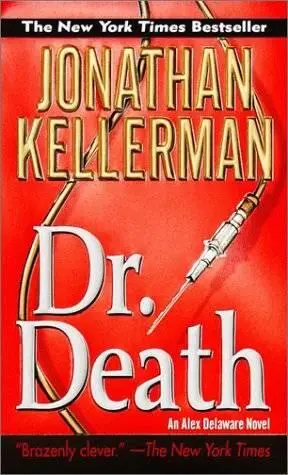
- Название:Dr. Death
- Автор:
- Жанр:
- Год:неизвестен
- ISBN:нет данных
- Рейтинг книги:5 / 5. Голосов: 1
-
Избранное:Добавить в избранное
- Отзывы:
-
Ваша оценка:
Dr. Death: краткое содержание, описание и аннотация
Предлагаем к чтению аннотацию, описание, краткое содержание или предисловие (зависит от того, что написал сам автор книги «Dr. Death»). Если вы не нашли необходимую информацию о книге — напишите в комментариях, мы постараемся отыскать её.
"More than satisfying… Kellerman delves deep into the psyche of his characters, peeling back the layers of secrets to uncover a stunning truth." -The Orlando Sentinel
"Kellerman uses bloody killings, psychological intrigue and a straight-ahead writing style to keep readers turning pages well into the night." -The Denver Post
"Often, mystery writers can either plot like devils or create believable characters. Kellerman stands out because he can do both. Masterfully." – USA Today
"[An] intriguing thriller… A heady blend of criminal profiling and police procedural and another surefire hit for the bestselling Kellerman." -Booklist
***
People are voluntarily dying before their time in California. Some call it assisted suicide when cancer or heart disease or painful old age make the quality of life unbearable. Others say it is murder, that no-one has the right to help others take their own life.
As the debate rages over whether euthanasia should be legalised or not the man at the centre of the row, nick-named Doctor Death, continues his work. Dr Alex Delaware joins in the argument, but when Detective Milo Sturgis comes to him with the suspicion that some of Doctor Death's patients are not willing collaborators, Delaware finds himself on the front line of the affair, and increasingly believes that euthanasia is not the prime motivation. So what is driving Doctor Death to kill so many?
Dr. Death — читать онлайн бесплатно полную книгу (весь текст) целиком
Ниже представлен текст книги, разбитый по страницам. Система сохранения места последней прочитанной страницы, позволяет с удобством читать онлайн бесплатно книгу «Dr. Death», без необходимости каждый раз заново искать на чём Вы остановились. Поставьте закладку, и сможете в любой момент перейти на страницу, на которой закончили чтение.
Интервал:
Закладка:
"All this within two years of high-school graduation?" I said. "He was only twenty?"
"Correct," said Fusco. "Precocious lad. The next few years are another cloudy area. I can't prove it, but I know he returned to Syracuse to visit Grandma a year later. Though no one remembers seeing him."
"Something happened to Grandma," said Milo.
Fusco's lips curled inward. He ran a hand over the white bush atop his head. "One of those Syracuse winters, late at night, Grandma drove her car into a tree on a rural road and went through the windshield. Her blood alcohol was just over the limit and an empty brandy bottle was found on the front seat. By the time they found her body, it was frozen stiff. No reason to think it was anything other than a single-driver DUI thing, except for the fact that Grandma was a stay-at-home drinker, never went out at night. Rarely drove, period. No one could explain why she'd taken the car out in a freezing storm or why she was out in the sticks, a good fifteen miles from her house. No one also thought to question why, with that kind of impact, the bottle would be right there on the seat. Irma Huie didn't leave much of an estate-her place was rented, she kept no bank accounts. The police didn't find any money, not a penny in the cookie jar. Which I find curious because she'd lived on pension money from her husband and Social Security income, and her landlord said she kept cash around, he'd seen wads of bills bound by rubber bands. A year later, Mitchell Sartin surfaced as Michael Ferris Burke and enrolled in City University of New York as a sophomore pre-med major. He presented a transcript-later shown to be forged-from Michigan State University, claiming a year of courses, GPA of 3.8. CUNY bought it. Burke gave his age as twenty-six-to match the stats on another I.D. he'd cribbed, this time from a dead baby in Connecticut. But he was only twenty-two."
"He bought himself some time with Grandma's money?" I said. "But he made no attempt to claim the pension or the Social Security payments."
"He knows how to be careful," said Fusco. "That's why there are periods in his life I just can't tag, and a lot of what I'm going to tell you won't go beyond theory and guesses. But have I said anything, so far, that doesn't make sense from a psychological standpoint, Doctor?
Go on," I said.
"Let me backtrack. During the year between Irma Huie's death in Syracuse and Michael Burke's enrollment at CUNY, two clusters of mutilation murders occurred that bear marked similarities to the particulars of the Denver victim. The first popped up in Michigan. Beginning four months after Mitchell Sartin left Colorado, three coeds were attacked in Ann Arbor. All were jogging at night on pathways near the University of Michigan campus. Two were ambushed from behind by a man wearing a ski mask, knocked to the ground, punched in the face till semiconscious, then raped, stabbed and slashed with a sharp knife-probably a surgical scalpel. Both escaped with their lives when other joggers happened upon the scene, and the assailant fled into the bushes. The third girl wasn't so lucky. She was taken three months later, by that time some of the campus panic generated by the first two attacks had died down. Her body was found near a reservoir, badly mutilated."
"Mutilated in what way?" I said.
"Extensive abdominal and pelvic cutting. Wrists and ankles bound to a tree with a thick hemp rope. Breasts removed, skin peeled from the inner thighs-your basic sadistic sexual surgery. Subdural hematomas from head wounds that might've eventually proven fatal. But arterial spurts on the tree said she'd been alive while being cut. The official cause of death was bleeding out from a jugular slash. Shreds of blue paper were found nearby and the Ann Arbor investigators matched it, eventually, to disposable surgical scrub suits used at that time at the University of Michigan Medical Center. That led to numerous interviews with med-school staff and students, but no serious leads developed. The surviving girls could only give a sketchy description of the attacker: male Caucasian, medium-size, very strong. He never spoke or showed his face, but one of them remembers seeing white skin between his sleeve and his glove. His modus was to throw a choke hold on them as he hit them from behind, then flip them over and punch them in the face. Three very hard blows in rapid succession." Fusco's fist smacked into an open hand. Three loud, hollow reports. The old woman drinking soup didn't turn around.
" 'Calculated,' one of the surviving victims called it. A girl named Shelly Spreen. I had the chance to interview her four years ago-fourteen years after the attack. Married, two kids, a husband who loves her like crazy. Reconstructive facial surgery restored most of her looks, but if you see pre-attack pictures, you know it didn't do the trick completely. Gutsy girl, she's been one of the few people willing to talk to me. I'd like to think talking about it helped her out a little.
"Calculated," I said.
"The way he hit her-silently, mechanically, methodically. She never felt he was doing it out of anger, he always seemed to be in control. 'Like someone going about his business,' she told me. Ann Arbor did a competent job, but once again, no leads. I had the luxury of working backward-focusing on young men in their twenties, possibly security guards, or university employees who'd left town shortly after, then dropped completely out of sight. The only individual who fit the bill was a fellow named Huey Grant Mitchell. He'd worked at the U. Mich medical school, as an orderly on the cardiac unit."
I said, "Grant Huie Rushton plus Mitchell Sartin equals Huey Grant Mitchell-wordplay instead of a graveyard switch."
"Exactly, Doctor. He loves to play. The Mitchell I.D. was created out of whole cloth. The job reference he gave-a hospital in Phoenix, Arizona-turned out to be bogus, and the Social Security number listed on his employment application was brand-new. He paid for his Ann Arbor single with cash, left behind no credit card receipts-no paper trail of any kind, except for a single employment rating: he'd been an excellent orderly. I think the switch from graveyard hoax to brand-new I.D. represents a psychological shift. Heightened confidence."
Fusco pushed his Coke glass away, then the half-eaten sandwich. "Something else leads me to think he was stretching. Craving a new game. During the time he worked the cardiac floor, several patients died suddenly and inexplicably. Sick but not terminally ill patients who could've gone either way. No one suspected anything- no one realizes anything, to this day. It's just something that turned up when I was digging."
"He cuts up girls and snuffs ICU patients?" said Milo. "Versatile."
Any trace of amiability left Fusco's face. "You have no idea," he said.
"You're talking nearly two decades of bad stuff and it's never come out? What, one of those covert federal things? Or are you out to write a book?"
"Look," said Fusco, jawbones flexing. Then he smiled, sat back. Let his eyes disappear in a mass of folds. "It's covert because I've got nothing to go overt. Air-sandwich time. I've only been on it for three years."
"You said two clusters. Where and when was the second?"
"Back here, in your Golden State. Fresno. A month after Huey Mitchell left Ann Arbor, two more girls were snagged off hiking trails, two weeks apart. Both were found tied to trees, cut up nearly identically to the Colorado and the Michigan vies. A hospital orderly named Hank Spreen left town five weeks after the second body turned up."
"Spreen," I said. "Shelly Spreen. He took his victim's name?"
Fusco grinned horribly. "Mr. Irony. Once again, he got away with it. Hank Spreen had worked at a private hospital in Bakersfield specializing in cosmetic work, cyst removals, that kind of thing. It was a big surprise when three post-op patients had sudden reversals and died in the middle of the night. Official cause: heart attacks, idiopathic reactions to anesthesia. That happens, but not usually three times in a row over a six-month period. The publicity helped close the hospital down, but by then Hank Spreen was long gone. The following summer, Michael Burke showed up at CUNY."
Читать дальшеИнтервал:
Закладка:
Похожие книги на «Dr. Death»
Представляем Вашему вниманию похожие книги на «Dr. Death» списком для выбора. Мы отобрали схожую по названию и смыслу литературу в надежде предоставить читателям больше вариантов отыскать новые, интересные, ещё непрочитанные произведения.









Обсуждение, отзывы о книге «Dr. Death» и просто собственные мнения читателей. Оставьте ваши комментарии, напишите, что Вы думаете о произведении, его смысле или главных героях. Укажите что конкретно понравилось, а что нет, и почему Вы так считаете.