Meyer Levin - Compulsion
Здесь есть возможность читать онлайн «Meyer Levin - Compulsion» весь текст электронной книги совершенно бесплатно (целиком полную версию без сокращений). В некоторых случаях можно слушать аудио, скачать через торрент в формате fb2 и присутствует краткое содержание. Жанр: Триллер, на английском языке. Описание произведения, (предисловие) а так же отзывы посетителей доступны на портале библиотеки ЛибКат.
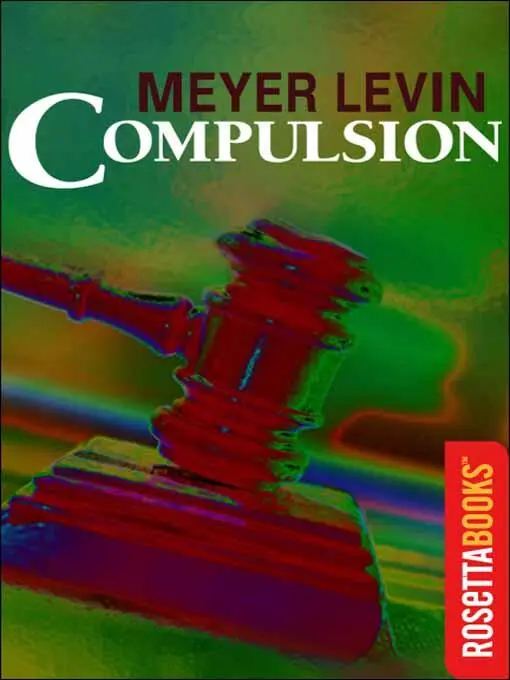
- Название:Compulsion
- Автор:
- Жанр:
- Год:неизвестен
- ISBN:нет данных
- Рейтинг книги:5 / 5. Голосов: 1
-
Избранное:Добавить в избранное
- Отзывы:
-
Ваша оценка:
Compulsion: краткое содержание, описание и аннотация
Предлагаем к чтению аннотацию, описание, краткое содержание или предисловие (зависит от того, что написал сам автор книги «Compulsion»). Если вы не нашли необходимую информацию о книге — напишите в комментариях, мы постараемся отыскать её.
Compulsion — читать онлайн бесплатно полную книгу (весь текст) целиком
Ниже представлен текст книги, разбитый по страницам. Система сохранения места последней прочитанной страницы, позволяет с удобством читать онлайн бесплатно книгу «Compulsion», без необходимости каждый раз заново искать на чём Вы остановились. Поставьте закладку, и сможете в любой момент перейти на страницу, на которой закончили чтение.
Интервал:
Закладка:
And there was the curious, even touching intensity of his plea for Artie to decide the whole issue. “Now, Artie, I am going to make a request to which I have perhaps no right, and yet which I dare to make also for Auld Lang Syne. Will you, if not too inconvenient, let me know your answer (before I leave tomorrow)? This, to which I have no right, would greatly help my peace of mind in the next few days when it is most necessary to me. You can if you will merely call up my home before 12 noon and leave a message saying, ‘Artie says yes’, if you wish our relations to continue as before, and ‘Artie says no’, if not…”
I felt almost guilty, peering into so intimate a confession. Judd, at one moment pleading with Artie to judge him, to “inflict physical punishment, or anything else you like”, if he had been “treacherous”, and at the next moment arrogantly vowing that he had been ready to kill Artie. For the first time, I began to understand the strange bondage, to glimpse a love relationship entirely outside my knowledge.
And what could Artie think Judd had betrayed that was important enough to have brought the boys to imprisoning each other and to threatening death?
“Something Judd knew about Artie,” Tom reasoned. Again, we studied the dense wording. At bottom it was a sort of “you said he said I said” affair. It had the ring of tempestuous accusations among children and – yes – among girls.
And I tried to set this image against the two young men I had seen only an hour ago, sophisticated, self-possessed, superior to their little predicament.
Tom handed me another sheet. This was a copy of a letter Judd had written two days later, from a train; he had been making a trip to New York. It was clear that Artie had in the meantime chosen to “continue their relationship” by taking back his accusation of “treachery”. And Judd was “forgiving” him.
The point in the whole controversy, Judd said in the forgiveness letter, was to determine which of them was guilty of a mistake, for a mistake was the greatest crime a person of their sort could commit! “But I am going to add a little more in an effort to explain my system of the Nietzschean philosophy in regard to you. It may not have occurred to you why a mere mistake in judgment on your part should be treated as a crime when on the part of another it should not be so considered. Here are the reasons. In formulating a superman, he is, on account of certain superior qualities inherent in him, exempted from the ordinary laws which govern ordinary men. He is not liable for anything he may do, whereas others would be, except for the one crime that it is possible for him to commit – to make a mistake.
“Now obviously any code which conferred upon an individual or upon a group extraordinary privileges without also putting on him extraordinary responsibility, would be unfair and bad. Therefore, the superman is held to have committed a crime every time he errs in judgment…”
Tom repeated a phrase from the beginning, “… exempted from the ordinary laws which govern ordinary men…” I read that part over: “In formulating a superman, he is, according to the superior qualities inherent in him, exempted…”
“These dirty perverts think they can do any damn thing they want,” Tom said.
I was trying to recall things from Nietzsche, but then I realized that it really didn’t matter what Nietzsche had said or meant. What mattered was the meaning expressed here by Judd himself – he and Artie were playing some kind of game, a superman game, and these were their rules. If Judd and Artie were “exempted from the ordinary laws which govern ordinary men”, then what would stop them from murder?
It was as though two dense curtains had shrouded the possibility of seeing these rich, clever boys as perpetrators of the crime. The outer curtain was the negative one, the one that excluded them from the action, a curtain of “why they would not”. For all the fears of punishment, all the laws of man provided a “why not”. And this curtain seemed now to be lifting. If they really believed in this idea of being superior to ordinary law, then there was no “why not” for them. The inner curtain was the “why?” and was still impenetrable, though the sexual motive provided a rent in it.
Yet their superman idea was hard to grasp because I had seen them in everyday life. It was hard to believe that within their very appearance of living under the same rules as the rest of us, they had their own contrary rules. It was hard to take their own words and believe them, just as it was to be hard, only a decade later in our lives, to believe that an entire nation could seriously subscribe to this superman code.
What I had sensed emotionally, intuitively, the night before, from Ruth, I was now trying to justify by fact and by reasoning, and the effort seemed heavy, like trying to provide a mathematical formulation for an answer you had already glimpsed.
In Horn’s office, too, they were puzzling over the letters. Horn was no reader of Nietzsche. He tended to brush aside the superman letter as show-off kid stuff; you never could hang anybody with that.
Perhaps he was right. We were to see the philosophy for a time as an explanation – it was even offered as a kind of excuse. But could it ever have been a cause?
The first letter, Horn said, was only a lot of wild talk about some silly quarrel. Except for the perversion business. But even that had to be taken up carefully. In a roundabout way, Padua might try to find out if these fellows had anything to do with young boys. One thing was sure after these letters: you couldn’t let these two fellows go so soon.
Padua and Czewicki had a short discussion of their own. Padua had always meant to read Nietzsche, but never found the time; perhaps Nietzsche could have helped him trip these wiseacres. Czewicki wasn’t so sure. He had read Ecce Homo in a Haldeman-Julius Little Blue Book. It didn’t tell you you could go out and murder anybody.
But the strange letters, published in the papers, even with the key words omitted, had raised an active apprehension in one other person who was to enter the case. Edgar Feldscher was a cousin of Randolph Straus, Artie’s father. A lawyer, engaged with his brother Ferdinand Feldscher in corporation work for various members of the family, Edgar Feldscher had interests outside the law. He was something of an aesthete, a bachelor in his early forties who went often to Europe. He read a great deal, and was fond of Havelock Ellis and D. H. Lawrence. He was also acquainted with the works of Freud, and when people made jokes about suppressed desires or the inferiority complex, Edgar Feldscher was apt to start lecturing on the serious meaning of the terms.
Edgar Feldscher telephoned Artie’s father. He was a little disturbed, he said. Of course he knew the boys had been close to each other for several years. But if stuff like this was going to be dragged through the papers, it might prove harmful to them and to the families. Besides, who could tell what might turn up? It might be time, he suggested, to get Artie, at least, out of the hands of the State’s Attorney.
“The harm’s already been done,” Randolph Straus said wearily. Every reporter in town knew what the unprinted word was in that letter. In a way, he almost wished the police would give Artie a good pushing around, to teach him not to play detective and get himself into this kind of a mess. After all, what did Artie know about the Kessler murder? To go in now and demand his release might only make things worse, give the papers a story about the family trying to use influence.
“Yes, there’s something to that,” Edgar Feldscher agreed. The feeling of apprehension was deepening in him, but he couldn’t find it in himself to utter the real question. No, it was impossible that the boys had done it…
Читать дальшеИнтервал:
Закладка:
Похожие книги на «Compulsion»
Представляем Вашему вниманию похожие книги на «Compulsion» списком для выбора. Мы отобрали схожую по названию и смыслу литературу в надежде предоставить читателям больше вариантов отыскать новые, интересные, ещё непрочитанные произведения.








Обсуждение, отзывы о книге «Compulsion» и просто собственные мнения читателей. Оставьте ваши комментарии, напишите, что Вы думаете о произведении, его смысле или главных героях. Укажите что конкретно понравилось, а что нет, и почему Вы так считаете.