Matt Ruff - Bad Monkeys
Здесь есть возможность читать онлайн «Matt Ruff - Bad Monkeys» весь текст электронной книги совершенно бесплатно (целиком полную версию без сокращений). В некоторых случаях можно слушать аудио, скачать через торрент в формате fb2 и присутствует краткое содержание. Год выпуска: 2008, Издательство: HarperCollins Publishers, Жанр: Триллер, на английском языке. Описание произведения, (предисловие) а так же отзывы посетителей доступны на портале библиотеки ЛибКат.
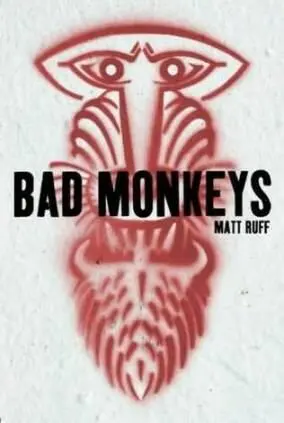
- Название:Bad Monkeys
- Автор:
- Издательство:HarperCollins Publishers
- Жанр:
- Год:2008
- ISBN:нет данных
- Рейтинг книги:4 / 5. Голосов: 1
-
Избранное:Добавить в избранное
- Отзывы:
-
Ваша оценка:
Bad Monkeys: краткое содержание, описание и аннотация
Предлагаем к чтению аннотацию, описание, краткое содержание или предисловие (зависит от того, что написал сам автор книги «Bad Monkeys»). Если вы не нашли необходимую информацию о книге — напишите в комментариях, мы постараемся отыскать её.
She tells police that she is a member of a secret organization devoted to fighting evil; her division is called the Department for the Final Disposition of Irredeemable Persons—"Bad Monkeys" for short.
This confession earns Jane a trip to the jail's psychiatric wing, where a doctor attempts to determine whether she is lying, crazy—or playing a different game altogether. What follows is one of the most clever and gripping novels you'll ever read.
Bad Monkeys — читать онлайн бесплатно полную книгу (весь текст) целиком
Ниже представлен текст книги, разбитый по страницам. Система сохранения места последней прочитанной страницы, позволяет с удобством читать онлайн бесплатно книгу «Bad Monkeys», без необходимости каждый раз заново искать на чём Вы остановились. Поставьте закладку, и сможете в любой момент перейти на страницу, на которой закончили чтение.
Интервал:
Закладка:
“I’ll just be a minute,” she said, and crawled into the box.
Some questions you don’t ask, especially of a crazy person. So while I was waiting, I decided to treat this situation as one of the organization’s test puzzles, which for all I knew it was. I hadn’t seen a ring on Annie’s fingers, so William Dane probably wasn’t her husband. He could have been her lover, I thought, but then when I took another look at the plot, I noticed the stone outline was too small for an adult-sized coffin.
“All right…” Annie reappeared, wearing a light blue knapsack that clashed with her bag-lady couture. She crouched beside the grave and patted the headstone in a way that dispelled any doubt Billy Dane was her son. Then she looked up at the sky. The rain had stopped but it was still overcast, and I could tell she didn’t like the idea of leaving the kid alone in bad weather; I half expected her to pull the tarp off the refrigerator box and use it as a blanket. But she resisted the impulse, and got back up after giving the headstone one more pat.
“Where to now?” I asked.
“Just follow me. And pay attention.”
We set off on foot in the general direction of downtown. We’d gone maybe a block when Annie started doing the muttering thing again. This time I couldn’t make out a single word. I tried to just ignore it, but I couldn’t do that either—the babble coming out of her mouth had this weird insistent edge to it, like fingernails on a blackboard.
“Annie?” I said. “Snap out of it, Annie,” but all that did was up her volume a couple notches. People on the street were turning to stare at us, and so I started craning my head around, looking up at the clouds, at the buildings we passed, my body language sending out the message: “Just because I’m walking next to this person doesn’t mean I’m with her.”
Then suddenly the mutter cut off, and Annie’s hand caught my wrist. I looked down; my right foot was in midair, about to step down onto the jagged base of a broken wine bottle.
“Pay attention,” Annie said.
So after that I watched where I was walking, while Annie’s mutter wormed its way into my ear and set up shop in my back brain. Next thing I knew we were back in the Haight, in front of a hotel called the Rose & Cross. The doorman nodded to Annie and slipped her a set of keys.
We went up to the second floor, to a room with a single twin-size bed. The bed was just made, the covers turned down invitingly; Annie pushed me towards it and said, “I’m going to take a shower. You sleep.”
“Sleep?” I said. “It’s like eleven o’clock in the morning…” But the truth is I was exhausted; the miles of listening to her babble had worn me out. I kicked off my shoes and climbed under the covers. By the time my head hit the pillow I was elsewhere.
I was in a classroom, sitting at a pupil’s desk, third row center. Up at the blackboard, a younger, saner-looking Annie was sketching out an organizational chart. The boxes in the chart formed a rough pyramid; the one at the very top was marked T.A.S.E. Directly below this, connected to it by a double line, was a box labeled COST-BENEFITS. More lines radiated downwards from there, linking to other divisions and subdivisions, some of which I already knew about (Catering, Random Acts of Kindness), but most of which I didn’t (Scary Clowns?). I was kind of disappointed to see that despite having a direct link to Cost-Benefits, Bad Monkeys was at the bottom of the pyramid.
While Annie finished up the chart, I looked around for a distraction. There were no other students, so note-passing was out, and the classroom windows didn’t offer a view, just this white glow, like the school was floating in a cloud. Then I lifted up my desktop and found a textbook inside, something called Secrets of the Invisible College. It sounded interesting.
It wasn’t. The pages were full of that dense, tiny type that you know is going to be boring even before you try to read it. I started flipping through the book to see if there were any pictures (there weren’t), and somebody kicked the back of my chair.
Phil had materialized in the seat behind me. Not the grown-up Phil, who I liked; the ten-year-old Phil, who’d bugged the shit out of me back before I was sent away. “Knock it off,” I warned him. I turned back to the textbook, and Phil kicked my chair again.
“Knock it off!” I whirled around, brandishing the book with both hands. But Phil was gone.
A sharp rapping came from the front of the classroom. “Jane,” Annie said. “We need you in the present day.”
“Yes ma’am,” I heard myself say.
“The subjects to be covered in today’s lesson include the organization’s command structure, the proper handling of the NC gun, and the use of the Daily Jumble as a covert communication channel. Please turn to page one thousand, four hundred and sixty-five…”
Long dream. The worst part of it was, unlike a real classroom, I couldn’t just drift off, because I already had.
When I finally woke up, it was nighttime. Annie was over by the window, looking out; she heard me fumbling for the bedside lamp and said, “Leave it off.”
I joined her at the window. Across the street from the hotel was a model-railroad store; there were apartments above it, and in one unit on the second floor, I could see a thirtysomething guy walking around in his underwear. “That’s him?”
“That’s him.” Annie gave a nudge to a shoebox on the windowsill. “This came for you.”
My NC gun. I took it out, hefted it, and did a couple quick integrity checks that I’d learned about in dream class. Once I’d verified it was in working order, Annie said: “Now let’s review…Suppose I asked you to shoot him from here. Could you?”
On the MI setting, the NC gun’s effective range is about fifty feet; on the CI setting, around half that. “I could probably nail him with a heart attack,” I said. “But I’d need to open this window, and get him to open one of his.”
“Why not just shoot him through the glass?”
“Doesn’t work. The gun can penetrate ordinary clothing, but anything more substantial will either absorb the shot or bounce it in a random direction. Reflective surfaces are bad.”
“And another important implication of that is…?”
“Unless I’m so close that I can’t miss, I never want to shoot at anybody standing in front of a reflective surface, either.”
“Good,” Annie said. “You were listening.”
“Yeah, so now I’ve got a question: are you asking me to shoot him? Because I could just go over there and ring his buzzer.”
“Not tonight.” She handed me a wireless headset. “This will put you in touch with the rest of the surveillance team. If it looks like he’s going to leave the apartment, let them know. Otherwise, just keep an eye on him.” She went over to the bed. “Wake me at dawn, or sooner if something happens. And Jane—”
“Yeah, I know. Pay attention.”
Annie didn’t go to sleep right away. I heard her praying, and then, for a while, she talked to William. Maybe a half hour after she finally got quiet, the lights went out at Arlo’s place. After that it was just me in the dark, with nothing to do but twiddle my thumbs.
I was tired. I know that probably sounds strange seeing as I’d slept the whole day away, but the thing about dream school is, it’s not restful. Also I hadn’t eaten anything since breakfast, and my feet hurt from the walking. I decided to sit down for a while, only there weren’t any chairs in the room, so I ended up on the floor with my back to the wall beneath the windowsill. At first I was good about poking my head up every few minutes to check on Arlo’s apartment, but pretty soon I was nodding.
I started awake in gray dawn light. A fog had come in off the bay while I’d slept; through the haze, I could see that Arlo’s windows were still dark, but whether that meant he was still in bed or had already gone out was anybody’s guess.
Читать дальшеИнтервал:
Закладка:
Похожие книги на «Bad Monkeys»
Представляем Вашему вниманию похожие книги на «Bad Monkeys» списком для выбора. Мы отобрали схожую по названию и смыслу литературу в надежде предоставить читателям больше вариантов отыскать новые, интересные, ещё непрочитанные произведения.









Обсуждение, отзывы о книге «Bad Monkeys» и просто собственные мнения читателей. Оставьте ваши комментарии, напишите, что Вы думаете о произведении, его смысле или главных героях. Укажите что конкретно понравилось, а что нет, и почему Вы так считаете.