Matt Ruff - Bad Monkeys
Здесь есть возможность читать онлайн «Matt Ruff - Bad Monkeys» весь текст электронной книги совершенно бесплатно (целиком полную версию без сокращений). В некоторых случаях можно слушать аудио, скачать через торрент в формате fb2 и присутствует краткое содержание. Год выпуска: 2008, Издательство: HarperCollins Publishers, Жанр: Триллер, на английском языке. Описание произведения, (предисловие) а так же отзывы посетителей доступны на портале библиотеки ЛибКат.
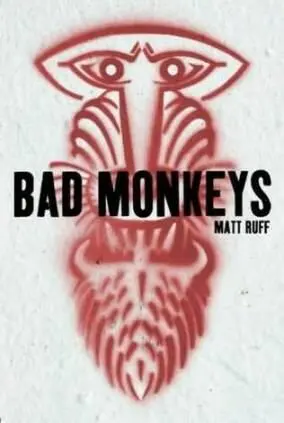
- Название:Bad Monkeys
- Автор:
- Издательство:HarperCollins Publishers
- Жанр:
- Год:2008
- ISBN:нет данных
- Рейтинг книги:4 / 5. Голосов: 1
-
Избранное:Добавить в избранное
- Отзывы:
-
Ваша оценка:
Bad Monkeys: краткое содержание, описание и аннотация
Предлагаем к чтению аннотацию, описание, краткое содержание или предисловие (зависит от того, что написал сам автор книги «Bad Monkeys»). Если вы не нашли необходимую информацию о книге — напишите в комментариях, мы постараемся отыскать её.
She tells police that she is a member of a secret organization devoted to fighting evil; her division is called the Department for the Final Disposition of Irredeemable Persons—"Bad Monkeys" for short.
This confession earns Jane a trip to the jail's psychiatric wing, where a doctor attempts to determine whether she is lying, crazy—or playing a different game altogether. What follows is one of the most clever and gripping novels you'll ever read.
Bad Monkeys — читать онлайн бесплатно полную книгу (весь текст) целиком
Ниже представлен текст книги, разбитый по страницам. Система сохранения места последней прочитанной страницы, позволяет с удобством читать онлайн бесплатно книгу «Bad Monkeys», без необходимости каждый раз заново искать на чём Вы остановились. Поставьте закладку, и сможете в любой момент перейти на страницу, на которой закончили чтение.
Интервал:
Закладка:
“I work for what’s known as the Cost-Benefits division.”
“You handle the money.”
“I help allocate the organization’s resources. Which are substantial, but still finite.”
“‘Resources’ includes people?”
“Of course.”
“Well then, if you know anything about people, you know I’m not a good Samaritan.”
“No,” True said, “I don’t suppose you are…” He placed a green NC gun in the center of the table. “You’ll recognize this.”
“The one I had last time was orange.”
“The one you had in Siesta Corta was standard issue. This is a special model.”
“What’s special about it?”
“We’ll get to that. First I have a hypothetical question for you. A test question.”
“OK.”
“There are two men, both evil. One is a former concentration-camp commandant, responsible for the murder of half a million people; he’s ninety years old, living in hiding in the South American jungle. The other man is much younger—barely twenty-five, in excellent health—and living openly in the middle of San Francisco. He’s only killed once so far, but he’s discovered he has a talent and a taste for it, and it’s likely he’ll kill again many times…though of course, the total number of his victims will never be more than a fraction of the commandant’s.
“The death of either of these men would leave the world a better place. You have the power to kill one of them—but only one. Whom do you choose?”
“That’s easy,” I said. “The young guy.”
“Why?”
“Because killing the Nazi is the obvious choice, and this is a trick question.”
“Clever,” True said, in a tone that suggested it was anything but. “Now how about a less glib answer.”
“In this hypothetical situation, I’m supposed to be you?”
“Someone with my job description, let’s say.”
“Then the answer’s the same. Kill the young guy.”
“Why?”
“His worst days are still ahead of him. With the Nazi, the Holocaust is already out of the barn—killing him might be more satisfying, but the net benefit is smaller.”
“What about deterrence?” True said. “Wouldn’t killing the Nazi discourage other people from following in his footsteps?”
“It might, if it were a public execution. If I were the government, I could put him on trial for genocide and then hang him on pay-per-view. That might turn some heads. Trouble is, I’m not the government, I’m a member of a secret organization that dresses its agents like cheerleaders so people can’t talk about them. An execution that no one knows about won’t deter squat.”
“What about justice?”
“Is this a hypothetical real situation, or a hypothetical comic book?”
“And what about vengeance?”
“It’s fun. But it doesn’t have anything to do with fighting evil.”
“No,” True agreed, “it doesn’t.”
“Does that mean I pass the test?”
“The first half. The second half is less theoretical…” He laid a couple booklets on the table. They looked like those question booklets you get when you take the SATs. A name was written on the cover of each one in felt-tip pen. The one on the first booklet was BENJAMIN LOOMIS; the one on the second was JULIUS DEEDS.
“Two men,” True said. “Both evil. One you’ve already met—”
“Yeah, I have,” I said. “And he’s not ninety years old, if that’s where you’re going with this.”
“Julius Deeds has been indicted for murder. The case against him is strong, and despite his efforts at jury tampering he’ll probably be convicted. Even if he avoids prison, his actions have made him enemies on both sides of the law. A ninety-year-old might well outlive him.”
“And Loomis? Let me guess: he’s barely twenty-five, in excellent health…”
“Twenty-seven, actually. And he’s killed four times, not just once. Other than that, yes, he’s just like the younger man in the hypothetical. A predator. He’s been operating on a three-month cycle, so unless someone stops him, we expect he’ll take his next victim in early December.”
“The police don’t have a clue who he is?”
“The police aren’t even aware of his crimes yet. He hunts male prostitutes, men who’ve been abandoned by their families and have no one to report them missing. He kills discreetly and buries the bodies. In time he’ll be found out, of course—they almost always are—but it could be years from now.”
I stared at the tabletop. “The gun’s a one-shot, isn’t it? That’s the special modification. And the test is I have to choose.”
“We need to know what your real priorities are,” True said. “In a moment you’ll select one of these booklets; inside, you’ll find all the information you need to complete your first assignment. The other booklet will go back into our files, with a notation that its subject is never to be harmed or otherwise acted against by any agent of the organization.”
“So if I pick Deeds, Loomis gets a free pass? You’d really do that?”
“It wouldn’t be much of a test, otherwise.” He looked at his wristwatch. “You have one minute to decide.”
“Screw that. I don’t need a minute.” I reached for a booklet. True took the other one. “Don’t lose the gun,” he said. “You’ll see me again when the job is completed.”
I was in the hospital for a few more weeks. Towards the end of my stay, even though I hadn’t said a word about the organization, the doctors downgraded me from morphine to Vicodin. This made me cranky.
They released me right before Thanksgiving. I had a quiet holiday at home—just Phil, a couple microwave turkey dinners, and some nonprescription painkillers—and then, on the last day of November, I killed Julius Deeds.
It happened like this: Deeds’ favorite hangout was a nightclub in the Mission District. He’d show up most nights around ten, driving a red Mustang convertible that he’d park asshole-fashion in front of a hydrant, or just facing the wrong direction—like to say, you know, I’m the king of the jungle, the normal rules don’t apply to me. If it wasn’t raining, he’d leave the top down, too. I figured the deal with that was he wanted to show what a tough guy he was, so tough that nobody would dare steal his car. Or maybe he hoped someone would steal it, so he’d have an excuse to get in some batting practice.
That night, I was hiding in an alley across the street from the club when he drove up. I watched him go inside, and gave him half an hour to get comfortable. Then I set his Mustang on fire.
Gasoline would have been poetic, but besides being really conspicuous, a gas can is tough to sling one-handed, and my right arm was still in a cast. I used charcoal starter instead—a twenty-ounce container, small enough to slip inside my jacket. I strolled up to the car during a lull in the street traffic and stood there casually, peeing lighter fluid over the front-seat upholstery. When the container was empty, I took out a strike-anywhere match and lit it off my cast.
The Mustang’s interior was burning nicely by the time the nightclub’s bouncer raised the alarm. People started coming out of the club. Most of them hung back, but one particular Cro-Magnon went charging at the car. For a second it looked like Deeds was going to do my job for me by diving headfirst into the fire.
Where were you at this point?
A couple blocks up the street, by the entrance to this park. It was on a rise, so I had a clear line of sight to the nightclub, and vice versa. I was standing under a streetlamp, spotlit.
You wanted Deeds to see you?
That was the plan. It took a while, though. You know that expression, “a blind rage”? I know what that means now. Deeds was still trying to decide whether to throw himself on the flames when the bouncer came up with a fire extinguisher. The guy was trying to help, right, but as soon as he started spraying foam onto the Mustang, Deeds went berserk and swung on him. The guy went down, and then Deeds grabbed the fire extinguisher himself, and spent about a minute trying to figure out how to work it. Then he went berserk again, and tossed the extinguisher through a shop window.
Читать дальшеИнтервал:
Закладка:
Похожие книги на «Bad Monkeys»
Представляем Вашему вниманию похожие книги на «Bad Monkeys» списком для выбора. Мы отобрали схожую по названию и смыслу литературу в надежде предоставить читателям больше вариантов отыскать новые, интересные, ещё непрочитанные произведения.






Обсуждение, отзывы о книге «Bad Monkeys» и просто собственные мнения читателей. Оставьте ваши комментарии, напишите, что Вы думаете о произведении, его смысле или главных героях. Укажите что конкретно понравилось, а что нет, и почему Вы так считаете.