Dan Simmons - Drood
Здесь есть возможность читать онлайн «Dan Simmons - Drood» весь текст электронной книги совершенно бесплатно (целиком полную версию без сокращений). В некоторых случаях можно слушать аудио, скачать через торрент в формате fb2 и присутствует краткое содержание. Год выпуска: 2009, ISBN: 2009, Жанр: Триллер, на английском языке. Описание произведения, (предисловие) а так же отзывы посетителей доступны на портале библиотеки ЛибКат.
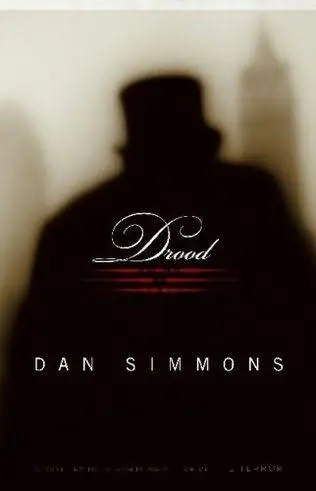
- Название:Drood
- Автор:
- Жанр:
- Год:2009
- ISBN:978-0-316-04068-6
- Рейтинг книги:3 / 5. Голосов: 1
-
Избранное:Добавить в избранное
- Отзывы:
-
Ваша оценка:
Drood: краткое содержание, описание и аннотация
Предлагаем к чтению аннотацию, описание, краткое содержание или предисловие (зависит от того, что написал сам автор книги «Drood»). Если вы не нашли необходимую информацию о книге — напишите в комментариях, мы постараемся отыскать её.
Did Dickens begin living a dark double life after the accident? Were his nightly forays into the worst slums of London and his deepening obsession with corpses, crypts, murder, opium dens, the use of lime pits to dissolve bodies, and a hidden subterranean London mere research… or something more terrifying?
Just as he did in
, Dan Simmons draws impeccably from history to create a gloriously engaging and terrifying narrative. Based on the historical details of Charles Dickens's life and narrated by Wilkie Collins (Dickens's friend, frequent collaborator, and Salieri-style secret rival),
explores the still-unsolved mysteries of the famous author's last years and may provide the key to Dickens's final, unfinished work:
. Chilling, haunting, and utterly original,
is Dan Simmons at his powerful best.
Drood — читать онлайн бесплатно полную книгу (весь текст) целиком
Ниже представлен текст книги, разбитый по страницам. Система сохранения места последней прочитанной страницы, позволяет с удобством читать онлайн бесплатно книгу «Drood», без необходимости каждый раз заново искать на чём Вы остановились. Поставьте закладку, и сможете в любой момент перейти на страницу, на которой закончили чтение.
Интервал:
Закладка:
I had not missed the use of “we” and “our tale.” Keeping my own tone dry, I said, “If not The Eye of the Serpent … or The Serpent’s Eye … what title do you imagine might apply to the tale of a diamond that had been set in the eye of a Hindoo statue to a serpent god?”
“Oh,” Dickens said airily, perching on the edge of his writing desk and grinning his editor’s grin, “I think we can dispense with the serpent god and the eye altogether. What about a title that avoids the sensational and invites the young female readers into the novel a bit more enthusiastically?”
“My books do wonderfully well with women readers,” I said stiffly.
“And so they do, my dear Wilkie!” cried Dickens, clapping his hands. “No one knows that more than I after your absolute triumph with The Woman in White. Why, there were a hundred eager readers for each instalment of that for every one reader who looked forward to my much more modestly selling Our Mutual Friend .”
“Oh, I would hardly say that…”
“What about… The Moonstone ?” interrupted Dickens.
“Moonstone?” I said stupidly. “Do you suggest I have the stone brought back from the moon rather than from India?”
Dickens laughed easily in that loud, boyish laugh of his. “A marvellous jest, my dear Wilkie. But seriously… something like The Moonstone would interest the potential lady readers—or certainly not alienate them—and it has an aura of mystery and romance about it, without any hint of the profane or diabolical.”
“ The Moonstone, ” I muttered, just to hear the sound of it from my own lips. It sounded terribly flat and colourless after The Serpent’s Eye (or possibly The Eye of the Serpent ).
“Wonderful,” cried Dickens, rising again. “We shall have Wills draw up a draft of the agreement with that as the proposed title. I tell you again that your outline was as exciting as reading the finished—or almost-finished—work itself will surely be. A marvellous tale filled with marvellous and delightful surprises. Your twist of the opium-induced sleepwalking where the hero himself steals the stone without remembering he did so is a stroke of genius, Wilkie, sheer genius.”
“Thank you, Charles,” I said again, rising and putting away my pencil. My tone held a tad less enthusiasm than it had earlier.
“It’s time to walk, my dear Wilkie,” cried Dickens, going to the corner to take up his stick and to pull down his hat from a peg. “I thought perhaps all the way to Rochester and back this beautiful May day. You are looking fit and ruddy these days, my friend. Are you game?”
“I am game for the first half to Rochester, where I shall catch the afternoon train back to London,” I said. “Caroline and Carrie expect me home for dinner this night.”
This last was a tiny fib; Carrie was visiting relatives in the country and Caroline thought I was spending the night at Gad’s Hill. But someone expected me for dinner that night.
“A half walk with a full friend is better than none,” said Dickens, setting his own manuscripts away in a valise and striding quickly to the door. “Let us away before the roads and pathways get dusty and the day gets a minute older.”
IT WAS THE EVENING OF THURSDAY the sixth of June, and I was indulging in a minor pleasure I had cultivated since the early spring—that is, taking the mountainous mass of Detective Inspector Hibbert Aloysius Hatchery out for a pint and a snack at a local public house before turning myself over to his guardianship and then descending into the dockside slums and the even darker world beneath Ghastly Grim’s Cemetery in order to partake of what I had come to think of as King Lazaree’s Emporium of Subterranean Delights.
As I’d gotten to know Detective Hatchery better during our Thursday-night public-house stops, I had been surprised by some of the revelations from this huge man whom I had considered from our first meeting to be little more than a comic figure. It seemed he lived in a decent Dorset Square neighbourhood near my own home at Melcombe Place, and although his wife had died some years earlier, he had three grown daughters whom he doted on and a son who had just entered Cambridge. Most surprising, Hatchery himself read widely, and some of his favourite books, it turned out, were of my creation. The Woman in White was foremost amongst these, although he had only been able to afford reading it during its serialisation in All the Year Round some years before. I had brought a copy of the bound book this very night and was in the process of autographing it for my sometimes guardian when someone stopped at our table.
I recognised the brown tweed suit first, then the compact but heavy body poured into it. The man had removed his hat, and I noticed that his curly grey hair seemed longer than it had in Birmingham—but it had been wet then.
“Mr Collins,” he said, two fingers flicking towards his brow as if touching the brim of a hat that was no longer there, “Reginald Barris at your service, sir.”
I grunted a reply. I did not wish to see Detective Reginald Barris. Not that night, not any night. The memory of those terrible few seconds of violence in that Birmingham alley was just beginning to fade.
But Barris greeted Hatchery, who nodded back even as he was accepting the gift of my autographed The Woman in White —a conjunction of events that I found, unreasonably perhaps, treacherous—and Barris joined us at the table without even asking permission, boldly pulling up a chair and seating himself backwards on it, straddling it, his powerful forearms set atop the chair’s back. Aghast at his bad manners, I wondered for a moment if Barris—despite his Cambridge accent—was an American.
“A fortunate coincidence, Mr Collins, running into you like this,” said Barris.
I did not honour that nonsense with a reply, but looked at Hatchery in a way that showed cool disapproval of his being so free with the details of our habits. Then I remembered wryly that the huge man worked for Inspector Field—and almost certainly reported to this insufferable Barris as well, since the younger man seemed to be a lieutenant of the tiresome inspector—and reminded myself that there had been no real friendship between Hatchery and me, despite my generosity towards him in recent weeks.
Barris leaned forward over his forearms and lowered his voice. “Inspector Field was hoping for a report, sir. I volunteered that if I were to run into you, I would mention it. Time is getting short.”
“I gave Inspector Field a report less than a fortnight ago,” I said. “And time is getting short for what?”
Barris smiled but set a quick finger to his lips, his eyes darting left and right in a melodramatic reminder that we must be discreet. I always forgot that Field and his men presumed agents of the phantasm Drood to be lurking everywhere.
“Until the ninth of June,” Barris whispered.
“Ah,” I said and took a drink. “The ninth of June. The sacred anniversary of Staplehurst and…”
“Shhh,” said Mr Reginald Barris.
I shrugged. “I’ve not forgotten.”
“Your report was a little less than clear, Mr Collins, on…”
“Less than clear?” I interrupted, my voice loud enough to be heard throughout the public house if anyone had been interested in eavesdropping—which certainly none of the few inhabitants seemed to be. “Mr Barris, I am a writer . A journalist for several years, a novelist now by vocation. I hardly think that my report could have been less than clear .”
“No, no, no,” agreed the young detective, smiling in his embarrassment. “I mean, yes. That is, no—I chose the wrong words, Mr Collins. Never less than clear, but… perhaps… perfectly clear but a trifle sketchy?”
Читать дальшеИнтервал:
Закладка:
Похожие книги на «Drood»
Представляем Вашему вниманию похожие книги на «Drood» списком для выбора. Мы отобрали схожую по названию и смыслу литературу в надежде предоставить читателям больше вариантов отыскать новые, интересные, ещё непрочитанные произведения.




Обсуждение, отзывы о книге «Drood» и просто собственные мнения читателей. Оставьте ваши комментарии, напишите, что Вы думаете о произведении, его смысле или главных героях. Укажите что конкретно понравилось, а что нет, и почему Вы так считаете.