Stephen King - Dreamcatcher
Здесь есть возможность читать онлайн «Stephen King - Dreamcatcher» весь текст электронной книги совершенно бесплатно (целиком полную версию без сокращений). В некоторых случаях можно слушать аудио, скачать через торрент в формате fb2 и присутствует краткое содержание. Год выпуска: 2001, Жанр: Триллер, на английском языке. Описание произведения, (предисловие) а так же отзывы посетителей доступны на портале библиотеки ЛибКат.
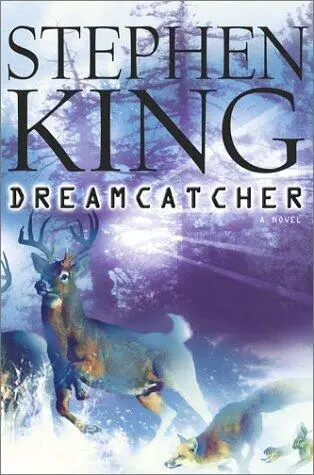
- Название:Dreamcatcher
- Автор:
- Жанр:
- Год:2001
- ISBN:нет данных
- Рейтинг книги:3 / 5. Голосов: 1
-
Избранное:Добавить в избранное
- Отзывы:
-
Ваша оценка:
Dreamcatcher: краткое содержание, описание и аннотация
Предлагаем к чтению аннотацию, описание, краткое содержание или предисловие (зависит от того, что написал сам автор книги «Dreamcatcher»). Если вы не нашли необходимую информацию о книге — напишите в комментариях, мы постараемся отыскать её.
Dreamcatcher — читать онлайн бесплатно полную книгу (весь текст) целиком
Ниже представлен текст книги, разбитый по страницам. Система сохранения места последней прочитанной страницы, позволяет с удобством читать онлайн бесплатно книгу «Dreamcatcher», без необходимости каждый раз заново искать на чём Вы остановились. Поставьте закладку, и сможете в любой момент перейти на страницу, на которой закончили чтение.
Интервал:
Закладка:
Henry backed out of the room, squirting lighter fluid as he went. He got halfway across the Navajo rug before the can ran empty. He tossed it aside, scratched another match, and tossed it. This time the flump! was immediate, and the flames sprang up orange. The heat baked against his sweat-shiny face, and he felt a sudden urge-it was both strong and joyful-to cast the painters” masks aside and simply stride into the fire. Hello heat, hello summer, hello darkness, my old friend.
What stopped him was as simple as it was powerful. If he pulled the pin now, he would have suffered the unpleasant awakening of all his quiescent emotions to no purpose. He would never be clear on the details of what had happened here, but he might get at least some answers from whoever was flying the helicopters and shooting the animals. If they didn’t just shoot him, too, that was.
At the door, Henry was struck by a memory so clear that his heart cried out inside him: Beaver kneeling in front of Duddits, who is trying to put on his sneaker backwards. Let me fix that, man , Beaver says, and Duddits, looking at him with a wide-eyed perplexity that you could only love, replies. Fit neek?
Henry was crying again. “So long, Beav,” he said. “Love you, man-and that’s straight from the heart.” Then he stepped out into the cold.
He walked to the far end of Hole in the Wall, where the woodpile was. Beside it was another tarp, this one ancient, black fading to gray. It was frost-frozen to the ground, and Henry had to yank hard with both hands in order to pull it free. Under it was a tangle of snowshoes, skates, and skis. There was an antediluvian ice-auger, as well.
As he looked at this unprepossessing pile of long-dormant winter gear, Henry suddenly realized how tired he was… except tired was really too mild a word. He had just come ten miles on foot, much of it at a fast trot. He had also been in a car accident and discovered the body of a childhood friend. He believed both his other two childhood friends were likewise lost to him.
If I hadn’t been suicidal to begin with, I’d be stark-raving crazy by now , he thought, and then laughed. It felt good to laugh, but it didn’t make him feel any less tired. Still, he had to get out of here. Had to find someone in authority and tell them what had happened. They might already know-based on the sounds, they sure as shit knew something, although their methods of dealing with it made Henry feel uneasy-but they might not know about the weasels. And the eggs. He, Henry Devlin, would tell them-who better? He was the eggman, after all.
The rawhide lacings of the snowshoes had been chewed by so many mice that the shoes were little more than empty frames. After some sorting, however, he found a stubby pair of crosscountry skis that looked as if they might have been state-of-the-art around 1954 or so. The clamps were rusty, but when he pushed them with both thumbs, he was able to move them enough to take a reluctant grip on his boots.
There was a steady crackling sound coming from inside the cabin now. Henry laid one hand on the wood and felt the heat. There was a clutch of assorted ski-poles leaning under the eave, their handgrips buried in a dirty cobweb caul. Henry didn’t like to touch that stuff-the memory of the eggs and the weasel-thing’s wriggling spawn was still too fresh-but at least he had his gloves on. He brushed the cobwebs aside and sorted through the poles, moving quickly. He could now see sparks dancing inside the window beside his head.
He found a pair of poles that were only a little short for his lanky height and skied clumsily to the comer of the building. He felt like a Nazi snow-trooper in an Alistair MacLean film, with the old skis on his feet and Jonesy’s rifle slung over his shoulder. As he turned around, the window beside which he had been standing blew out with a surprisingly loud report-as if someone had dropped a large glass bowl from a second-story window. Henry hunched his shoulders and felt pieces of glass spatter against his coat. A few landed in his hair. It occurred to him that if he had spent another twenty or thirty seconds sorting through the skis and poles, that exploding glass would have erased most of his face.
He looked up at the sky, spread his hands palms-out beside his cheeks like Al Jolson, and said, “Somebody up there likes me! Hotcha!”
Flames were shooting through the window now, licking up under the eaves, and he could hear more stuff breaking inside as the heat-gradient zoomed. Lamar Clarendon’s father’s camp, originally built just after World War Two, now burning merry hell. It was a dream, surely.
Henry skied around the house, giving it a wide berth, watching as gouts of sparks rose from the chimney and swirled toward the low-bellied clouds. There was still a steady crackle of gunfire off to the east. Someone was bagging their limit, all right. Their limit and more. Then there was that explosion in the west-what in God’s name had that been? No way of telling. If he got back to other people in one piece, perhaps they would tell him.
“If they don’t just decide to bag me, too,” he said. His voice came out in a dry croak, and he realized he was all but dying of thirst. He bent down carefully (he hadn’t been on skis of any type in ten years or more), scooped up a double handful of snow, and took a big mouthful. He let it melt and trickle down his throat. The feeling was heavenly. Henry Devlin, psychiatrist and onetime author of a paper about the Hemingway Solution, a man who had once been a virgin boy and who was now a tall and geeky fellow whose glasses always slid down to the tip of his nose, whose hair was going gray, whose friends were either dead, fled, or changed, this man stood in the open gate of a place to which he would never come again, stood on skis, stood eating snow like a kid eating a Sno-Cone at the Shrine Circus, stood and watched the last really good place in his life bum. The flames came through the cedar shingles. Melting snow turned to steaming water and ran hissing down the rusting gutters. Arms of fire popped in and out of the open door like enthusiastic hosts encouraging the newly arrived guests to hurry up, hurry up, dammit, get your asses in here before the whole place bums down. The mat of red-gold fuzz growing on the granite slab had crisped, lost its color, turned gray. “Good,” Henry muttered under his breath. He was clenching his fists rhythmically on the grips of his ski-poles without being aware of it. “Good, that’s good.”
He stood that way for another fifteen minutes, and when he could bear it no more, he set his back to the flames and started back the way he had come.
There was no hustle left in him. He had twenty miles to go (22.2 to be exact , he told himself), and if he didn’t pace himself he’d never make it. He stayed in the packed track of the snowmobile, and stopped to rest more frequently than he had going the other way.
Ah, but I was younger then , he thought with only slight irony.
Twice he checked his watch, forgetting that it was now Eastern Standard No Time At All in the Jefferson Tract. With the mat of clouds firmly in place overhead, all he knew for sure was that it was daytime. Afternoon, of course, but whether mid or late he couldn’t tell. On another afternoon his appetite might have served as a gauge, but not today. Not after the thing on Jonesy’s bed, and the eggs, and the hairs with their protuberant black eyes. Not after the foot sticking out of the bathtub. He felt that he would never eat again… and if he did, he would never eat anything with even a slight tinge of red. And mushrooms? No thanks.
Skiing, at least on cross-country stubs like these, was sort of like riding a bike, he discovered: you never forgot how to do it. He fell once going up the first hill, the skis slipping out from under him, but glided giddily down the other side with only a couple of wobbles and no spills. He guessed that the skis hadn’t been waxed since the peanut-farmer was President, but if he stayed in the crimped and flattened track of the snowmobile, he should be all right. He marvelled at the stippling of animal tracks on the Deep Cut Road he had never seen a tenth as many. A few critters had gone walking along it, but most of the tracks only crossed it, west to east. The Deep Cut took a lazy northwest course, and west was clearly a point of the compass the local animal population wanted to avoid.
Читать дальшеИнтервал:
Закладка:
Похожие книги на «Dreamcatcher»
Представляем Вашему вниманию похожие книги на «Dreamcatcher» списком для выбора. Мы отобрали схожую по названию и смыслу литературу в надежде предоставить читателям больше вариантов отыскать новые, интересные, ещё непрочитанные произведения.




Обсуждение, отзывы о книге «Dreamcatcher» и просто собственные мнения читателей. Оставьте ваши комментарии, напишите, что Вы думаете о произведении, его смысле или главных героях. Укажите что конкретно понравилось, а что нет, и почему Вы так считаете.