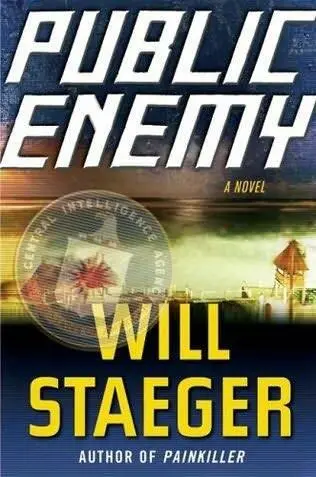
Will Staeger - Public Enemy
Здесь есть возможность читать онлайн «Will Staeger - Public Enemy» весь текст электронной книги совершенно бесплатно (целиком полную версию без сокращений). В некоторых случаях можно слушать аудио, скачать через торрент в формате fb2 и присутствует краткое содержание. Жанр: Триллер, на английском языке. Описание произведения, (предисловие) а так же отзывы посетителей доступны на портале библиотеки ЛибКат.
- Название:Public Enemy
- Автор:
- Жанр:
- Год:неизвестен
- ISBN:нет данных
- Рейтинг книги:3 / 5. Голосов: 1
-
Избранное:Добавить в избранное
- Отзывы:
-
Ваша оценка:
Public Enemy: краткое содержание, описание и аннотация
Предлагаем к чтению аннотацию, описание, краткое содержание или предисловие (зависит от того, что написал сам автор книги «Public Enemy»). Если вы не нашли необходимую информацию о книге — напишите в комментариях, мы постараемся отыскать её.
Public Enemy — читать онлайн бесплатно полную книгу (весь текст) целиком
Ниже представлен текст книги, разбитый по страницам. Система сохранения места последней прочитанной страницы, позволяет с удобством читать онлайн бесплатно книгу «Public Enemy», без необходимости каждый раз заново искать на чём Вы остановились. Поставьте закладку, и сможете в любой момент перейти на страницу, на которой закончили чтение.
Интервал:
Закладка:
There came no expression from Knowles, whose sunglasses remained planted on the bridge of his nose, the man a poker player.
“I’ll anticipate some of your questions because we don’t have time for process particulars. We’ll work out of this motel for now. Food and laundry services will be provided. There are rules, but we’ll get into that later. You are now, but only temporarily, members of a miniscule, clandestine counterterror unit. That oversimplifies it, but it’s the closest and best explanation. We have support personnel who will perform back-room investigative work-research, fingerprint matching, forensics and other technical analysis, if needed. There is an operative available to us for investigative work, surveillance, or certain preemptive acts as needed. You could also look at it this way: you have just joined a counterterrorism video game already in progress-or board game, if that helps the translation for any of you as old-fashioned as me-except that it is real. Our combined role in the ‘game’ is simple: we use the clues, tools, and ingenuity available to us to identify and stop Benjamin Achar’s fellow sleepers and the individual or organization who sent them.”
Knowles cleared his throat and Laramie inclined her chin in his direction.
“The difference between the definition of ‘counterterror,’” he said, “and ‘antiterror’ centers around proactive measures designed to preemptively combat the terrorist threat-you’re proactive in ‘counterterror,’ reactive in ‘antiterror.’ I assume your choice of words reflects and considers this fact. Do we have a commando team in this tool kit of ours?”
Cole frowned and made a sighing sound.
Laramie said, “If you’re asking me whether part of our assignment is to kill the enemy, I’m not entirely clear on that. Our actions may lead to that, however, so if you have any problem-”
“No problem here,” Knowles interrupted.
Laramie nodded. When Knowles passed on following up with more questions, Laramie gestured with the dry-erase marker, first toward Knowles, then Cole.
“It is anticipated that you, Mr. Knowles, may function as the chief scenario builder, and that you, Detective Cole, would contribute primarily as an investigator. The third member of the team is a reasonably well-known diplomacy and foreign affairs professor who has consulted with the federal government from time to time. He will assist us in narrowing the list of likely nations, or people, who might have sent the sleepers here. Despite this general orientation, there are no titles, there exists no hierarchy besides my leadership, and there are no lines dividing your roles.”
She set the marker lengthwise on the table like a tower and took a sip from the latest in a long line of bad cups of coffee. For once, she didn’t feel much need for the caffeine. She swallowed the sip and replaced the coffee on the table beside the marker.
“Unless you convince me otherwise,” she said, “we will be operating under the theory that Benjamin Achar did not make a mistake in blowing himself up or dispersing the amount of pathogen he did. According to what his wife revealed to me-which you would not have seen in the terror book-Achar told her to be prepared to hide for ‘no less than seven days’ if anything happened while she was out of town with their son. He knew he was going to do what he did when he did it, and I believe he also knew how much filo serum it would take to do some damage but not cause a plague.”
“Used his flare gun,” Cole said gruffly.
Laramie couldn’t quite hear.
“Sorry?”
“He used his flare gun. Fired one into the sky for us to see. Saying, ‘Look what’s about to happen if you don’t do anything about it.’ So we can do something about the others. That’s the way I read it too.”
“Really,” Knowles said. His tone was laced with sarcasm-indicating very clearly he believed Cole was playing the role of teacher’s pet, adjusting his theory to get some extra credit. Laramie saw Cole steer a challenging look at the author. Thinking she was already being made to feel like a day care supervisor, Laramie addressed Cole.
“Then I suppose you’d also agree,” she said, “that if the whole explosion was a flare gun, he probably left some firecrackers lying around too. Or bread crumbs. Depending on the analogy.”
“Yes,” Cole said, holding his evil eye with Knowles.
“Second question,” Knowles said. Loudly.
“Second answer,” Laramie said. “Maybe.”
Knowles almost appeared to Laramie to have smirked, but if he had, the movement of the straight line that was his mouth vanished as quickly as it had come.
“How much do you know about the lies in the media?” he said.
Laramie waited, considering her answer.
“Not much,” she said. “Why do you ask.”
“I don’t have a lot of faith in your average reporter,” the author said, “but maybe you can help me here. I study the news like religion, and I can tell you with assurance that there has not been one single leak of the facts as they’ve been shown to us in the ‘terror book.’ I find this an unlikely if not impossible set of circumstances. Except, that is, if the so-called crisis you’ve dropped us into is nothing more than an exercise.”
Laramie almost smiled at the very serious Wally Knowles.
“I’ll agree, it does seem unlikely,” she said. “My introduction to this incident came six days ago in almost exactly the same way you’re getting this intro now. Is it an exercise? Same question I asked. Answer: it could be. I don’t know. I no longer think so, but you’ll have to judge for yourself.”
“I always do,” he said.
Cole pulled his glare away from Knowles.
“How about you?” Laramie said to Cole. “Any questions? Doubts? Challenges?”
“None,” the cop said.
“If he has none,” Knowles said, “I’m happy to move things along. There is no evidence-paper, photo, or image-of Achar’s existence before January 1995?”
She gave his question, and her answer, some thought.
“No,” she said, “none we’ve got.”
“Idea, then,” he said. “We’ll need five or ten photographs of Achar to do what I’m thinking-ideally, spaced out over the past ten years, so we get shots taken of him at various ages. We’d also need a computer with high-speed access, and permission from whoever has kept the lies intact to hook into my home system.”
Laramie waited to see whether her guide would appear in the doorway between rooms and acknowledge Knowles’s requests. He didn’t.
“An image search?” she said.
“Correct. Two companies and a series of universities have been compiling a national image database along with an accompanying search technology. The database includes video. I’m in possession of the beta version of the search engine, but searches can only be conducted by computers with Internet-2 access, which I have, but only at home. The only images that will show up are those that have been archived into the national database, of course. But ours is the age of the camera, and that was true eleven years ago too.”
“Meaning he could have been photographed, or videotaped, by somebody, somewhere, in his prior identity,” Laramie said.
“Yes. The search engine is rudimentary and it’s been claimed that three percent of the world’s images have been digitally archived to date. My guess? It’s actually far under one percent. But worth a search anyway.”
“Assuming,” Laramie said, “all this is true-not an exercise.”
“Yes. Assuming that. But either way, it’s a good idea.”
One the task force hadn’t thought of, Laramie thought. At least not that they revealed to me.
“One thing people do to you when you’re a cop,” Cole said from his chair, “especially when you’re working a homicide, is lie.”
Читать дальшеИнтервал:
Закладка:
Похожие книги на «Public Enemy»
Представляем Вашему вниманию похожие книги на «Public Enemy» списком для выбора. Мы отобрали схожую по названию и смыслу литературу в надежде предоставить читателям больше вариантов отыскать новые, интересные, ещё непрочитанные произведения.

![Томас Гарди - Джуд неудачник [Литрес, Public Domain]](/books/437392/tomas-gardi-dzhud-neudachnik-litres-public-domain-thumb.webp)







Обсуждение, отзывы о книге «Public Enemy» и просто собственные мнения читателей. Оставьте ваши комментарии, напишите, что Вы думаете о произведении, его смысле или главных героях. Укажите что конкретно понравилось, а что нет, и почему Вы так считаете.