Stephen King - Different Seasons
Здесь есть возможность читать онлайн «Stephen King - Different Seasons» весь текст электронной книги совершенно бесплатно (целиком полную версию без сокращений). В некоторых случаях можно слушать аудио, скачать через торрент в формате fb2 и присутствует краткое содержание. Год выпуска: 2004, ISBN: 2004, Издательство: Signet, Жанр: Триллер, на английском языке. Описание произведения, (предисловие) а так же отзывы посетителей доступны на портале библиотеки ЛибКат.
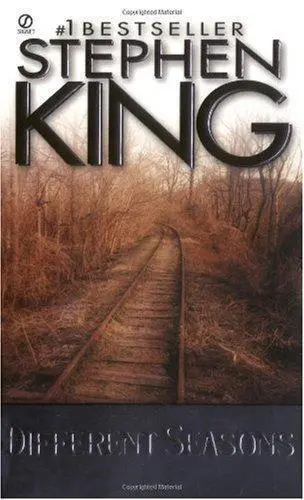
- Название:Different Seasons
- Автор:
- Издательство:Signet
- Жанр:
- Год:2004
- ISBN:978-0451167538
- Рейтинг книги:5 / 5. Голосов: 1
-
Избранное:Добавить в избранное
- Отзывы:
-
Ваша оценка:
Different Seasons: краткое содержание, описание и аннотация
Предлагаем к чтению аннотацию, описание, краткое содержание или предисловие (зависит от того, что написал сам автор книги «Different Seasons»). Если вы не нашли необходимую информацию о книге — напишите в комментариях, мы постараемся отыскать её.
, "Apt Pupil" into Bryan Singer's 1998 film
, and "The Body" into Rob Reiner's
(1986).
The final novella, "Breathing Lessons," is a horror yarn told by a doctor, about a patient whose indomitable spirit keeps her baby alive under extraordinary circumstances. It's the tightest, most polished tale in the collection.
Different Seasons — читать онлайн бесплатно полную книгу (весь текст) целиком
Ниже представлен текст книги, разбитый по страницам. Система сохранения места последней прочитанной страницы, позволяет с удобством читать онлайн бесплатно книгу «Different Seasons», без необходимости каждый раз заново искать на чём Вы остановились. Поставьте закладку, и сможете в любой момент перейти на страницу, на которой закончили чтение.
Интервал:
Закладка:
'Here you go, David,' Waterhouse said from my elbow, and I jumped. He hadn't deserted me after all; had only trudged off into some uncharted locale to bring back drinks. 'Bombay martini's yours, isn't it?'
'Yes. Thank you. Mr Waterhouse -'
'George,' he said. 'Here it's just George.'
'George, then,' I said, although it seemed slightly mad to be using his first name. 'What is all of-'
'Cheers,' he said.
We drank. The martini was perfect. I said so instead of finishing my question.
'Stevens tends the bar. He makes fine drinks. He likes to say it's a small but vital skill.'
The martini took the edge off my feelings of disorientation and awkwardness (the edge, but the feelings themselves remained - I had spent nearly half an hour gazing into my closet and wondering what to wear; I had finally settled on dark brown slacks and a rough tweed jacket that almost matched them, hoping I would not be wandering into a group of men either turned out in tuxedos or wearing bluejeans and L.L. Bean's lumberjack shirts ... it seemed that I hadn't gone too far wrong on the matter of dress, anyway). A new place and a new situation makes one crucially aware of every social act, no matter how small, and at that moment, drink in hand and the obligatory small toast made, I wanted very much to be sure that I hadn't overlooked any of the amenities.
'Is there a guest book I ought to sign?' I asked. 'Something like that?'
He looked mildly surprised. 'We don't have anything like that,' he said. 'At least, I don't think we do.' He glanced around the dim, quiet room. Johanssen rattled his Wall Street Journal, I saw Stevens pass in a doorway at the far end of the room, ghostly in his white messjacket. George put his drink on an endtable and tossed a fresh log onto the fire. Sparks corkscrewed up the black throat of the chimney.
'What does that mean?' I asked, pointing to the inscription on the keystone. 'Any idea?'
Waterhouse read it carefully, as if for the first time. IT IS THE TALE, NOT HE WHO TELLS IT.
'I suppose I have an idea,' he said. 'You may, too, if you should come back. Yes, I should say you may have an idea or two. In time. Enjoy yourself, David.'
He walked away. And, although it may seem odd, having been left to sink or swim in such an unfamiliar situation, I did enjoy myself. For one thing, I have always loved books, and there was a trove of interesting ones to examine here. I walked slowly along the shelves, examining the spines as best I could in the faint light, pulling one out now and then, and pausing once to look out a narrow window at the 2nd Avenue intersection up the street. I stood there and watched through the frost-rimmed glass as the traffic light at the intersection cycled from red to green to amber and back to red again, and quite suddenly I felt the queerest - and yet very welcome -sense of peace come to me. It did not flood in; instead it seemed to almost steal in. Oh yes, I can hear you saying, that makes great sense; watching a stop-and-go light gives everyone a sense of peace.
All right; it made no sense. I grant you that. But the feeling was there, just the same. It made me think for the first time i r years of the winter nights in the Wisconsin farmhouse where I grew up: lying in bed in a draughty upstairs room and marking die contrast between the whistle of the January wind outside, drifting snow as dry as sand along miles of snow-fence, and the warmth my body created under the two quilts.
There were some law books, but they were pretty damn strange: Twenty Cases of Dismemberment and Their Outcomes under British Law is one title I remember. Pet Cases was another. I opened that one and sure enough, it was a scholarly legal tome dealing with the law's treatment (American law, this time) of cases which bore in some important respect upon pets - everything from housecats that had inherited great sums of money to an ocelot that had broken its chain and seriously injured a postman.
There was a set of Dickens, a set of Defoe, a nearly endless set of Trollope; and there was also a set of novels - eleven of them - by a man named Edward Gray Seville. They were bound in handsome green leather, and the name of the firm gold-stamped on the spine was Stedham Son. I had never heard of Seville nor of his publishers. The copyright date of the first Seville - These Were Our Brothers - was 1911. The date of the last, Breakers, was 1935.
Two shelves down from the set of Seville novels was a large folio volume which contained careful step by step plans for Erector Set enthusiasts. Next to it was another folio volume which featured famous scenes from famous movies. Each of these pictures filled one whole page, and opposite each, filling the facing pages, were free-verse poems either about the scenes with which they were paired or inspired by them. Not a very remarkable concept, but the poets who were represented were remarkable - Robert Frost, Marianne Moore, William Carlos Williams, Wallace Stevens, Louis Zukofsky, and Erica Jong, to mention just a few. Halfway through the book I found a poem by Archibald MacLeish set next to that famous photograph of Marilyn Monroe standing on the subway grating and trying to hold her skirt down. The poem was titled The Toll' and it began:
The shape of the skirt is -we would say- the shape of a bell The legs are the clapper And some such more. Not a terrible poem, but certainly not MacLeish's best or anywhere near the top drawer. I felt I could hold such an opinion because I had read a good deal of Archibald MacLeish over the years. I could not, however, recall this poem about Marilyn Monroe (which it is; the poem announces it even when divorced from the picture - at the end MacLeish writes: My legs clap my name:/Marilyn, ma belle). I have looked for it since then and haven't been able to find it;.. which means nothing, of course. Poems are not like novels or legal opinions; they are more like blown leaves and any omnibus volume titled The Complete So-and-So must certainly be a lie. Poems have a way of getting lost under sofas - it is one of their charms, and one of the reasons they endure. But -
At some point Stevens came by with a second martini (by then I had settled into a chair of my own with a volume of Ezra Pound). It was as perfect as the first. As I sipped it I saw two of those present, George Gregson and Harry Stein (Harry was six years dead on the night Emlyn McCarron told us the story of the Breathing Method), leave the room by a peculiar door less than three feet high. It was an Alice Down the Rabbit-Hole door if ever there was one. They left it open, and shortly after their odd exit from the library I heard the muted click of billiard balls.
Stevens passed by and asked if I would like another martini. I declined with real regret He nodded. 'Very goodt sir.' His face never changed, and yet I had an obscure feeling that I had somehow pleased him.
Laughter startled me from my book sometime later. Someone had thrown a packet of chemical powder into the fire and turned the flames momentarily parti-coloured. I thought of my boyhood again ... but not in any wistful, sloppily romantic-nostalgic way. I feel a great need to emphasize that, God knows why. I thought of times when I had done just such a thing as a kid, but the memory was a strong one, pleasant, untinged with regret.
I saw that most of the others had drawn chairs up around the hearth in a semi-circle. Stevens had produced a heaping, smoking platter of marvellous hot sausages. Harry Stein returned through the down-the-rabbit-hole door, introducing himself hurriedly but pleasantly to me. Gregson remained in the billiard room, practising shots, by the sound.
After a moment's hesitation I joined the others. A story was told - not a pleasant one. It was Norman Stett who told it, and while it is not my purpose to recount it here, perhaps you'll understand what I mean about its quality if I tell you that it was about a man who drowned in a telephone booth.
Читать дальшеИнтервал:
Закладка:
Похожие книги на «Different Seasons»
Представляем Вашему вниманию похожие книги на «Different Seasons» списком для выбора. Мы отобрали схожую по названию и смыслу литературу в надежде предоставить читателям больше вариантов отыскать новые, интересные, ещё непрочитанные произведения.



Обсуждение, отзывы о книге «Different Seasons» и просто собственные мнения читателей. Оставьте ваши комментарии, напишите, что Вы думаете о произведении, его смысле или главных героях. Укажите что конкретно понравилось, а что нет, и почему Вы так считаете.