Jeffery Deaver - Watchlist
Здесь есть возможность читать онлайн «Jeffery Deaver - Watchlist» весь текст электронной книги совершенно бесплатно (целиком полную версию без сокращений). В некоторых случаях можно слушать аудио, скачать через торрент в формате fb2 и присутствует краткое содержание. Жанр: Триллер, на английском языке. Описание произведения, (предисловие) а так же отзывы посетителей доступны на портале библиотеки ЛибКат.
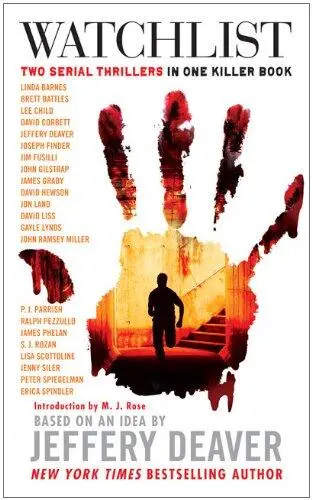
- Название:Watchlist
- Автор:
- Жанр:
- Год:неизвестен
- ISBN:нет данных
- Рейтинг книги:5 / 5. Голосов: 1
-
Избранное:Добавить в избранное
- Отзывы:
-
Ваша оценка:
Watchlist: краткое содержание, описание и аннотация
Предлагаем к чтению аннотацию, описание, краткое содержание или предисловие (зависит от того, что написал сам автор книги «Watchlist»). Если вы не нашли необходимую информацию о книге — напишите в комментариях, мы постараемся отыскать её.
In the first novella, THE CHOPIN MANUSCRIPT, former war crimes investigator Harold Middleton possesses a previously unknown score by Frederic Chopin. But he is unaware that, locked within its handwritten notes, lies a secret that now threatens the lives of thousands of Americans. As he races from Poland to America to uncover the mystery of the manuscript, Middleton will be accused of murder, pursued by federal agents, and targeted by assassins. But the greatest threat will come from a shadowy figure from his past: the man known only as Faust.
Harold Middleton returns in THE COPPER BRACELET -- the explosive sequel to THE CHOPIN MANUSCRIPT -- as he’s drawn into an international terror plot that threatens to send India and Pakistan into full-scale nuclear war. Careening from Nice to London and Moscow to Kashmir to prevent nuclear disaster, Middleton is unaware that his prey has changed and that the act of terror is far more diabolical than he knows. Will he discover the identity of the Scorpion in time to halt an event that will pit the United States, China, and Russia against each other at the brink of World War III?
Watchlist — читать онлайн бесплатно полную книгу (весь текст) целиком
Ниже представлен текст книги, разбитый по страницам. Система сохранения места последней прочитанной страницы, позволяет с удобством читать онлайн бесплатно книгу «Watchlist», без необходимости каждый раз заново искать на чём Вы остановились. Поставьте закладку, и сможете в любой момент перейти на страницу, на которой закончили чтение.
Интервал:
Закладка:
14
Kaminski stood at the window staring down at the inner harbor. A fog had rolled in and the lights of the buildings blinked back at her like eyes in the dark.
Her head was pounding-from bone-deep fatigue and the lingering effects of Faust’s Champagne. But also from fear.
She had never really felt fear like this before. Not when her parents disappeared and she was left on her own. Not when she had felt the press of the violin string against her neck when the man tried to kill her in Rome. Not even after she found out Uncle Henryk had been murdered.
But an hour ago, seeing the tattooed man bound in the closet, his bald head pouring blood, the cold, hammering fear began. It built as she heard him whimper as Faust whispered in his ear, as she saw his terrified tears, smelled the stench of his urine.
Shivering, she now moved away from the window, rubbing her hands over her arms. She scanned the suite’s living room, its oriental carpets and colonial furnishings. A mahogany bar dominated one corner, a gleaming baby grand piano the other. Off to the left, through open French doors, she could see one of the two bedrooms. Faust’s Vuitton duffle sat on the four-poster bed.
After the trip to the apartment, Faust had dropped her back at the hotel, and without another word, locked the door behind him and left. The man he called Nacho had been told to watch her. When he finally dozed off in the chair by the door, gun in hand, Kaminski had thought of running.
But where would she go? Faust had taken her passport, the one with the Joanna Phelps name on it, and her money. She knew no one in this country.
No, that wasn’t true. She knew of one person: Harold Middleton, who taught at the American University in Washington, D.C., and whose name was on the package containing the Mozart manuscript Uncle Henryk had sent to Signor Abe days before he was murdered.
Kaminski shut her eyes, Abe Nowakowski’s offer of help echoing in her head. She had tried to call him again in Rome, but the operator told her there was a block on her phone. No calls in or out. And so she was Faust’s prisoner, and she didn’t know why.
Nacho stirred, but went back to his snoring.
Kaminski paced slowly across the living room.
Her eyes found the piano in the corner and she went to it.
She ran a hand over the sleek black surface then slowly lifted the keyboard’s lid. The keys glowed in the soft light.
Suddenly, the image of her father was in her head. She could almost see his long fingers moving over the keys of the old piano in their home. Her little hands had tried so hard at her lessons to please him.
He had been so disappointed when she chose the violin, her mother’s instrument. Almost as if she had chosen her mother over him. But it had never been like that. She had loved her father so much, missed him so much.
And when he died, Uncle Henryk had been there for her to take his place.
Now the tears came. Kaminski did not stop them.
She sat down at the piano.
She played one chord. Then a quick section from a half-forgotten song. The Yamaha had an overly bright sound and a too-light action. But it didn’t matter. Just hearing the notes was soothing.
She played a Satie Gymnopedie then started Eine Kleine Nachtmusik, a piece Uncle Henryk had so loved.
She stopped suddenly.
Mozart.
She wiped a hand over her face. The Mozart manuscript Signor Abe had given her: Was this the reason Faust had brought her here?
She glanced over at Nacho, who watched her with tired eyes.
She went quickly to Faust’s bedroom. He had said the manuscript was “safe,” locked in a closet. She threw open its louvered doors. The closet was empty. She turned and spotted his slender black briefcase sitting on the bed near the duffle.
There was nothing in it but an automatic gun, with an empty clip nearby, and a copy of Il Denaro. She stared at the date: four days ago. She picked it up and unfolded the paper.
Several yellowed manuscript papers fluttered to the bed. Where better for a man like Faust to hide a priceless Mozart manuscript than in plain sight, bundled in the financial news?
She carefully gathered the pages. Back at La Musica, when she had first seen the manuscript, she hadn’t had time to really look at it. But now everything registered. The black scratchings were unmistakable. The fine strokes of faded ink. The distinctive signature. And finally, in the left corner very small: no. 28.
Her heart began to beat fast. She knew there were only twenty-seven catalogued Mozart piano concertos. Many of the originals that had resurfaced after the war were now housed in the Jagiellonska Library in Krakow.
Where had this one come from?
And was it the reason her uncle was dead?
She took the manuscript back to the piano. She sat down, carefully setting the fragile papers before her. She began to play.
The first movement opened with throbbing D minor chords. She had to go slowly, the technical demands way beyond her skills. Her heart was pounding with excitement as she grasped that she might be the first in centuries to play this.
She was sweating by the time she reached the end of the first movement. She stopped suddenly.
My God. A cadenza.
She stared at the notes. Her father had taught her that Mozart himself often injected cadenzas-improvised virtuoso solos-into his music. But he never wrote them down. Modern performers usually filled the gaps with their own improvisations that tried to mimic the master’s intent.
She began to play the cadenza. But her ears began to pick up strange discordant sounds. Odd little dissonances and patterns. She could suddenly hear her father’s voice speaking to her from behind as she practiced.
With Mozart, my dear, with music so pure, the slightest error stands out as an unmistakable blemish.
Kaminski stopped, her fingers poised over the keys.
There was something very strange about this cadenza.
The restaurant was almost empty. Two waiters stood at discreet attention just beyond a red curtain. Middleton could see from their faces they wanted to go home.
Yet Faust seemed in no hurry to go anywhere.
“So you never suspected anything about the Chopin?” Faust asked.
Middleton wasn’t sure how much to tell him. He still didn’t trust the man.
He thought suddenly about his interrupted ride to Baltimore with the two dopers Traci and Marcus. How he had made them listen to a Schoenberg recitatif, and Marcus’s crack that it sounded like nothing but wrong notes.
All the easier to hid a message in, he had told Marcus.
How hard could it be then to encrypt a code within the mathematical beauty of Chopin?
“As soon as I saw it, I felt something was wrong with it,” Middleton said. “But I just chalked it up to a bad forgery.”
“Jedynak didn’t say anything?” Faust asked.
Middleton shook his head. “When we were going over all the manuscripts, he seemed very interested in the Chopin in particular. He insisted I take it back to the States for authentication. Even though I told him I was sure it was a fake.”
“Maybe he was trying to get it safely out of the country. Maybe he was trying to keep it out of the wrong hands.”
“Jedynak knew the VX formula was encrypted in it?”
Faust shrugged.
Middleton sat back in his chair. “So I was supposed to be some fuckin’ mule?”
Faust said nothing. Which angered Middleton even more.
“Can I see it?” Faust asked.
When Middleton didn’t move, Faust gave him a sad smile. “I told you. I am desperate. I need your help.”
Middleton reached down to the briefcase at his feet and pulled out the manuscript. He handed it to Faust across the table.
Читать дальшеИнтервал:
Закладка:
Похожие книги на «Watchlist»
Представляем Вашему вниманию похожие книги на «Watchlist» списком для выбора. Мы отобрали схожую по названию и смыслу литературу в надежде предоставить читателям больше вариантов отыскать новые, интересные, ещё непрочитанные произведения.
Обсуждение, отзывы о книге «Watchlist» и просто собственные мнения читателей. Оставьте ваши комментарии, напишите, что Вы думаете о произведении, его смысле или главных героях. Укажите что конкретно понравилось, а что нет, и почему Вы так считаете.