Jeffery Deaver - Watchlist
Здесь есть возможность читать онлайн «Jeffery Deaver - Watchlist» весь текст электронной книги совершенно бесплатно (целиком полную версию без сокращений). В некоторых случаях можно слушать аудио, скачать через торрент в формате fb2 и присутствует краткое содержание. Жанр: Триллер, на английском языке. Описание произведения, (предисловие) а так же отзывы посетителей доступны на портале библиотеки ЛибКат.
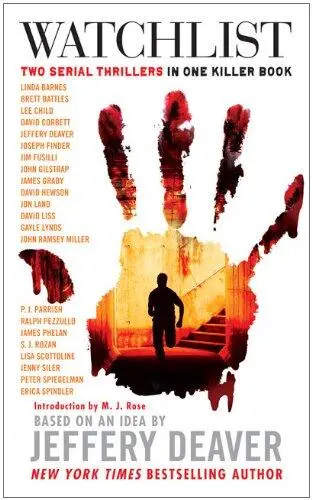
- Название:Watchlist
- Автор:
- Жанр:
- Год:неизвестен
- ISBN:нет данных
- Рейтинг книги:5 / 5. Голосов: 1
-
Избранное:Добавить в избранное
- Отзывы:
-
Ваша оценка:
Watchlist: краткое содержание, описание и аннотация
Предлагаем к чтению аннотацию, описание, краткое содержание или предисловие (зависит от того, что написал сам автор книги «Watchlist»). Если вы не нашли необходимую информацию о книге — напишите в комментариях, мы постараемся отыскать её.
In the first novella, THE CHOPIN MANUSCRIPT, former war crimes investigator Harold Middleton possesses a previously unknown score by Frederic Chopin. But he is unaware that, locked within its handwritten notes, lies a secret that now threatens the lives of thousands of Americans. As he races from Poland to America to uncover the mystery of the manuscript, Middleton will be accused of murder, pursued by federal agents, and targeted by assassins. But the greatest threat will come from a shadowy figure from his past: the man known only as Faust.
Harold Middleton returns in THE COPPER BRACELET -- the explosive sequel to THE CHOPIN MANUSCRIPT -- as he’s drawn into an international terror plot that threatens to send India and Pakistan into full-scale nuclear war. Careening from Nice to London and Moscow to Kashmir to prevent nuclear disaster, Middleton is unaware that his prey has changed and that the act of terror is far more diabolical than he knows. Will he discover the identity of the Scorpion in time to halt an event that will pit the United States, China, and Russia against each other at the brink of World War III?
Watchlist — читать онлайн бесплатно полную книгу (весь текст) целиком
Ниже представлен текст книги, разбитый по страницам. Система сохранения места последней прочитанной страницы, позволяет с удобством читать онлайн бесплатно книгу «Watchlist», без необходимости каждый раз заново искать на чём Вы остановились. Поставьте закладку, и сможете в любой момент перейти на страницу, на которой закончили чтение.
Интервал:
Закладка:
Kaminski sighed and sank deeper into the cushions. Her head swam and the harbor lights blinked at her, even through her closed lids. She had smoked opium once, an oily black bead with that Tunisian boy-what was his name?-who played guitar near the Castel Sant’Angelo, and it had set her drifting like this. Floating, her worries no more than distant lights.
There was a sharp knock and she came to with a bump. She rubbed her eyes and sat up to see Faust opening the suite door. A man came in, squat and muscular, wearing jeans and a black-leather jacket. His hair was gray and cut short, and he greeted Faust in Italian, then glanced at his guest and switched to something else. Whatever it was sounded fast and harsh to Kaminski’s ears-Slavic, she thought, but otherwise no clue. Faust listened and nodded and checked his watch. He said something to the man-an order, a dismissal-and the man nodded and left.
Faust looked at her. “Another trip,” he said.
Felicia could barely find her voice. “What? Now? At this hour?”
Again the smile. “No rest for the wicked, Felicia, but we won’t be gone long. If you wish to wash up first, I will wait.”
She rubbed her hands over her face, rubbing life back into it. “No,” she said. “I’m tired of being dragged around, and now I’m done with it. Sono rifinito. Non sto andando.”
Even to herself she sounded like a child, but she was beyond caring. She looked at Faust, leaning so casually against the doorframe, his suit somehow without a wrinkle and every hair in place, as if he had stepped from a page in a fashion magazine.
He shook his head. “You are not staying here alone, Felicia.”
Anger welled in her. “No? And why not?”
“It is not safe.”
“I take care of myself.”
“Yes, I saw how well back in Rome.”
She said, “Screw you! I don’t need a goddamn babysitter.”
“You are the tough little urchin now, eh?”
“Tough enough,” Kaminski said, grinding her teeth. “I didn’t grow up in places like this, being waited on hand and foot.”
Faust’s smile widened. “You think that I did?”
“Let’s say you don’t look out of place.”
He chuckled. “You haven’t known the real romance of street life until you’ve experienced it in Buenos Aires, caught between the Montoneros and the Battalion 601 boys. Now those were charming fellows, and much more dedicated than your average Roman teppista.”
Kaminski massaged her temples, trying to get her brain to function. Buenos Aires? Montoneros? What the fuck? She’d read something once about the Dirty War, but she couldn’t remember what. “So you had it rough and now you’re up from the gutter-a real success story.”
“Something like that.”
“Good for you. You’ve earned all this! And never mind that you’re a thief or a spy or some kind of terrorist-someone who bullies old men, and kidnaps girls from the streets of Rome.”
“I’ve told you, Felicia, your friend Abe is fine, and I am no spy. I have no taste for politics at all. If I had to describe my profession, I’d say I was a broker. I match buyers with sellers, and take a fee. A modest fee, all things considered.”
“Buyers and sellers of what?”
Faust shrugged. “This and that. Odds and ends.”
“Like stolen music manuscripts?”
“The manuscript is in the closet, Felicia, behind lock and key. My own musical inclinations run more to Sinatra than Mozart.”
“Not music, then what-drugs, guns? Whatever it is, I’m sure it makes your family very proud.”
Kaminski felt the air change, going silent and thick around her. The smiling Mr. Faust was no longer smiling, and those dark eyes seemed to look right through her. Defiance and anger drained from her, replaced by choking fear. This time, the knock on the door was a relief.
It was the squat man again, and he looked nervously at Faust. Faust said something to the man-she didn’t know what-and walked out the door. The squat man turned to her.
“Come,” he said in gravelly English.
She was not inclined to argue.
Faust hadn’t lied about the trip. It was a short one in the back of the big BMW, through sodium-lit nighttime streets. Kaminski looked for signs and landmarks: Light Street, East Lombard, a big stadium off to the left, bathed in light and carpeted in impossible green, then a tangle of narrower streets, and old brick buildings. In 10 minutes, they pulled up in front of one of them.
Four stories and broad, the building looked to her like a warehouse or an old factory. And so it had been once upon a time, as she read on the shiny brass plaque near the modern glass entry: The Sail Cloth Factory-1888. Just above that plaque another, with the address: 121 South Fremont Avenue.
Home, she thought, her anger returning as she followed Faust inside.
Exposed brick and ornamental wrought iron whispered of the building’s industrial past; otherwise, the rest of the lobby-gleaming brass, etched glass and marble-proclaimed its current incarnation as a luxury apartment building. Faust crossed to the elevator and Felicia followed him in and then, on the fourth floor, out again. Around a corner, down a pale gray corridor, and to a black door at its end; Faust knocked twice. Then he took a key from his jacket pocket, worked the lock, and stepped inside. And stopped short.
Kaminski didn’t see the wiry, bearded man pointing a Glock 30 at Faust’s chest until she bumped into Faust’s back. Then she gasped and gripped Faust’s bicep.
“Jesus,” she whispered.
The bearded man smiled at Faust, who smiled back. “ Qué tal , Nacho,” Faust said.
“ Nada , Jefe,” the man said, and slipped the Glock into a holster behind his back. “All quiet on the western front. Have a look for yourself.”
Faust gently removed Kaminski’s hand from his bicep and followed Nacho to a window. She let out a long breath and looked around. The large loft apartment-brick walls, high ceilings, exposed beams and ductwork, shiny plank floors, and little in the way of furniture: a card table, some folding chairs, a dim floor lamp, and heavy white drapes across the windows. There was plenty of technical equipment: three laptops; several cameras wearing long lenses; and two massive, tripod-mounted binoculars. They were pointed at a narrow gap in the drapes, and now Nacho fiddled with one of them.
“Got the image intensifier on this one, Jefe,” he said as Faust bent to the eyepieces.
“When was the last delivery?” Faust asked as he looked.
“This afternoon. Maybe five o’clock.”
“You know what it was?”
Nacho looked at Kaminski and switched to Spanish. She tried to follow it, but it came too fast and the accents were strange, and anyway it sounded scientific to her, chemical terms maybe. She walked slowly to the binoculars while Faust and Nacho spoke. The men saw her but seemed not to care. She peered into the eyepiece.
Outside, the world was tinted green, as was a brick building, low and long, that seemed very close. It had a lot of windows, all shuttered, and she thought it looked abandoned. There was a loading dock in the center of the image, and the only thing that moved was a plastic bag, blowing in the warm night breeze.
Nacho pulled the drapes and the outside images went black. He looked at Kaminski and nodded his head at a chair in the corner. She sat, still straining to catch the conversation. It was less technical now, Faust asking something about someone-does he know… Does he know what? Horario. Was that like orario, meaning schedule, timetable? And who was this he?
It seemed as if Nacho was uncertain too. He shrugged at Faust and moved to a large closet’s double doors. He put his hands on the knobs. “Maybe you have better luck than me, Jefe,” he said in English, and swung the doors wide.
Читать дальшеИнтервал:
Закладка:
Похожие книги на «Watchlist»
Представляем Вашему вниманию похожие книги на «Watchlist» списком для выбора. Мы отобрали схожую по названию и смыслу литературу в надежде предоставить читателям больше вариантов отыскать новые, интересные, ещё непрочитанные произведения.





Обсуждение, отзывы о книге «Watchlist» и просто собственные мнения читателей. Оставьте ваши комментарии, напишите, что Вы думаете о произведении, его смысле или главных героях. Укажите что конкретно понравилось, а что нет, и почему Вы так считаете.