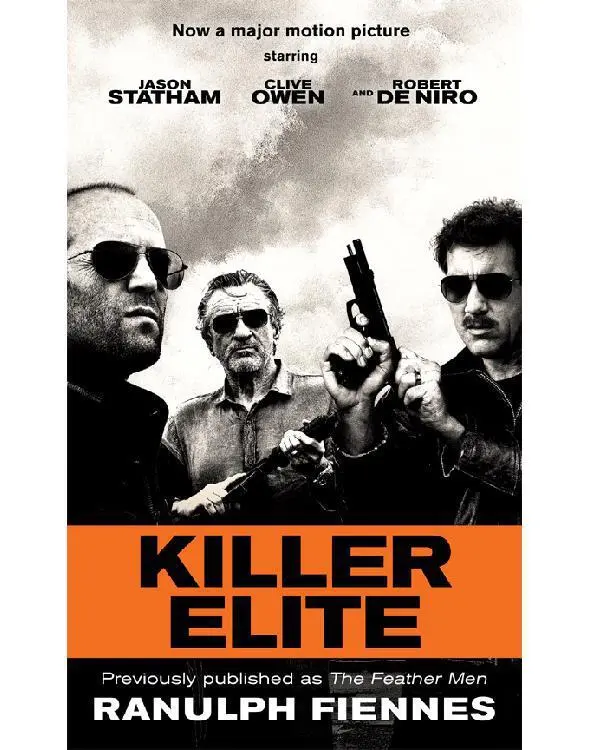
Ranulph Fiennes - Killer Elite
Здесь есть возможность читать онлайн «Ranulph Fiennes - Killer Elite» весь текст электронной книги совершенно бесплатно (целиком полную версию без сокращений). В некоторых случаях можно слушать аудио, скачать через торрент в формате fb2 и присутствует краткое содержание. Жанр: Триллер, на английском языке. Описание произведения, (предисловие) а так же отзывы посетителей доступны на портале библиотеки ЛибКат.
- Название:Killer Elite
- Автор:
- Жанр:
- Год:неизвестен
- ISBN:нет данных
- Рейтинг книги:3 / 5. Голосов: 1
-
Избранное:Добавить в избранное
- Отзывы:
-
Ваша оценка:
Killer Elite: краткое содержание, описание и аннотация
Предлагаем к чтению аннотацию, описание, краткое содержание или предисловие (зависит от того, что написал сам автор книги «Killer Elite»). Если вы не нашли необходимую информацию о книге — напишите в комментариях, мы постараемся отыскать её.
Killer Elite — читать онлайн бесплатно полную книгу (весь текст) целиком
Ниже представлен текст книги, разбитый по страницам. Система сохранения места последней прочитанной страницы, позволяет с удобством читать онлайн бесплатно книгу «Killer Elite», без необходимости каждый раз заново искать на чём Вы остановились. Поставьте закладку, и сможете в любой момент перейти на страницу, на которой закончили чтение.
Интервал:
Закладка:
Sheikh Amr had been specific. His son had died fighting Sultanate troops near Sherishitti on that fatal day in January 1975. Together with two other jebalis of the Bin Dhahaib unit he had been killed by a mortar barrage from the army position on the twin bald hills to the east of Zakhir. De Villiers’s discovery of the book SAS Operation Oman had revealed that the man in charge of the mortars on that day was not, as they had thought, a Sultan’s Forces soldier but rather an SAS mortar controller.
In May 1987 Davies joined two of his Hereford pub acquaintances for a meal at a fish and chip shop called Chancers. He was introduced to the owner, a friendly, hard-drinking fellow who also owned an adjacent wine bar and upstairs restaurant. Davies became a regular patron of the wine bar and a confidant of its owner, Tosh Ash, ex-member of G Squadron SAS.
Tosh and his wife had in 1986 purchased the Golden Galleon fish and chip shop and the adjoining premises. They had worked hard to convert the site and lived in a comfortable flat above the restaurant. By the following spring the place was a proper little gold mine and the wine bar attracted many of the older SAS men of Tosh’s generation, who enjoyed the atmosphere of the long, narrow bar, audiovisual jukebox and ceiling-suspended monitor screens, as well as palatable wine at good prices.
Despite Davies’s growing friendship with Tosh and the fact that he was not after information that could conceivably be described as classified, let alone secret, the months passed with no sign of progress. Davies knew that, to an SAS man, secrecy is a fetish. All his careful preparations would be wasted were he to ask a single question out of place. So he kept his patience and explained the delay as best he could when de Villiers made inquiring phone calls.
One cold autumn evening Tosh asked Davies up for a drink in his flat above the restaurant. Over a stiff whiskey Tosh poured out his woes. Life was a bastard. His health was giving out and the wife was being awkward, very awkward. Davies, having listened to local gossip, thought there might be good reason for such awkwardness but he said nothing. Tosh became maudlin. Without prompting from Davies, he began to reminisce about the Army. The finest days of his life. How he wished he was back. He mentioned many weird names in various parts of the world that meant nothing to Davies until the word Sherishitti dropped from heaven into his lap. He was ready for it. “That was where you attacked the cave system, wasn’t it, Tosh?”
Tosh was surprised. Did Davies know about Sherishitti?
Davies laughed. “Your memory is going. You told me all about the event a month ago.” To prove it he reeled off all that he knew by heart from many readings of the Jeapes and Akehurst accounts of the action. “I think,” he ended, “that you said you were controlling the mortars on Hill 985.”
“No, no, no,” Tosh exclaimed. “That was poor old Mac, the best mortarman in the British Army. I was with him”-he subconsciously felt for the old wound in his wrist-“and we were both hit by the same bullet. But he was the boss with the tube, not me.”
“Why poor Mac? Did he die?”
Tosh shook his head.
“No, though sometimes I think he wishes that he had. His skull was damaged some weeks after Sherishitti and he’s never been the same since. A proud man, Mac, still keeps a job down, over at Sun Valley Poultry, however sick he’s feeling.”
Tosh filled their glasses and they drank to Mac and other absent friends. “He comes in here from time to time. You’ve probably seen him.” Tosh reached for a black book entitled This Is the SAS, by Tony Geraghty, and thumbed through it. “That’s Mac.” He indicated a photograph of Prince Charles inspecting four SAS soldiers back in 1970. “The fellow on the right with the sharp nose.” Tosh chuckled to himself, his mood beginning to lift as his domestic worries receded. “You should have seen old Mac with a mortar. He could aim by sheer instinct, ignoring the aiming marker, and I never saw him miss a target.”
Tosh sighed and stood up. “Give either of us a mortar nowadays and we’d be hard-pressed to hit an advancing regiment. You ought to see poor Mac on his bike. Wobbles all over the place. Bloody lethal to himself and everyone else. Mind you some days he’s quite okay; it all depends on his pills. Up at the factory they say he gets so drowsy sometimes, the other lads have to cover up for him.”
Davies told Tosh he was unlikely to call again for a while owing to pressure of work. That night he called de Villiers to come at once.
Three days of observation outside Sun Valley Poultry revealed nine possible Macs but only one whose features tallied with Tosh’s photograph. Davies followed the man to Salisbury Avenue and, on the third day, noticed the cyclist’s problems with balance. Outside the factory that evening Davies heard the words, “See you tomorrow, Mac,” shouted by a colleague, and knew he had his man. The watch on the Salisbury Avenue house was maintained by the Tadnams people, allowing Davies to establish the movements of Mac, his wife, his daughter and all callers to the house.
In the last week of November, soon after the arrival of de Villiers, a car with a doctor’s sign on the rear window parked outside Mac’s house and Davies followed the driver back to Sarum House surgery in Ethelburt Street. At 2 a.m. on Wednesday, December 2, de Villiers let himself quietly into the surgery, leaving no trace of entry. There was only one Mac with the correct address in Salisbury Avenue, and de Villiers photographed the relevant details on his medical file.
“He has epilepsy,” he told Davies back in their car. “He may die in a few days or after many years.”
“Are you saying we’d better hurry?” Davies asked.
De Villiers ignored the question.
“What’s the prognosis, to date?” continued Davies.
“Easy. He spends many weekends at home and often alone. The best time is Saturday morning at 8:15 a.m. The wife will have gone to work and the daughter to ride her pony. The only other possibility is on his bicycle, but that is a definite second best as he usually travels at the busiest times of day.”
De Villiers drove to London to collect the necessary equipment.
Davies never returned to Chancers. Tosh Ash died eight months later. His body was found by the seaside in Spain. It seemed that he had taken his dog for a coastal walk and, when another dog attacked his, he died of a heart attack.
40
Early in December David Mason’s other commitments forced him to withdraw from the Salisbury Avenue watch. Darrell Hallett met him in a tearoom in Ross and took over the operation. Mason had already visited a number of hotels and bed and breakfast houses asking for help to trace the men in the Sumail photographs. There had been no response despite the paucity of out-of-season tourists and Mason’s two Mac-watchers had seen no sign of outside interest in the house or the man.
Hallett was no longer selling Yorkie bars. After his twelve years of faithful service, his employers had put pressure on him and others to resign, as they wanted to reduce their sales force in South Wales. With free help from two ex-SAS officers, one a city barrister, Hallett had fought for his rights and, on March 28, 1985, at the Cardiff Industrial Tribunal, he had won?3,500 in an out-of-court settlement from Rowntree in respect of his claim of unfair dismissal. By dint of hard work, he had begun to build a new career with one of the major life-insurance groups and found it increasingly difficult to take time off for Spike. Wild horses, however, would not keep him from another chance of meeting up with the elusive Welshman.
Mason explained the VHF pocket receiver, which would bleep should Mac press his ankle-buzzer-an action easily and unobtrusively carried out even at gunpoint.
Читать дальшеИнтервал:
Закладка:
Похожие книги на «Killer Elite»
Представляем Вашему вниманию похожие книги на «Killer Elite» списком для выбора. Мы отобрали схожую по названию и смыслу литературу в надежде предоставить читателям больше вариантов отыскать новые, интересные, ещё непрочитанные произведения.











Обсуждение, отзывы о книге «Killer Elite» и просто собственные мнения читателей. Оставьте ваши комментарии, напишите, что Вы думаете о произведении, его смысле или главных героях. Укажите что конкретно понравилось, а что нет, и почему Вы так считаете.