Ranulph Fiennes - Killer Elite
Здесь есть возможность читать онлайн «Ranulph Fiennes - Killer Elite» весь текст электронной книги совершенно бесплатно (целиком полную версию без сокращений). В некоторых случаях можно слушать аудио, скачать через торрент в формате fb2 и присутствует краткое содержание. Жанр: Триллер, на английском языке. Описание произведения, (предисловие) а так же отзывы посетителей доступны на портале библиотеки ЛибКат.
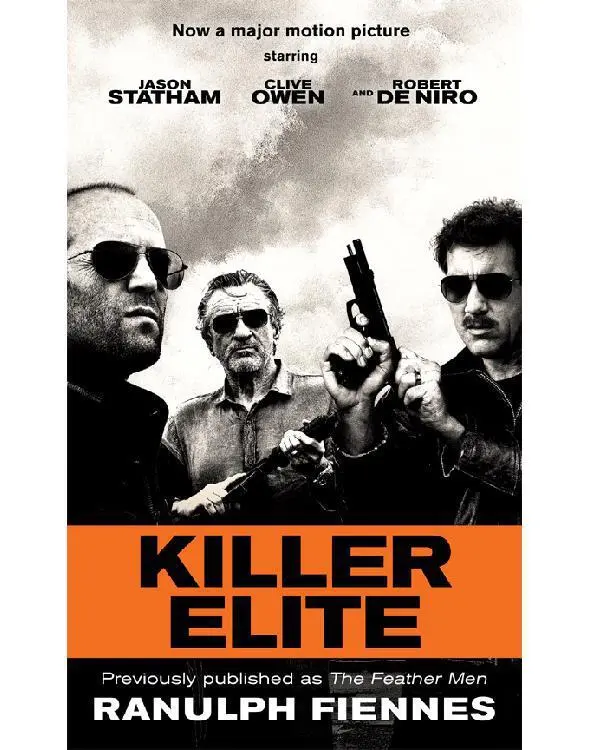
- Название:Killer Elite
- Автор:
- Жанр:
- Год:неизвестен
- ISBN:нет данных
- Рейтинг книги:3 / 5. Голосов: 1
-
Избранное:Добавить в избранное
- Отзывы:
-
Ваша оценка:
Killer Elite: краткое содержание, описание и аннотация
Предлагаем к чтению аннотацию, описание, краткое содержание или предисловие (зависит от того, что написал сам автор книги «Killer Elite»). Если вы не нашли необходимую информацию о книге — напишите в комментариях, мы постараемся отыскать её.
Killer Elite — читать онлайн бесплатно полную книгу (весь текст) целиком
Ниже представлен текст книги, разбитый по страницам. Система сохранения места последней прочитанной страницы, позволяет с удобством читать онлайн бесплатно книгу «Killer Elite», без необходимости каждый раз заново искать на чём Вы остановились. Поставьте закладку, и сможете в любой момент перейти на страницу, на которой закончили чтение.
Интервал:
Закладка:
David Mason was annoyed. He prided himself on his memory for faces yet he could not place the policemen at Marman’s house. The fawn Range Rover, a manual 1985 model, sped up the M40 and A40 to Oxford and then Eynsham, as Mason niggled away at the recesses of his mind, attempting to match the two faces to an associated event. Eventually, not far from home, it came to him in a rush and the Range Rover accelerated, gravel flying, as Mason realized the full implications of his blunder.
Running into Scott’s House, he located the keys and let himself into the gun-room. Inside one of the inner document safes he located a green folder and withdrew a sheaf of photographs, the Sumail pictures of Milling’s killers that he had taken ten years earlier. There could be no mistaking the two men. The colleagues of Floppy Hat had called on Michael Marman that evening. They might conceivably still be there.
Mason telephoned at once and was greatly relieved when Marman answered. “No. They have gone. They were only here for twenty minutes. Something to do with a street fight at the Antelope. Thought I was involved but I soon put them right and they apologized. Why do you ask?”
“Listen, Mike,” Mason said with deliberate intensity, for he knew Marman took most things in life with a pinch of salt, “those men were not policemen. They are dangerous and you should avoid them like the plague. I will be with you as soon as I can tomorrow to explain.”
After a good deal of amused cajoling, Marman promised that he would at least lock his doors and windows that night, if only to humor Mason.
Mason then called Spike Allen, who was in and agreed to contact the Feather Men immediately.
31
Colonel Tommy Macpherson believed that British citizens exposed, in the 1980s, as wartime Nazi killers and torturers should not receive a pardon merely because they had outwitted justice for forty years. He also believed that the hunt for the killers of Milling and Kealy should continue until they were caught. When Spike Allen called him, some nine years after Kealy’s death, to say his assassins were again at large, Macpherson’s immediate reaction was, “Excellent. This time they will not slip through the net.”
He agreed to a committee meeting the next morning despite an unavoidable early date with the New Zealand billionaire Ron Brierley at the London flat of an Irish entrepreneur.
Since the 1970s Macpherson’s life had become very full and, in four weeks’ time, he was due to submit to the Secretary of State for Defense a full report, called for by Prime Minister Margaret Thatcher, on employment and other problems affecting the efficiency of Britain’s Territorial Army and other volunteer reserves.
Two years earlier, Macpherson, a senior nonexecutive director of the National Coal Board and the close confidant and adviser of Ian MacGregor, the NCB chairman, had performed two roles that were to prove critical in the defeat of the miners’ leader, Arthur Scargill. First, he persuaded Ian MacGregor to limit his appearances on television and to let the more subtle and down-to-earth Michael Eaton become the visible face of the NCB. Second, he urged the formation of British Coal Enterprises with the specific and enormous task of finding new work for the miners whom MacGregor had to render redundant.
Additionally Macpherson had chaired the London Chamber of Commerce, the British National Chamber of Commerce, the CBI’s London and Southeastern branch, Birmid Qualcast, Webb-Brown International, and the Mallinson-Denny Group.
Even when the founder of the Feather Men had initially checked out the young Tommy Macpherson in the early fifties, his record had been impressive. Educated at Fettes College (of which he was now governor) and Trinity College, Oxford, he was a First Open Classical Scholar, an Athletics Blue and Scottish International. He also played rugby and hockey for Oxford. Soon after the outbreak of war he joined the Scottish Commando from the Queen’s Own Cameron Highlanders, became a POW in November 1941 but escaped late in 1943, and served in the Special Forces with the French and the Italian Resistance. He received the Military Cross with two Bars, the Legion d’Honneur, the Croix de Guerre, and various other honors.
By the winter of 1986 Tommy Macpherson was as busy as he had ever been, but on the morning of Tuesday, November 4, he hurried through his meeting with Ron Brierley and Tony O’Reilly, the chairman of Heinz International, and arrived only minutes late for the committee meeting of the Feather Men. Bletchley was in the chair and Macpherson was shocked at the look of him. Thin and gaunt to the point of emaciation, he seemed to have lost interest in his appearance. His collar was awry and food stains were clearly evident on his poorly adjusted tie. A recent minor road accident, when his foot had applied pressure to his Audi’s accelerator instead of the brake, had left contusions and cuts on his forehead, eyebrows and nose. All in all he was a sorry sight, and Jane, seated close beside him with her notes, was obviously giving him the mother-hen treatment.
Macpherson nodded his apologies to the chair and Spike Allen spoke. “The chairman allowed me to wait for your arrival, Colonel, before bringing up the specific matter which is the reason for today’s unscheduled meeting.”
Macpherson nodded.
The don smiled to himself. Spike had fought Bletchley hard to delay things for Macpherson’s benefit.
Apart from Macpherson, nobody was aware of the reason for Spike’s sudden call. Their interest was aroused. The twins had long since retired, replaced by two fifty-year-olds with excellent Home Office connections. Both had been put forward by Mantell and seconded by Bletchley. August Graves had dubbed them the “little gray men.”
“Most of you,” Spike’s voice was toneless, “will remember that in 1976 the committee sanctioned one of our Locals to follow a suspect to Arabia. The Local identified this man’s intended target but, unfortunately, the wrong target. An ex-Marine helicopter pilot was killed and the three Europeans involved were photographed but not identified.”
Spike looked around. As he later commented to Macpherson, “You could hear a flea fart, they were so attentive.” Bletchley had begun to sweat profusely and his shoulder moved with a furtive tic as though some manikin was trying to burst out of his collarbone.
“A year later,” Spike continued, “one of Bob Mantell’s sources in the Worcester police gave us another lead to the same suspect. This time our Locals identified the correct target but their watch was called off when, after a three-week period, the suspect appeared to have been frightened off by one of them. Sadly this second target, an SAS officer, was killed and no additional information was obtained about the assassins.”
“A pretty abysmal record by all counts,” muttered Mike Panny.
Spike ignored him and continued. “A great deal of water has passed under the bridge since then, but yesterday a veteran Local recognized the same suspect who was implicated in both previous murders, at the house of a Major Michael Marman in Clapham. The suspect posed as a policeman and was accompanied by a second colleague whom our man also recognized from the 1977 Milling affair. The reason for their visit to Marman’s home seems to have been familiarization with his house and circumstances.”
“What has Marman to do with the two previous targets?” Mantell asked.
“That is not the point,” Bletchley burst out. White in the face and shaking as though from St. Vitus’s Dance, he hammered his fist on his papers. “The question should be: ‘What has any of this to do with us?’ ” For a minute or more, words seemed to fail him. He leaned forward, jerking at the neck, and Jane placed her hands anxiously around him. His eyes stood out and he stared at her, gulping as though for air. Believing Bletchley was having a stroke, Macpherson was about to suggest an immediate journey to the hospital when Bletchley recovered both his voice and his composure.
Читать дальшеИнтервал:
Закладка:
Похожие книги на «Killer Elite»
Представляем Вашему вниманию похожие книги на «Killer Elite» списком для выбора. Мы отобрали схожую по названию и смыслу литературу в надежде предоставить читателям больше вариантов отыскать новые, интересные, ещё непрочитанные произведения.










Обсуждение, отзывы о книге «Killer Elite» и просто собственные мнения читателей. Оставьте ваши комментарии, напишите, что Вы думаете о произведении, его смысле или главных героях. Укажите что конкретно понравилось, а что нет, и почему Вы так считаете.