Alan Jacobson - False accusations
Здесь есть возможность читать онлайн «Alan Jacobson - False accusations» весь текст электронной книги совершенно бесплатно (целиком полную версию без сокращений). В некоторых случаях можно слушать аудио, скачать через торрент в формате fb2 и присутствует краткое содержание. Жанр: Триллер, на английском языке. Описание произведения, (предисловие) а так же отзывы посетителей доступны на портале библиотеки ЛибКат.
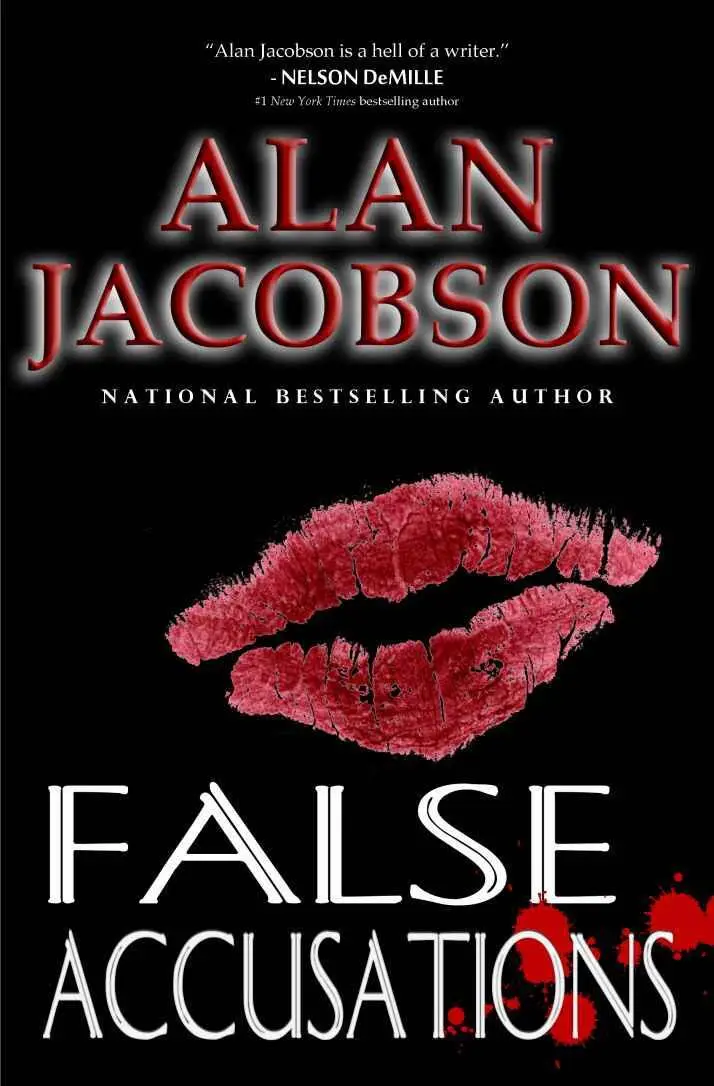
- Название:False accusations
- Автор:
- Жанр:
- Год:неизвестен
- ISBN:нет данных
- Рейтинг книги:4 / 5. Голосов: 1
-
Избранное:Добавить в избранное
- Отзывы:
-
Ваша оценка:
False accusations: краткое содержание, описание и аннотация
Предлагаем к чтению аннотацию, описание, краткое содержание или предисловие (зависит от того, что написал сам автор книги «False accusations»). Если вы не нашли необходимую информацию о книге — напишите в комментариях, мы постараемся отыскать её.
False accusations — читать онлайн бесплатно полную книгу (весь текст) целиком
Ниже представлен текст книги, разбитый по страницам. Система сохранения места последней прочитанной страницы, позволяет с удобством читать онлайн бесплатно книгу «False accusations», без необходимости каждый раз заново искать на чём Вы остановились. Поставьте закладку, и сможете в любой момент перейти на страницу, на которой закончили чтение.
Интервал:
Закладка:
The front door opened and revealed Harding, dressed in a smart, tightly tailored suit and ready to walk out the door. “What do you want now?” she asked, an air of defensiveness hardening her face. “I’m on my way to a job interview.”
“Miss Brittany Harding,” Jennings said, stepping through the open front door, “we have a warrant for your arrest in the murders of Otis Silvers and Imogene Pringle.”
“Like hell you do!” she shouted, backpedaling. Jennings reached for her wrist, but she yanked it back. “Get your goddamn hands off me. How dare you come in here and accuse me of murder?”
Moreno rested a hand on her baton.
“Miss Harding, I’m sure you don’t want to make this more difficult than it already is,” Jennings said as he advanced on her. “Come peacefully and it’ll be easier. For all of us.”
She backed against the entryway wall; as Jennings took another step toward her, she kicked him in the groin, doubling him over. Moreno leaped forward and pinned Harding back with the baton shoved beneath her chin. She then spun her around and took her suspect down, face first, onto the tile floor.
Jennings stood up slowly, his brow crumpled in pain. He pulled out his handcuffs and leaned over the suspect’s prone body, fastening the restraints to her forearms with a swift flick of his wrist. He made them exceptionally tight.
“I think,” he said through clenched teeth, “we’ll add resisting arrest to the charges against you.”
He proceeded to Mirandize her, and while still somewhat stooped over, led her outside where the uniformed deputy took her to the waiting patrol car.
CHAPTER 60
Eight weeks later
April 20
Sacramento Superior Courthouse
720 9th Street
In the private sector, the different categories of attorneys are grouped by fields of practice: litigation, criminal defense, real estate, business, estate planning, and the like. In the public defender’s office, however, the attorneys are categorized somewhat differently: those whose goal is to gain valuable trial experience, at which time they will leave to join a local firm; those who are superb trial attorneys; those who are mediocre and thus could not land a private position that approached the salary and benefits of their civil service job; and those who are so incompetent that the important, challenging cases are shifted away from them-and replaced with mundane misdemeanors and conservatorships.
When someone needs a public defender, as is stated in Miranda, one is assigned. From the accused’s perspective, the luck of the draw is worse than a crapshoot-for in a crapshoot, the only thing on the line is money. With respect to the public defender’s office, the luck of the draw could be a matter of life and death, depending upon who is assigned to your case.
Brittany Harding drew Wendell Warwick for her defense. Warwick, a fifteen-year veteran of the public defender’s office, was generally considered to fit into the mediocre category. He had lost more than his share of cases, but occasionally he would surprise everyone with a sagacious defense. Problem was, such triumphs and flashes of brilliance were few and far between. It was theorized in the office that personal problems suctioned away his ability to devote the time and focus necessary to win important cases consistently.
Harding’s case began on an inauspicious note. In keeping with accepted procedure, Warwick made a pre-trial motion to challenge Denton’s introduction of DNA evidence. However, two days before the Kelly-Frye hearing-a court proceeding to determine whether evidence had scientific validity and reliability-his expert canceled due to illness, and Warwick did a one-eighty, changing his mind on the hearing and deciding to proceed without one. He had his reasons, he explained, and apologized to the court for wasting its time.
The following day, Warwick was due to appear before the judge in chambers, with Denton present, to contest evidence the DA wanted to bring against his client. Denton had requested that this pretrial motion be held in chambers, out of earshot of the press, so as to preserve both Madison’s reputation and Harding’s privacy. He explained that it would be undesirable to go public with unsubstantiated rape complaints, stories of extortion and clandestine videos if there was a chance the judge could deem it all to be inadmissible.
Warwick agreed, and shortly before noon they found themselves sitting in Calvino’s plush, wood-lined office facing the crotchety man who was staring down at his plate of food.
“Damned restaurant botched my grilled halibut. Dried it to a crisp. But I didn’t have time for them to redo the order because I had to get back here for this meeting.”
Both Warwick and Denton listened intently, as if they were genuinely concerned about the judge’s lunch and his misfortune. In fact, they could not care less. Denton laughed inside, realizing that it was probably the last thing he and Warwick would agree on for the rest of the trial.
They both ceremoniously apologized to the judge for his spoiled lunch and moved on to the purpose of the hearing.
Calvino nodded to the court reporter to begin her stenography. “So I presume that you have a problem with the evidence that Mr. Denton intends to bring,” he said to Warwick.
“Yes, Your Honor. The defense wishes to exclude from trial any information pertaining to accusations of extortion relative to either Phillip Madison or Mark Stanton.”
“Your Honor,” Denton said, “this evidence, and the witnesses who will testify as to the two prior episodes of extortion, are paramount for establishing motive. Harding extorted money from her prior employer with false accusations of sexual harassment-and admitted as much on video. She then tried this same tactic on Dr. Madison two years later-but his attorney didn’t let her get away with it-”
“Yes, yes, Mr. Denton, I’m familiar with the story,” Calvino said. “Get to the point. Quickly.”
“Yes, Your Honor,” Denton said, squaring his shoulders and taking a deep breath. “There is a distinct pattern of behavior beginning with a similar episode of extortion two years ago and continuing to the present. When her attempt at extorting Dr. Madison failed, she became enraged and formulated a plan by which she could effect her revenge. She made no attempt at disguising her intentions. She shouted in a public place that she would get even and make him pay. This most definitely goes to motive, and is completely proper in its logical progression from past to present.”
As Calvino opened his mouth to speak, Warwick interrupted. “Your Honor, if I may.”
Calvino nodded.
“Miss Harding’s former employer and her behavior during that supposed videotaped incident have nothing do with her feelings or motives relative to Phillip Madison. Further, the production of the evidence, particularly the video recording of Miss Harding and Mr. Stanton, is inflammatory and prejudicial, collateral, and definitely inadmissible. Moreover, we have no way of verifying the tape’s authenticity or even when it was filmed.”
“We have Mr. Stanton himself who will testify that the video is authentic and he will be able to verify exactly when it was made,” Denton said. “And we can subpoena the cameraman-the private investigator who Mr. Stanton’s attorney hired to film the event. We can subpoena Stanton’s attorney, for that matter, to establish place and time, and obtain a copy of the check written by the attorney to the investigator, not to mention a digital-”
Calvino held up a hand for Denton to stop. “I get the point, counselor.”
Warwick leaned forward. “This doesn’t even address the issues of my client being incapable of committing this crime. The DA is, in effect, saying that Miss Harding had access to Madison’s vehicle-which Madison will undoubtedly tell you she didn’t-so she had to have broken into his garage, stolen his Mercedes, committed the act, planted the beer cans in his car to frame Madison, and then returned his car to the garage. This isn’t reasonable. In, fact, it’s ridiculous.”
Читать дальшеИнтервал:
Закладка:
Похожие книги на «False accusations»
Представляем Вашему вниманию похожие книги на «False accusations» списком для выбора. Мы отобрали схожую по названию и смыслу литературу в надежде предоставить читателям больше вариантов отыскать новые, интересные, ещё непрочитанные произведения.







Обсуждение, отзывы о книге «False accusations» и просто собственные мнения читателей. Оставьте ваши комментарии, напишите, что Вы думаете о произведении, его смысле или главных героях. Укажите что конкретно понравилось, а что нет, и почему Вы так считаете.