Justin Cronin - The Twelve
Здесь есть возможность читать онлайн «Justin Cronin - The Twelve» весь текст электронной книги совершенно бесплатно (целиком полную версию без сокращений). В некоторых случаях можно слушать аудио, скачать через торрент в формате fb2 и присутствует краткое содержание. Город: New York, Год выпуска: 2012, ISBN: 2012, Издательство: Ballantine Books, Жанр: Триллер, sf_postapocalyptic, на английском языке. Описание произведения, (предисловие) а так же отзывы посетителей доступны на портале библиотеки ЛибКат.

- Название:The Twelve
- Автор:
- Издательство:Ballantine Books
- Жанр:
- Год:2012
- Город:New York
- ISBN:978-0345504982
- Рейтинг книги:4 / 5. Голосов: 1
-
Избранное:Добавить в избранное
- Отзывы:
-
Ваша оценка:
The Twelve: краткое содержание, описание и аннотация
Предлагаем к чтению аннотацию, описание, краткое содержание или предисловие (зависит от того, что написал сам автор книги «The Twelve»). Если вы не нашли необходимую информацию о книге — напишите в комментариях, мы постараемся отыскать её.
In his internationally bestselling and critically acclaimed novel
, Justin Cronin constructed an unforgettable world transformed by a government experiment gone horribly wrong. Now the scope widens and the intensity deepens as the epic story surges forward with…
In the present day, as the man-made apocalypse unfolds, three strangers navigate the chaos. Lila, a doctor and an expectant mother, is so shattered by the spread of violence and infection that she continues to plan for her child’s arrival even as society dissolves around her. Kittridge, known to the world as “Last Stand in Denver,” has been forced to flee his stronghold and is now on the road, dodging the infected, armed but alone and well aware that a tank of gas will get him only so far. April is a teenager fighting to guide her little brother safely through a landscape of death and ruin. These three will learn that they have not been fully abandoned—and that in connection lies hope, even on the darkest of nights.
One hundred years in the future, Amy and the others fight on for humankind’s salvation… unaware that the rules have changed. The enemy has evolved, and a dark new order has arisen with a vision of the future infinitely more horrifying than man’s extinction. If the Twelve are to fall, one of those united to vanquish them will have to pay the ultimate price.
A heart-stopping thriller rendered with masterful literary skill,
is a grand and gripping tale of sacrifice and survival.
Named one of the Ten Best Novels of the Year by
and
, and one of the Best Books of the Year by
•
e •
•
•
THE TWELVE
PRAISE FOR JUSTIN CRONIN’S
“Magnificent… Cronin has taken his literary gifts, and he has weaponized them…. The Passage can stand proudly next to Stephen King’s apocalyptic masterpiece The Stand, but a closer match would be Cormac McCarthy’s The Road.”
—Time “Read this book and the ordinary world disappears.”
—Stephen King “[A] big, engrossing read that will have you leaving the lights on late into the night.”
—The Dallas Morning News
The Twelve — читать онлайн бесплатно полную книгу (весь текст) целиком
Ниже представлен текст книги, разбитый по страницам. Система сохранения места последней прочитанной страницы, позволяет с удобством читать онлайн бесплатно книгу «The Twelve», без необходимости каждый раз заново искать на чём Вы остановились. Поставьте закладку, и сможете в любой момент перейти на страницу, на которой закончили чтение.
Интервал:
Закладка:
By the afternoon of the third day, they were approaching Philadelphia. They had traveled half the width of a continent; ahead lay the eastern seaboard, with its barricade of cities, a wall of humanity pressed to the sea. A feeling of finality had taken over. There was no place else to run. They homed in on the city along the Schuylkill River, its surface as dark and impenetrable as granite. The outer towns felt to be in hiding, houses boarded, roads empty of cars. The river widened to a broad basin; heavy trees, dappled with sunlight, draped like a curtain over the road. A sign read: CHECKPOINT 2 MILES. A brief conferral and all were agreed: they had come to the end. Their fates would find them here.
The soldiers gave them directions. Curfew was two hours away, but already the streets were quiet, virtually without movement except for Army vehicles and a few police cars. Narrow, sun-drenched lanes, ramshackle brownstones, the infamous corners where packs of young men had once lingered; then suddenly the park appeared, an oasis of green in the heart of the city.
They followed the signs past the barricades, masked soldiers waving them through. The park was teeming with people, as if for a concert. Tents, RVs, figures curled on the ground by their suitcases as if lodged there by a tide. When the crowds grew too thick they were forced to abandon the bus by the side of the road and continue on foot. A terminal act: to leave it behind felt disloyal, like putting down a beloved dog who could no longer walk. They moved as one, unable to let go of one another yet, to fade into a faceless collective. A long line had formed; the air was as heavy as milk. Above them, unseen, armies of insects buzzed in the darkening trees.
“I can’t do this,” said Pastor Don. He had halted on the path, a look of sudden horror on his face.
Wood had stopped, too. Twenty yards ahead lay a series of chutes, harshly lit by spotlights on poles; people were being patted down, giving their names. “I know what you mean.”
“I mean, Jesus. It’s like we only just came from here.”
The mob was streaming past. The two Frenchmen moved by with barely a glance, their meager belongings bundled under their arms. They could all feel it: something was being lost. They stepped to the side.
“Do you think we can find gas?” Jamal asked.
“I just know I’m not going in there,” Pastor Don said.
They returned to the bus. Already a man was trying to jimmy the ignition. He was skinny, his face blackened with grime, his eyes roving in their sockets like he was on something. Wood seized him by the scruff of the neck and hurled him down the steps. Get the fuck out of here, he said.
They boarded. Danny turned the key; the engine roared under them. Slowly they backed away, the crowd parting around them like waves around a ship. The air was drinking up the last of the light. They turned in a wide circle on the grass and pulled away.
“Where to?” Danny asked.
No one had an answer. “I don’t think it matters,” Pastor Don said.
It didn’t. They spent the night in Valley Forge park, sleeping on the ground by the bus, then headed south, staying off the highways. Maryland, Virginia, North Carolina: they kept on going. The journey had acquired its own meaning, independent of any destination. The goal was to move, to keep moving. They were together; that was all that mattered. The bus jostled beneath them on its tired springs. One by one the cities fell, the lights went out. The world was dissolving, taking its stories with it. Soon it would be gone.
Her name was April Donadio. The child that even now had taken root inside her would be a boy, Bernard. April would give him the last name Donadio, so that he might carry a piece of each of them in name; and across the years she spoke to the boy often of his father, the kind of man he was—how brave and kind and a little sad, too, and how, though their time together was brief, he had imparted to her the greatest gift, which was the courage to go on. That’s what love is, she told the boy, what love does. I hope someday you love somebody the way that I loved him.
But that came later. This bus of survivors, twelve in sum: they could have continued that way forever. And in a sense, they did. The green fields of summer, the abandoned, time-stilled towns, the forests thick with shadow, the bus endlessly rolling. They were like a vision, they had slipped into eternity, a zone beyond time. There and not there, a presence unseen but felt, like stars in the daytime sky.
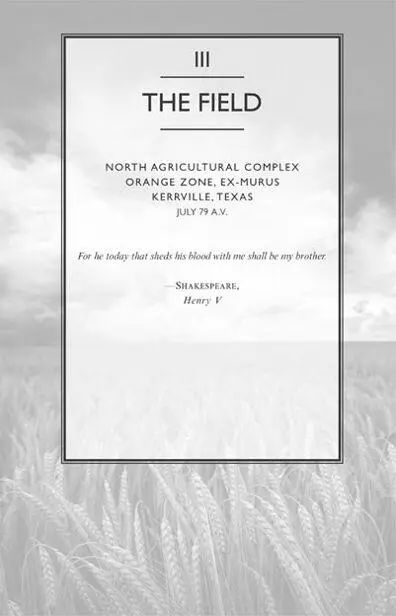
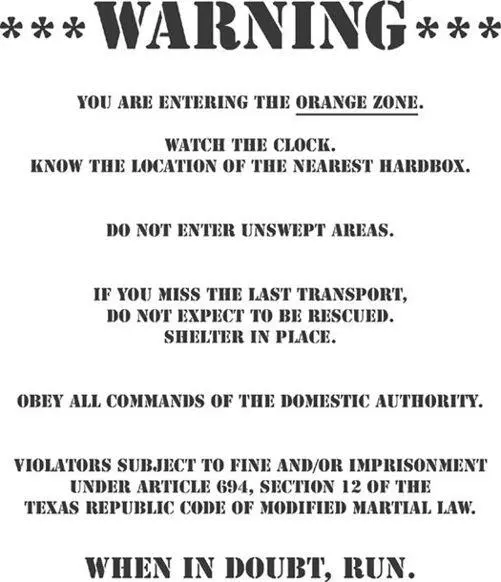
III. THE FIELD

23
It was Dee Vorhees who said she wanted to bring the children.
Though she was not the only one. All the women, as her husband, Curtis, was soon to discover, were in on the plan. Dee’s cousin Sally, and Mace Francis, and Shar Withers and Cece Cauley and Ali Dodd and even Matty Wright—the permanently nervous, twittering Matty Wright—told their husbands the same thing. A veritable ambush, the women flanking their men from left and right with a wifely insistence that could not be refused: A few hours in the sunshine , they all said, lying in bed or washing the dishes or readying the children for school. What’s the harm? Let’s bring the children this time .
And it wasn’t as if they hadn’t taken the girls ex-murus before, Dee reminded him, the two of them sharing a quiet moment in the kitchen after putting the girls to sleep. There was that time, she said—how long ago?—when they’d gone to Green Field for Nitia’s birthday. Little Siri just a toddler, Nitia still dragging that filthy blanket wherever she went. Those peaceful hours under the spillway, and the butterflies—did he remember? The way they seemed to float along an airborne river, their bright wings falling and pumping to rise again, and the one that, surprising them all, had alighted on Nitia’s nose. Dee said: Could you not feel God’s presence in a thing like that? The sweet, free feeling of it, the little girls laughing and laughing, the warning siren hours off, some distant future time, and the blue sky suspended like heaven itself above their heads and the four of them being ex-murus together. The Green Zone, it was true, she didn’t say it wasn’t, but they could see the perimeter from there, the watchtowers and the sentries and the fences with their curling razor wire, and who decided these things, anyway? Who decided where one zone ended and the next began? How was an outing to North Ag any different, any more dangerous, really? Cruk would be there, and Tifty as well (the name had popped out before she could stop herself, but what could you do?); there were the hardboxes if anything happened, but why would it? In the middle of a summer day? The traps had gone empty for months, not even any dopeys around. Everyone was saying so. A few hours in the sunshine, away from the gray and grime of the city. A summer picnic in the field. That was all she was asking.
Would he do it, this one thing? For the girls? But why not just come out and say it. Would he do it for her, the wife who loved him?
Which was how, two days later, on a sultry July morning, the temperature already rising through the eighties and headed for a hundred, Curtis Vorhees, age thirty-two, foreman of the North Agricultural Complex, his father’s old .38 tucked into his waistband with three rounds in the cylinder (his father had shot the other three), found himself on a transport full of whole families, and not just families: children. Nitia and Siri and their cousin Carson, just turned twelve but still so slight his feet dangled three inches above the floor; Bab and Dunk Withers, the twins; the Francis girls, Rena and Jules, seated at the rear so they wouldn’t have to pay attention to the boys; little Jenny Apgar, riding on her older brother Gunnar’s lap; Dean and Amelia Wright, the two of them old enough to act bored and put out; Merry Dodd and her baby brother, Satch, and little Louis Cauley, still in a basket; Reese Cuomo and Dash Martinez and Cindy-Sue Bodine. Seventeen in all, a concentrated mass of childlike heat and noise as distinct to Vorhees’s senses as a buzzing swarm of bees. It was common for the wives to join their husbands for planting, and of course at harvesttime, when every pair of hands found work to do; but this was something new. Even as the bus cleared the gate, its old diesel engine roaring and sputtering, its tired chassis swaying under them, Curtis Vorhees felt it. A hot, dull job had suddenly become an occasion; the day possessed the hopeful spirit of a tradition being born. Why hadn’t they thought of this before, that bringing the children would remake the day into something special?
Читать дальшеИнтервал:
Закладка:
Похожие книги на «The Twelve»
Представляем Вашему вниманию похожие книги на «The Twelve» списком для выбора. Мы отобрали схожую по названию и смыслу литературу в надежде предоставить читателям больше вариантов отыскать новые, интересные, ещё непрочитанные произведения.




Обсуждение, отзывы о книге «The Twelve» и просто собственные мнения читателей. Оставьте ваши комментарии, напишите, что Вы думаете о произведении, его смысле или главных героях. Укажите что конкретно понравилось, а что нет, и почему Вы так считаете.