Chris Ryan - Osama
Здесь есть возможность читать онлайн «Chris Ryan - Osama» весь текст электронной книги совершенно бесплатно (целиком полную версию без сокращений). В некоторых случаях можно слушать аудио, скачать через торрент в формате fb2 и присутствует краткое содержание. Город: London, Год выпуска: 2012, ISBN: 2012, Издательство: Coronet, Жанр: Триллер, Боевик, на английском языке. Описание произведения, (предисловие) а так же отзывы посетителей доступны на портале библиотеки ЛибКат.
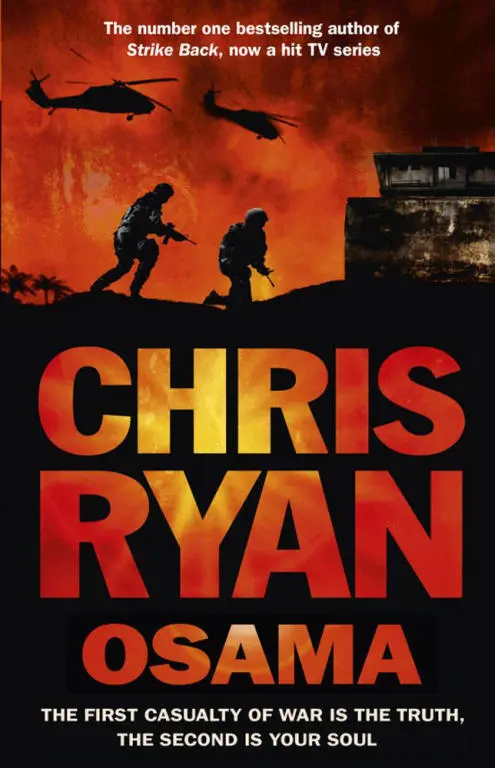
- Название:Osama
- Автор:
- Издательство:Coronet
- Жанр:
- Год:2012
- Город:London
- ISBN:9781444759952
- Рейтинг книги:5 / 5. Голосов: 1
-
Избранное:Добавить в избранное
- Отзывы:
-
Ваша оценка:
Osama: краткое содержание, описание и аннотация
Предлагаем к чтению аннотацию, описание, краткое содержание или предисловие (зависит от того, что написал сам автор книги «Osama»). Если вы не нашли необходимую информацию о книге — напишите в комментариях, мы постараемся отыскать её.
Bin Laden is dead.
The President of the United States knows it. The world knows it. And SAS hero Joe Mansfield knows it. He was on the ground in Pakistan when it happened. He saw Seal Team 6 go in, and he saw them extract with their grisly cargo. He was in the right place at the right time.
Or maybe, the wrong place at the wrong time.
Because now, somebody wants Joe dead, and they’re willing to do anything to make it happen. His world is violently dismantled. His family is targeted, his reputation destroyed. And as a mysterious and ruthless enemy plans a devastating terror attack on both sides of the Atlantic, Joe knows this: his only chance of survival is to find out what happened in Bin Laden’s compound the night the Americans went in.
But an unseen, menacing power has footprints it needs to cover. And it will stop at nothing to prevent him uncovering the sinister truth…
Osama — читать онлайн бесплатно полную книгу (весь текст) целиком
Ниже представлен текст книги, разбитый по страницам. Система сохранения места последней прочитанной страницы, позволяет с удобством читать онлайн бесплатно книгу «Osama», без необходимости каждый раз заново искать на чём Вы остановились. Поставьте закладку, и сможете в любой момент перейти на страницу, на которой закончили чтение.
Интервал:
Закладка:
Getting the boy out of the car was simple. Forcing him a kilometre cross-country was less so. He tripped and stumbled, falling helplessly to his knees on three occasions, and once flat on his face. Each time, the man pulled him up by his hair, thinking that the pain would make him stand more quickly. But the boy didn’t even seem to feel it. He said nothing. He didn’t complain, howl, or gasp. He just pushed himself slowly up and continued at his own pace.
It was four thirty by the time they reached the cliff’s edge. He pushed the boy to lie down and kicked his knee when he didn’t respond. But once he was down, prostrate on the cold ground, he didn’t move. He just shivered. The man eyed him suspiciously for a moment. It was all very well for Ashkani to believe that the kid was beyond causing problems, but he preferred to be sure. From his rucksack he pulled a length of rope. He tied the boy’s limp hands behind his back and bound his ankles together using the other end of the same piece. The boy didn’t struggle or complain.
The marksman turned his attention to the other contents of his rucksack. First, a satellite phone, which he laid on the ground next to him. Then his sniper rifle – a Galil .308 with a full magazine of tuned, match-grade rounds – which was separated into five sections. He could have slotted them together blindfolded – indeed, he had practised doing so many times in the past – so the darkness was not an obstacle for him. In less than a minute the rifle was assembled, its magazine of five 7.62mm rounds firmly clicked into place. He unfolded a small bipod, placed it on the edge of the bracken, and rested the barrel of the rifle on it. Lying on his front behind the weapon, he closed his left eye and looked through the sight.
It was still dark and the mist was thick, yet he could just make out the individual waves crashing onto the beach. He estimated the distance between his firing point and the sand at about 350 metres. Close enough for a swift, clean kill.
He looked over his shoulder. The boy was still lying on the ground. Still shivering. Still silent. It crossed his mind that he should kill him now, but Ashkani had been quite clear: the boy would only cease to be useful once his father was dead. The marksman looked at his watch. Four fifty-six: that gave the kid just over an hour to live.
0558 hours.
The gulls that had flocked on the flat, sandy beach had predicted the arrival of dawn. Their chorus had lasted for a full half-hour. There hadn’t been a particular moment when night had become morning. The sky had just grown almost imperceptibly lighter. The marksman lay very still, watching, waiting. There was a weak offshore wind. It blew the safety flag almost exactly in the marksman’s direction. He checked the direction of the spray, to make sure it matched up with the wind direction further from the ground. It did. He would wait until his target was positioned on a straight line between the rifle and the flag. It would make the shot more accurate because he would then not have to adjust for the altered trajectory of the round.
It was the gulls, too, that announced the arrival of the target. The marksman became aware of crowds of them flocking up from the sands at the northern end of the beach, shrouded by the mist and screeching loudly.
The figure came into view at 0600 hours exactly.
At first he was just a vague darkening of the mist 200 metres to the north, the shapeless form gradually developing a human frame as the gulls screeched and flew away from him. He was walking slowly, his head bowed, his hands stuck into the pockets of his hooded top. His frame was bulky – barrel-chested, almost – and although the hood he was wearing obscured his features, the marksman had the impression that his gait was slow and ponderous. Almost as if he knew he was walking to his death.
‘ Do not underestimate him, ’ Ashkani had said. The marksman didn’t. He examined every facet of the man’s movement. Something wasn’t right. Why was he not looking around? If he was here to see his son, why was he not searching for him?
Perhaps he was not so impressive as Ashkani had predicted.
Or perhaps he thought that if he sacrificed himself, his son would be set free. A foolish thought, but the marksman knew that, at times of stress, a person’s decision-making could lose clarity.
The figure continued to walk at a slow, steady pace. He was ten metres from the line of fire.
Five metres.
Three.
The marksman’s fingers brushed the cold metal of the trigger.
Two metres.
One.
The target stopped.
He turned round, peered out to sea and stood there immobile. Some of the gulls he had disturbed had settled on the sand again, and he was surrounded by them. The marksman experienced a moment of doubt. If this man was here to find his son, why was he not looking around? But he put that thought from his mind – Ashkani’s instructions had been very clear – and adjusted his line of fire by the fraction of a degree necessary to get the target in the centre of his sight. The edge of his body was slightly ill defined because of the mist, but he placed his cross-hairs over the centre of the target’s back: a location as deadly as the head, but broader and therefore easier to hit.
He heard a whimper from the boy: the first sound that had escaped his lips since the marksman had taken possession of him. It was almost as though he knew his father was about to die.
Which he was.
The marksman squeezed the trigger.
The retort of the rifle echoed over the vast expanse of sea and air. The gulls that had congregated on the sand flocked up into the sky with a single mind, and a sudden, frightened squawk.
And the target crumpled, instantly, to the ground.
The gunman watched the body. He didn’t know why. Something told him he should. Its head was pointing out to sea, and as the waves swelled towards the beach, the water lapped against it. A seagull settled on the body, and then another. To them, the corpse was clearly as still and solid as a rock.
The marksman lowered his gun. His fingers felt for the satellite phone at his side and, for the first time since arriving at the firing point, he rose to his feet. He stood a metre from the edge of the cliff, looking out to sea. Without the aid of the sight on his rifle, the body on the beach was just an indistinct lump. Further out, he could see the grey outline of an oil tanker. The breeze was a little stiffer now, and it blew his black hair away from his face as he called a number, which rang only once before it was answered.
‘Well?’ came Ashkani’s voice in Arabic.
‘It’s done.’
‘Good. See to the boy and do not contact me again.’
‘Wait!’
‘What is it?’
A pause.
‘ Allahu Akbar ,’ said the marksman.
‘ Allahu Akbar ,’ Ashkani replied.
The line went dead.
The marksman stared at the digital display for a brief moment. He thought of Ashkani. Thought of what he was about to do. ‘ You would not wish to deny the Lion his final roar? ’ he had said. No indeed. A picture rose in his mind: a thin, weak old man, wrapped in a blanket as he watched television in a shabby room in a compound far away in Pakistan. That was the image his killers wanted to present of the Sheikh al-Mujahid, but his last act would strike fear into the heart of the West.
Then he saw the briefest glint of something reflected in the screen.
He had no way of knowing what it was. No way of recognizing the checked lumberjack shirt or the expression of purest menace. And no way of defending himself as the figure marched relentlessly towards the edge of the cliff, his arm outstretched, a handgun in his fist as, having located the marksman, he strode close enough to ensure a single round from that weapon would serve its purpose.
Читать дальшеИнтервал:
Закладка:
Похожие книги на «Osama»
Представляем Вашему вниманию похожие книги на «Osama» списком для выбора. Мы отобрали схожую по названию и смыслу литературу в надежде предоставить читателям больше вариантов отыскать новые, интересные, ещё непрочитанные произведения.





Обсуждение, отзывы о книге «Osama» и просто собственные мнения читателей. Оставьте ваши комментарии, напишите, что Вы думаете о произведении, его смысле или главных героях. Укажите что конкретно понравилось, а что нет, и почему Вы так считаете.