Alan Evans - Thunder at Dawn
Здесь есть возможность читать онлайн «Alan Evans - Thunder at Dawn» весь текст электронной книги совершенно бесплатно (целиком полную версию без сокращений). В некоторых случаях можно слушать аудио, скачать через торрент в формате fb2 и присутствует краткое содержание. Год выпуска: 2013, ISBN: 2013, Издательство: Endeavour Press, Жанр: Триллер, prose_military, на английском языке. Описание произведения, (предисловие) а так же отзывы посетителей доступны на портале библиотеки ЛибКат.
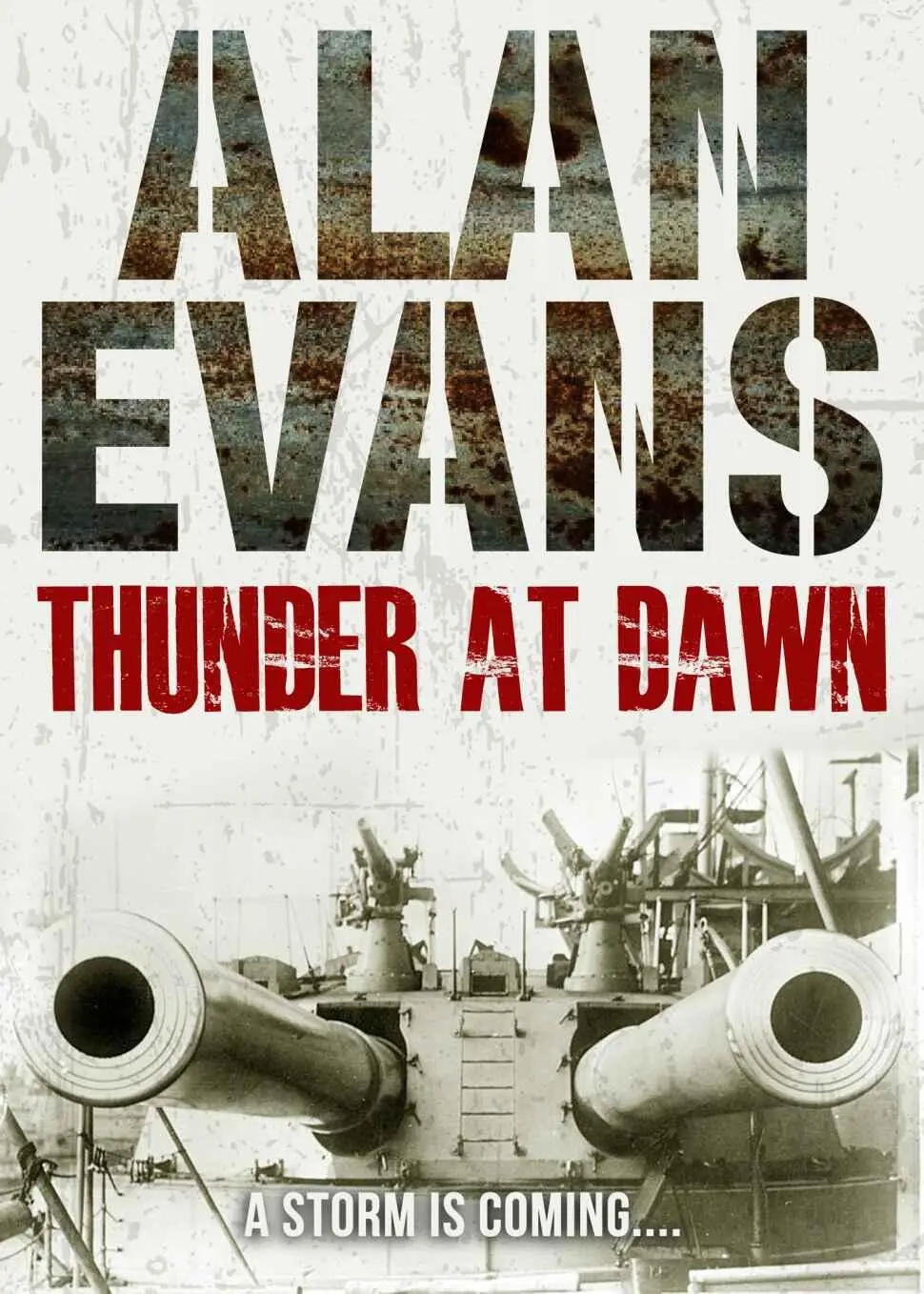
- Название:Thunder at Dawn
- Автор:
- Издательство:Endeavour Press
- Жанр:
- Год:2013
- ISBN:9780755105731
- Рейтинг книги:3 / 5. Голосов: 1
-
Избранное:Добавить в избранное
- Отзывы:
-
Ваша оценка:
Thunder at Dawn: краткое содержание, описание и аннотация
Предлагаем к чтению аннотацию, описание, краткое содержание или предисловие (зависит от того, что написал сам автор книги «Thunder at Dawn»). Если вы не нашли необходимую информацию о книге — напишите в комментариях, мы постараемся отыскать её.
After three years, the outcome of the Great War is poised on a knife-edge. One man believes he can make a difference. David Cochrane Smith, the captain of the armoured cruiser HMS Thunder, is patrolling off the coast of South America. He has attacked and sunk the Gerda, a neutral ship in a neutral port. He is labelled as mad man. Smith already has a reputation as a maverick. Now he faces professional ruin as he is called to account for the sinking. But he is certain he was right. He is sure the Gerda was one of two ships masquerading under neutral flags that are in fact supply ships for the German warships, Kondor and Wolf. These two superbly equipped German warships threaten to annihilate British shipping on the Pacific seaboard. Only an outdated cruiser and a young captain who is prepared to break all the rules stand in their way… As the battle draws to a climax, the battered HMS Thunder will be facing trials fiercer and more terrifying than any yet witnessed at sea.
‘
’ is an edge-of-the-seat WWI naval adventure that combines thrilling story-telling with meticulous research.
Alan Evans is a thriller writer known for vividly recreating the atmosphere of the First World War. His other titles include ‘
’, ‘
’ and ‘
’.
Endeavour Press is the UK's leading independent publisher of digital books. “I think a 21 gun salute is required… Alan Evans has produced a cracking thriller”
The Daily Mirror “Evans provides a different sea story, sustained suspense and vivid battle scenes”
Publishers Weekly
Thunder at Dawn — читать онлайн бесплатно полную книгу (весь текст) целиком
Ниже представлен текст книги, разбитый по страницам. Система сохранения места последней прочитанной страницы, позволяет с удобством читать онлайн бесплатно книгу «Thunder at Dawn», без необходимости каждый раз заново искать на чём Вы остановились. Поставьте закладку, и сможете в любой момент перейти на страницу, на которой закончили чтение.
Интервал:
Закладка:
Gibb had nothing to hit. The curtain lifted and he was first aware of pain in his hands. He lifted them and saw the knuckles skinned and oozing tiny beads of blood. He put them to his mouth, sucking, and then he saw Rattray. He stared, with the thick, sick, salt of his own blood in his mouth, retched and ran blindly from the turret.
He stumbled aft along the boat-deck away from the light and the milling crowd of labouring men forward. But another crowd worked aft and he swung away and brought up against the rails, staring at the lights of Guaya.
Rattray was dead and Gibb had killed him.
Voices shouted hoarsely in the clamour forward, sounding like a pack at his heels but the water moved oily black below him. He went over the rail and dived. He would have dived from the masthead if he had to.
There was a crowd on the waterfront staring at Thunder out in the pool so he had to swim a long way downriver before he could drag himself out of the water without being seen. He was an excellent swimmer. He skulked across the quay and into the shelter of an alley, found a dark corner and collapsed there. The water ran off him. He sat with his knees curled tight under his chin and shuddered spasmodically.
Now at least he had quiet but he knew he had to have shelter, to get away from prying eyes. He had never been in Fizzy’s out-of-bounds Bar but he knew where it was. He made his way through the alleys until he found the rear of Fizzy’s Bar and climbed the wall to drop down into the urinal. From there he went to the back of the house and tapped at the first window he came to. He was lucky, a girl was in the room but alone. She was patting powder on her face when he rapped at the window and she pulled back the curtain and stared at him, a hand to her mouth. Then came recognition that he was a seaman and she smiled.
She opened the window and he climbed in. She threw up her hands in horror at his condition and rattled a spate of Spanish at him. His legs gave way under him and he sank down on the bed. He held up a hand weakly to stem the flow and said, “Tomorrow. Yes? Tomorrow.” And laid head on his hands, miming sleep. She nodded and held out her hand. He fumbled his money from his belt and she took it all. He said, “No tell. No one.” And put finger to his lips.
She nodded again and repeated his gesture.
He stripped to the skin, folded his sodden clothes carefully and laid them on a chair. The girl reached out to him but he shook his head. He would not look at her. He got into the bed and pulled the covers over his head.
The girl peered at him, puzzled, then shrugged, hid the money, undressed and blew out the lamp. She climbed into bed, shoving him over and in minutes she was asleep. It was not until dawn that he sank into an uneasy doze.
XI
Aboard Thunder the work went on through the night and into the day, the crew working watch and watch. At Smith’s orders he was called when the watch was changed and inspected the work and talked with the men.
Garrick reported unhappily, “Able Seaman Rattray and Ordinary Seaman Gibb are missing from this working party, sir. They could have gone over the side. Gibb is a very good swimmer.”
Smith bit his lip. He did not want to believe it. “Together? They don’t sound a likely pair.”
“No, sir. That’s a fact.”
“Well, make a search but quietly. I don’t want this blown up.” There could be others who might find desertion preferable to facing the cruisers. God knew he could sympathise but he had a duty and so had his crew.
“Master-at-Arms is looking about, sir.”
Hobbs, the Master-at-Arms on his rounds spotted the open door of the turret and shoved in his bullet head. “Anybody working in here?”
The ship’s Corporal with him said, “Somebody over there.”
They entered the turret and then they saw Rattray properly. For one horrified moment they stared, then the Corporal, who had seen the bloody debris of bar-fights from Chatham to China, said in a hushed whisper, “Gawd Amighty!”
Somewhere along the way in that mad quarter-minute Rattray’s head had caught the breech of the gun and the laceration streamed blood that covered his face. His nose also bled so that at first they did not know him but then they went quickly to him and the Corporal said, “It’s Rattray.”
Rattray had a reputation as a brawler but not as a victim. The Master-at-Arms summed it up. “Well, I’ll be buggered.”
They started to lift Rattray and he recovered bleary consciousness so they stood him on wobbly legs. Hobbs asked, “Seen anything of young Gibb?”
Rattray blinked, muttered, “No. Never seen him.”
Hobbs looked thoughtful, but shrugged. They walked him, shambling and stupid, down to the sick-bay, where Purkiss peered at him and said, awed, “What happened to him?”
“Don’t ask me. I just found him,” Hobbs replied comfortably. “Can you fix him up?”
“Somebody’s already done it.”
“You know what I mean. Return him to duty.”
“Let’s have a look.” His examination was thorough but rapid and unsympathetic. He cleaned, and anointed where necessary, bandaged the torn scalp. “There y’are. Good as new. Who done it?” He started to wash his hands.
Hobbs said, “Gawd knows.” The Corporal thought that, leaving God aside, two of them could make out a bloody good list of probables. He kept his mouth shut. Hobbs nodded at Rattray. “You can ask him, but o’course he won’t split in case that big feller, whoever he is, gets ahold of him again.”
Rattray glared balefully from the one eye still open, climbed stiffly from the stool to his feet and limped out.
Purkiss said, “Strictly speaking I ought to make a report.”
“’Course you should.” Hobbs nodded. “Same as me. But times like these, when I’m busy, I sometimes forget.”
The Corporal thought, ‘You bleeding liar. Memory like an elephant.’
Purkiss also nodded. “I’m rushed off my feet just now.” He glanced around at the sick-bay that presented a picture of utter calm.
“I can see.” Hobbs started to leave. “Sorry to have troubled you when you’re that busy.”
“No trouble,” Purkiss replied, “no trouble at all.” He was whistling happily as they left.
The attempted deception was a waste of time because Rattray had already met Albrecht, who stared at him. “What happened to you?”
“Accident, sir. Fell down in the fore-turret.”
Rattray’s thinking was still sluggish and it took him a second or two to realise what he had said but Albrecht did not question the fatuous excuse; Rattray could have fallen a dozen times in the fore-turret and sustained fewer injuries.
Albrecht said only, “Very well.” And it was some time later before Rattray thought there might be some ambiguity in that simple remark.
In the sick-bay Albrecht glanced at the log, innocent of mention of Rattray — and said nothing.
Smith was at his desk before dawn. There was a letter to be written to Graham’s widow, another to Somers’s parents. They took him a long time. Then he wrote his report, adding his commendations of Garrick for the gunnery, and Somers. He was uncomfortable in full dress now with his cap and sword on the desk because later he had a formal duty.
As he finished he thought cynically that it would bring none of them honour or glory. It was a bald recital of a ship that had run for cover, been hit only twice and suffered but a single casualty — a decidedly unspectacular affair to the reader. It did not mention that every man aboard and many ashore thought he had performed a miracle, for the simple reason that he did not know it. But he would not have said so anyway.
He thought the next report would be a very different matter but he would not be writing it. He wondered what those men of his would think of him then, if any of them survived. They would know he had failed them. They followed him and asked for nothing but they were entitled to a fighting chance and they would not get it.
Читать дальшеИнтервал:
Закладка:
Похожие книги на «Thunder at Dawn»
Представляем Вашему вниманию похожие книги на «Thunder at Dawn» списком для выбора. Мы отобрали схожую по названию и смыслу литературу в надежде предоставить читателям больше вариантов отыскать новые, интересные, ещё непрочитанные произведения.










Обсуждение, отзывы о книге «Thunder at Dawn» и просто собственные мнения читателей. Оставьте ваши комментарии, напишите, что Вы думаете о произведении, его смысле или главных героях. Укажите что конкретно понравилось, а что нет, и почему Вы так считаете.