Alan Evans - Thunder at Dawn
Здесь есть возможность читать онлайн «Alan Evans - Thunder at Dawn» весь текст электронной книги совершенно бесплатно (целиком полную версию без сокращений). В некоторых случаях можно слушать аудио, скачать через торрент в формате fb2 и присутствует краткое содержание. Год выпуска: 2013, ISBN: 2013, Издательство: Endeavour Press, Жанр: Триллер, prose_military, на английском языке. Описание произведения, (предисловие) а так же отзывы посетителей доступны на портале библиотеки ЛибКат.
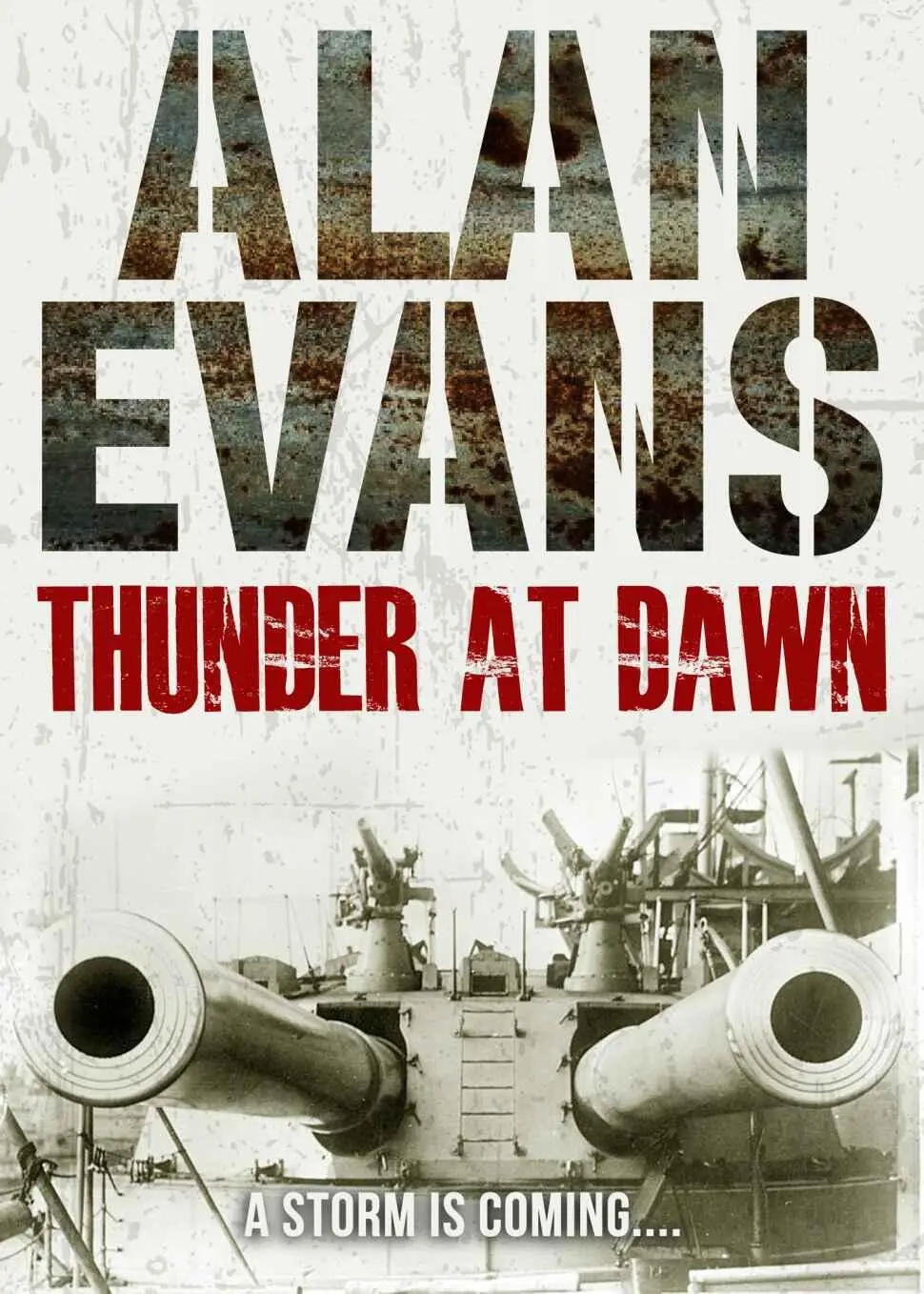
- Название:Thunder at Dawn
- Автор:
- Издательство:Endeavour Press
- Жанр:
- Год:2013
- ISBN:9780755105731
- Рейтинг книги:3 / 5. Голосов: 1
-
Избранное:Добавить в избранное
- Отзывы:
-
Ваша оценка:
Thunder at Dawn: краткое содержание, описание и аннотация
Предлагаем к чтению аннотацию, описание, краткое содержание или предисловие (зависит от того, что написал сам автор книги «Thunder at Dawn»). Если вы не нашли необходимую информацию о книге — напишите в комментариях, мы постараемся отыскать её.
After three years, the outcome of the Great War is poised on a knife-edge. One man believes he can make a difference. David Cochrane Smith, the captain of the armoured cruiser HMS Thunder, is patrolling off the coast of South America. He has attacked and sunk the Gerda, a neutral ship in a neutral port. He is labelled as mad man. Smith already has a reputation as a maverick. Now he faces professional ruin as he is called to account for the sinking. But he is certain he was right. He is sure the Gerda was one of two ships masquerading under neutral flags that are in fact supply ships for the German warships, Kondor and Wolf. These two superbly equipped German warships threaten to annihilate British shipping on the Pacific seaboard. Only an outdated cruiser and a young captain who is prepared to break all the rules stand in their way… As the battle draws to a climax, the battered HMS Thunder will be facing trials fiercer and more terrifying than any yet witnessed at sea.
‘
’ is an edge-of-the-seat WWI naval adventure that combines thrilling story-telling with meticulous research.
Alan Evans is a thriller writer known for vividly recreating the atmosphere of the First World War. His other titles include ‘
’, ‘
’ and ‘
’.
Endeavour Press is the UK's leading independent publisher of digital books. “I think a 21 gun salute is required… Alan Evans has produced a cracking thriller”
The Daily Mirror “Evans provides a different sea story, sustained suspense and vivid battle scenes”
Publishers Weekly
Thunder at Dawn — читать онлайн бесплатно полную книгу (весь текст) целиком
Ниже представлен текст книги, разбитый по страницам. Система сохранения места последней прочитанной страницы, позволяет с удобством читать онлайн бесплатно книгу «Thunder at Dawn», без необходимости каждый раз заново искать на чём Вы остановились. Поставьте закладку, и сможете в любой момент перейти на страницу, на которой закончили чтение.
Интервал:
Закладка:
Smith shook his head. “Not them. Exhilarated, yes, like our chaps are, but for slightly different reasons. Their commander will be annoyed that he did not sink us. But not gloating. They are brave, determined men. They know that they can never get home, that at the end of the day they will be hunted down and destroyed. That makes them even more dangerous. There can be no turning back for them.”
“And us?”
“Nothing has changed, Doctor.”
Albrecht stared after his retreating back. Nothing changed? They were no longer discussing hypothetical situations: if the cruisers existed, if they appeared.
Thunder was caught in Guaya like a rat in a trap.
Smith returned to the deck. Thunder cruised steadily up the deep-water channel past the little scatters of lights that marked villages. The ship was not darkened now. Garrick had lights rigged forward and aft and men milled in urgent, disciplined confusion. He encountered Wakely. “I want the fires lit in the pinnace, Mr. Wakely, ready to put her in the water as soon as we anchor.”
“Already seen to that, sir. Manton thought you might want the puncher.”
“Good.”
Both forward and aft the damage was at first sight horrendous, as it always was, as it might be expected from the blows of eight-inch projectiles of two-hundred-and-forty pounds apiece. Forward a hole gaped in the deck and below it the mess-deck was a devastated area, filthy with soot from the fire, dripping with water. Aft a huge bite had been taken out of deck and side. There was a great deal of work to be done, most of it ultimately dockyard work, but there was nothing that could not be patched by Thunder’s crew well enough to render her a fully effective unit, appearances not withstanding. He found the work well in hand, which he had a right to expect, but when he ran into Garrick he made a point of saying, clearly and loudly, with a score of men in earshot: “Very good, Number One. The ship’s company have behaved in very satisfactory fashion.” It sounded pompous to Smith as he said it but it could not be called back and Garrick seemed pleased, as did the men who listened.
He passed Somers’s gun, saw the door of the casemate hooked open and inside a section of the deck that had recently been washed down and sprinkled with sand.
Garrick said, “Chaps are in good spirits, sir.”
Smith nodded. He was keenly aware of it, had been watching them, catching at the tone of a voice, the quick reaction to orders, the general air of them. They were working hard and cheerfully. Joking. There was occasional laughter, some of it a little high-pitched, still excited, but laughter.
Then they rounded the turn in the channel and opened the port and the pool. Smith took his ship into port and to her anchorage, performing the evolution neatly with his usual insistence that a job be well done, but with only a part of his mind. He was preoccupied with the thought that his ship was not welcome here. A reminder was there in the way the masts of the Gerda poked out of the water at an angle where she had settled on her side on the bottom. They would be attacked, not with crude force but certainly in diplomatic terms.
He was not inclined to wait for that attack. So that as Thunder anchored, the telegraph rang ‘stop engines’, and the derrick yanked the pinnace up and over the side, he said, “I’m going ashore.”
“Yes, sir,” replied Garrick, then asked, “Do you think they’ll follow us in?”
Midshipman Vincent was on the bridge. Smith saw his startled glance and grinned. “Hadn’t thought of that? They have as much right to come in as we have.” He thought: And may well be more welcome. Then he said definitely, “But they won’t.” He did not explain.
Garrick followed him down to the entry port. “You’re going alone, sir? Do you want Knight as interpreter?”
“No.” Smith did not explain that, either, but the Port Captain would make his feelings clear enough without an interpreter and it would be unpleasant so he would go alone.
It was night, now. Darkness clothed and hid the hills but the town twinkled with a thousand yellow cats-eyes of lit windows. Half-a-dozen ships lay in the pool but Kansas loomed over them all. They were strung with lights, their decks crowded. The picket-boat, at Smith’s order headed for the quay above which lay the house of the Port Captain. The quay was lit by one big lamp and he could see a crowd there, too. He stood quiet, still, alongside Wakely who had the helm.
The cruisers waited for him outside and there would be no help from the battle-cruiser, no help from anyone. His choice was to fight them or be interned. Suicide or surrender.
He had coal for only twenty-four hours’ steaming.
They ran in on the quay. Two boats already lay there, tied-up clear of the steps. One belonged to the Chilean Admiral, the other to Kansas. Thunder’s pinnace slipped between them and Smith climbed the steps. At their head he found the crowd and in the forefront stood a little party. There were several women, all in evening dress, hair piled, bejewelled, gaudy as parakeets against the men. They were also in evening dress or full-dress uniform, black or navy-blue. The Chilean Admiral and the American, Donoghue. And Donoghue’s Flag-Captain and two young men who were obviously the respective Chilean and American FlagLieutenants. All of them glittered with decorations.
He saluted and smiled at them all. “Good evening. I seem to have interrupted a party. I’m sorry.” Like every other man in Thunder , soot streaked his face and his eyes were red-rimmed and stared. He presented a startling contrast to the group he faced.
Encalada, the Port Captain, fluent in English, almost choked at that opening remark. The Chilean Admiral had not understood a word but he scowled at Smith nevertheless. For a moment Encalada was bereft of speech and the American Flag-Lieutenant slipped into the gap. “If I may be permitted, sir, I have some knowledge of Spanish.”
His Spanish was excellent and he made the introductions. One of the party was Herr Doktor Muller, the German Consul, tall and stiff, bald and hook-nosed. The Flag-Lieutenant rolled off the titles in English and Spanish spectacularly: “Contra Almirante Gualcalda, the Navy of Chile, RearAdmiral Donoghue, United States Navy, Captain Encalada …”
Smith thought he had done his homework.
The Flag-Lieutenant came to the end of the titles and the ranks, the long, aristocratic-sounding names. Then he stumbled, “And Commander —” Only then he realised he did not know the name.
Smith supplied it for him, tersely. “Smith.”
And Donoghue remarked on that contrast, too, and grinned to himself. He said, “You didn’t exactly interrupt. We were having dinner when we heard the firing, but in the tradition of Drake we finished the meal. Then we came down to see what we could.” His eyes moved from Smith to Thunder lying in a circle of light out in the pool, aswarm with men. Through the hole torn in her side he could see the men labouring, tiny figures inside the smashed and mangled interior. His eyes moved back to Smith.
One more contrast. Donoghue was tall and broadshouldered, deep-chested, strongly handsome. An aristocrat. He could trace his family back three hundred years to a house in New England and before that to a castle in Ireland. It was a family that had always held rank, in the last hundred years it had enjoyed rank and privilege and wealth. It was now considerable wealth.
Smith had nothing but his pay. No family.
Donoghue saw a slight, young man, too thin, the face drawn. He cut a frail and lonely figure as he faced them all. And yet — there was something about the man, a restlessness, an energy that could be sensed even now when he stood unmoving.
Читать дальшеИнтервал:
Закладка:
Похожие книги на «Thunder at Dawn»
Представляем Вашему вниманию похожие книги на «Thunder at Dawn» списком для выбора. Мы отобрали схожую по названию и смыслу литературу в надежде предоставить читателям больше вариантов отыскать новые, интересные, ещё непрочитанные произведения.










Обсуждение, отзывы о книге «Thunder at Dawn» и просто собственные мнения читателей. Оставьте ваши комментарии, напишите, что Вы думаете о произведении, его смысле или главных героях. Укажите что конкретно понравилось, а что нет, и почему Вы так считаете.