Ross MACDONALD - The Underground Man
Здесь есть возможность читать онлайн «Ross MACDONALD - The Underground Man» весь текст электронной книги совершенно бесплатно (целиком полную версию без сокращений). В некоторых случаях можно слушать аудио, скачать через торрент в формате fb2 и присутствует краткое содержание. Год выпуска: 1971, ISBN: 1971, Издательство: Warner Books, Жанр: Крутой детектив, на английском языке. Описание произведения, (предисловие) а так же отзывы посетителей доступны на портале библиотеки ЛибКат.
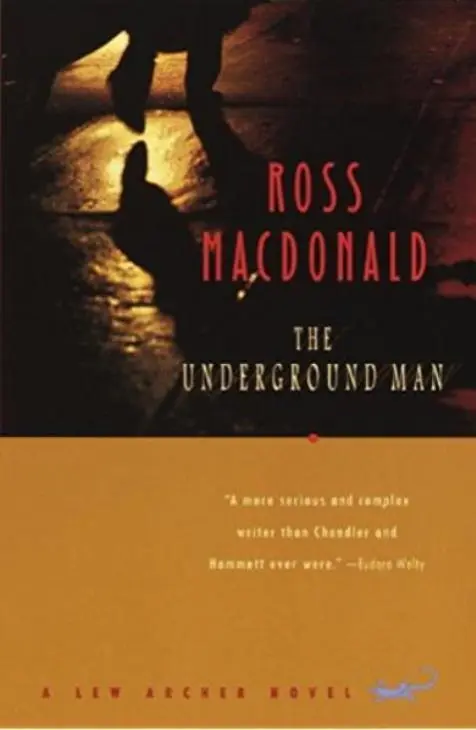
- Название:The Underground Man
- Автор:
- Издательство:Warner Books
- Жанр:
- Год:1971
- ISBN:9780446359016
- Рейтинг книги:3 / 5. Голосов: 1
-
Избранное:Добавить в избранное
- Отзывы:
-
Ваша оценка:
The Underground Man: краткое содержание, описание и аннотация
Предлагаем к чтению аннотацию, описание, краткое содержание или предисловие (зависит от того, что написал сам автор книги «The Underground Man»). Если вы не нашли необходимую информацию о книге — напишите в комментариях, мы постараемся отыскать её.
is a detective novel of merciless suspense and tragic depth, with an unfaltering insight into the moral ambiguities at the heart of California's version of the American dream.
If any writer can be said to have inherited the mantle of Dashiell Hammet and Raymond Chandler, it was Ross Macdonald. Between the late 1940s and his death in 1983, he gave the American crime novel a psychological depth and moral complexity that his predecessors had only hinted at. And in the character of Lew Archer, Macdonald redefined the private eye as a roving conscience who walks the treacherous frontier between criminal guilt and human sin.
.
The Underground Man — читать онлайн бесплатно полную книгу (весь текст) целиком
Ниже представлен текст книги, разбитый по страницам. Система сохранения места последней прочитанной страницы, позволяет с удобством читать онлайн бесплатно книгу «The Underground Man», без необходимости каждый раз заново искать на чём Вы остановились. Поставьте закладку, и сможете в любой момент перейти на страницу, на которой закончили чтение.
Интервал:
Закладка:
“I’m afraid that I can’t help you. I wasn’t there.”
“Your husband was, Mrs. Broadhurst.”
The cords in her neck pulled her head around. “How can you possibly know that?”
“He never left the place. He was shot and buried there. We dug him up this afternoon.”
“I see.” She didn’t tell me what she saw, but it seemed to make her eyes grimmer and smaller. The bones in her face became more prominent as if in imitation of the dead man’s. “It’s over then.”
“Not entirely.”
“It is for me. You’re telling me that both my men are dead – my husband and my son. You’re telling me that I’ve lost everything I held dear.”
She was struggling to assume a tragic role, but there was a doubleness in her which spoiled her resonance. Her words sounded exaggerated and hollow. I was reminded of the ambivalent words that she had written about her father, staggering across the yellow foolscap toward the edge of breakdown.
“I think you’ve known that your husband was dead and buried for fifteen years.”
“That simply isn’t true.” But the doubleness persisted in her voice as if she was listening to herself read lines. “I warn you, if you make this accusation publicly–”
“We’re very private, Mrs. Broadhurst. You don’t have to put on a front with me. I know you quarreled with your husband that night and followed him up the mountain afterwards.”
“How can you know that if it isn’t so?” She was playing a game that guilty people play, questioning the questioner, trying to convert the truth into a shuttlecock that could be batted back and forth and eventually lost. “Where did you get this alleged information, anyway? From Susan Crandall?”
“Part of it.”
“She’s scarcely a reliable witness. I gather from what you’ve told me that she’s emotionally disturbed. And she couldn’t have been more than three or four at the time. The whole thing must be fantasy on her part.”
“Three-year-olds have memories, and they can see and hear. I have pretty good evidence that she was in the Mountain House, and saw or heard the shot. Her story jibes with other things I know. It also helps to explain her emotional trouble.”
“You admit that she’s disturbed?”
“She has a hangup. Speaking of hangups, I wonder if Stanley didn’t witness the shot, too.”
“No! He couldn’t have.” She drew in her breath audibly, as if she was trying to suck back the words.
“How do you know if you weren’t there?”
“I was at home with Stanley.”
“I don’t think so. I think he followed you up there and heard his father shot, and for the rest of his life he tried to forget it. Or prove that it was just a bad dream he had.”
She had been talking like an advocate who doubted his client’s innocence. Now she gave up on it. “What do you want from me? Money? I’ve been bled white.” She paused, and looked at me with despairing eyes. “Don’t tell Jean I have nothing left. I’d never see Ronny again.”
I thought she was wrong, but I didn’t argue. “Who bled you, Mrs. Broadhurst?”
“I have no wish to discuss it.”
I picked up Brian Kilpatrick’s card from the dresser and let her see it. “If someone has been extorting money from you, you have a chance to stop it now.”
“I said I don’t want to discuss it. There’s no one I can trust. There never has been since my father died.”
“You want it to go on?”
She gave me a closed bitter look. “I don’t want anything to go on. Not my life or anything. Certainly not this conversation. This inquisition.”
“I’m not enjoying it much myself.”
“Then go away. I can’t stand any more.”
She grasped the arms of the chair so that her knuckles whitened, and stood up. The action somehow forced me out of the room.
I wasn’t ready to face the dead man right away. I found the door to the fire stairs and started down to the ground floor, taking my time about it. The concrete stairs with their gray steel railings, set in a windowless concrete stairwell, were like part of a prison structure, ugly and just about indestructible. I paused on a landing halfway down and tried to imagine Mrs. Broadhurst in prison.
When I returned the boy Ronny to his mother, I had really accomplished what I set out to do. The business left unfinished was bound to be painful and nasty. I had no overriding desire to pin her husband’s murder on Mrs. Broadhurst.
The hot breath of vengeance was growing cold in my nostrils as I grew older. I had more concern for a kind of economy in life that would help to preserve the things that were worth preserving. No doubt Leo Broadhurst had been worth preserving – any man, or any woman, was – but he had been killed in anger long ago. I doubted that a jury in the present would find his widow guilty of anything worse than manslaughter.
As for the other homicides, it was unlikely that Mrs. Broadhurst had had a reason to kill her son or an opportunity to kill Albert Sweetner. I told myself I didn’t care who killed them. But I cared. There was a winding symmetry in the case that like the stairs themselves took me down to the sickly green corridor where Dr. Silcox consulted his dead witnesses.
I went through the office and opened the steel-sheathed mortuary door. What was left of Leo Broadhurst lay under a bright light on a stainless steel table. Silcox was probing at the skull. Its fine curve was the only remaining sign that Leo had been a handsome man in his day.
Kelsey and Purvis, the deputy coroner, were standing in the penumbra against the wall. I moved past them toward the table.
“Was he shot?”
Silcox looked up from his work. “Yes. I found this.”
He picked up a lead slug and displayed it on the palm of his hand. It looked like a misshapen .22 long. “Where did it pierce the skull?”
“I’m not sure it did. All I can find is a minor external crease which hardly could have been fatal.” With the bright point of his probe, he showed me the faint groove the bullet had made in the front of Broadhurst’s skull.
“What killed him then?”
“This.”
He showed me a discolored triangle which rang on the table when he dropped it. For a moment I thought it was an Indian arrowhead. Then I picked it up and saw that it was the broken-off tip of a butcher knife.
“It was lodged in the ribs,” the doctor said. “Evidently the tip of the knife snapped off when the knife was pulled out.”
“Was he stabbed from the back or the front?”
“The front, I’d say.”
“Could a woman have done it?”
“I don’t see why not. What do you think, Purvis?”
The young deputy detached himself from the shadows and stepped forward between me and Dr. Silcox. “I think we better talk it over in private.” He turned to me. “I hate to be a spoilsport, Mr. Archer, but you’ve got no right in here. You saw the sign on the door: ‘Authorized Personnel Only.’ And you’re not authorized.”
I thought perhaps it was just a young man’s officiousness. “I am if you authorize me.”
“I can’t do that.”
“Who says so?”
“The sheriff-coroner gives me my orders.”
“Who gives him his orders?”
The young man flushed. His face looked porous and purplish in the raw light. “You better get out of here, mister.”
I looked past him at Kelsey, who seemed embarrassed. I said to both of them:
“Hell, I located this body.”
“But you’re not authorized personnel.”
Purvis put his hand on the butt of his gun. I didn’t know him well and didn’t trust him not to shoot me. I left with anger and disappointment running hot and sour in my veins.
Kelsey followed me out into the corridor. “I’m sorry about this, Archer.”
Читать дальшеИнтервал:
Закладка:
Похожие книги на «The Underground Man»
Представляем Вашему вниманию похожие книги на «The Underground Man» списком для выбора. Мы отобрали схожую по названию и смыслу литературу в надежде предоставить читателям больше вариантов отыскать новые, интересные, ещё непрочитанные произведения.




Обсуждение, отзывы о книге «The Underground Man» и просто собственные мнения читателей. Оставьте ваши комментарии, напишите, что Вы думаете о произведении, его смысле или главных героях. Укажите что конкретно понравилось, а что нет, и почему Вы так считаете.