The Medieval Murderers - The Deadliest Sin
Здесь есть возможность читать онлайн «The Medieval Murderers - The Deadliest Sin» весь текст электронной книги совершенно бесплатно (целиком полную версию без сокращений). В некоторых случаях можно слушать аудио, скачать через торрент в формате fb2 и присутствует краткое содержание. Жанр: Исторический детектив, на английском языке. Описание произведения, (предисловие) а так же отзывы посетителей доступны на портале библиотеки ЛибКат.
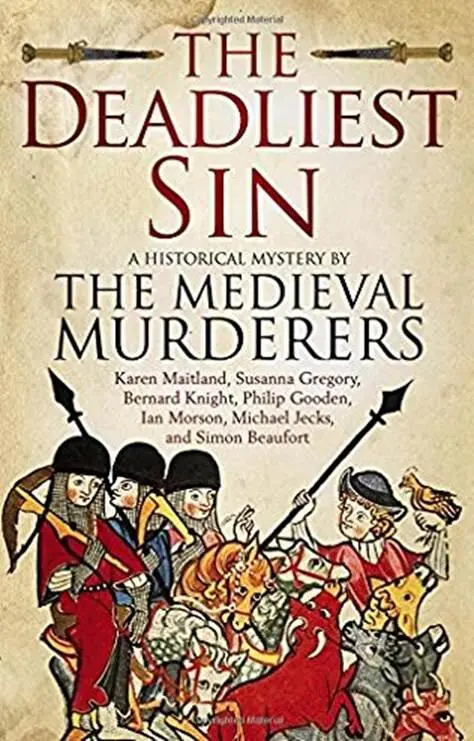
- Название:The Deadliest Sin
- Автор:
- Жанр:
- Год:неизвестен
- ISBN:нет данных
- Рейтинг книги:5 / 5. Голосов: 1
-
Избранное:Добавить в избранное
- Отзывы:
-
Ваша оценка:
The Deadliest Sin: краткое содержание, описание и аннотация
Предлагаем к чтению аннотацию, описание, краткое содержание или предисловие (зависит от того, что написал сам автор книги «The Deadliest Sin»). Если вы не нашли необходимую информацию о книге — напишите в комментариях, мы постараемся отыскать её.
And then there are those who hope that God's wrath might be averted by going on a pilgrimage. But if God was permitting his people to be punished by this plague, then it surely could only be because they had committed terrible sins?
So when a group of pilgrims are forced to seek shelter at an inn, their host suggests that the guests should tell their tales. He dares them to tell their stories of sin, so that it might emerge which one is the best.That is, the worst…
The Deadliest Sin — читать онлайн бесплатно полную книгу (весь текст) целиком
Ниже представлен текст книги, разбитый по страницам. Система сохранения места последней прочитанной страницы, позволяет с удобством читать онлайн бесплатно книгу «The Deadliest Sin», без необходимости каждый раз заново искать на чём Вы остановились. Поставьте закладку, и сможете в любой момент перейти на страницу, на которой закончили чтение.
Интервал:
Закладка:
Fat Humphrey de Cockville slurped his ale, wiped his thick lips and sneered at their concern.
‘What of it? It’s nothing to do with us, unless one of you two has been lacing his victuals with deadly nightshade!’
Blundus scowled at him. ‘Robert Giffard was a good, upright man – and a good physician. We are his only professional colleagues in the county, we cannot just ignore his passing.’
Humphrey leered at the others. ‘Then we will all attend his funeral and shed reptile’s tears – before rushing off and stealing his rich patients.’
‘That’s what concerns me,’ said Erasmus, in a voice loaded with worry. ‘Why should anyone murder a doctor, unless there was something to be gained? Suspicion must fall upon us, sooner or later.’
William Blundus, looking more stooped and emaciated than usual, grunted a disclaimer. ‘I know I’m innocent of anything, so what’s the problem? If one of you sent Giffard to his death, that’s your look-out, but I’m not feared of any probing by the law.’
‘Of course none of us did!’ snapped Humphrey, impatiently. ‘But are you so naïve as to think that the arrogant bastards that run this city care about justice? Giffard was so popular and useful to them and their families, that they need to find a scapegoat and to hell with any firm evidence!’
They pondered this, as they drank some of their ale, Humphrey motioning to the skivvy to bring another jug.
‘So what do we need to do?’ asked Blundus, looking to Erasmus Crote as the eldest of them and presumably the wisest.
‘What can we do, other than sit tight and play the innocents – which is what we are?’ grunted Erasmus.
Humphrey had other ideas. ‘We need to go down to the Giffard house and pay our condolences to the widow – and discover what’s going to be done about his patients,’ he said decisively. ‘It’s an ill wind that blows no good – and I intend to pick up any good that’s going!’
The coroner’s officer covered the few miles to Keynsham in an hour and a half, having a good horse, a decent road and dry weather. The village was near a double bend in the River Avon and depended for its existence on the large abbey founded a hundred and fifty years earlier by the Earl of Gloucester at the request of his dying son. Hangfield knew this much about the place, but was not prepared for its large size and obvious wealth. A huge church was adjacent to cloisters, courtyards and many subsidiary buildings, one of which must be the infirmary.
He reined in at the main gate and enquired of the porter about seeking Brother Xaxier, the name given to him by Edward Stogursey. His horse was taken to the stables for watering and feeding, whilst the porter called a young novitiate to guide Hangfield to the infirmary. The outer courtyard was thronged with local people, lay brothers and a few Augustinian canons regular in their white habits, but further inside the warren of buildings and cloisters only a few monks were to be seen.
The infirmary was a large building at the back of the complex, and here some villagers and travellers were sitting on benches outside waiting for their ailments to be dealt with.
The young postulant took William to a doorway and into a passage, where an alcove on one side appeared to be a treatment room, as a lay brother with a linen apron over his cassock was vigorously applying some salve to the legs of an old man lying on a table. Watching the process was a tall man of middle age with a solemn hollow-cheeked face. He wore the same vestments as the other Augustinian monks, but also had a white apron to both denote his status and protect his clothing. The novitiate bobbed his knee to the infirmarian and told him of the visitor from Bristol. With few last words of instruction to his assistant, Xavier came out of the alcove and greeted William, giving him the customary blessing.
The coroner’s officer, who was religious from habit rather than conviction, bent his knee briefly, then explained the reason for his visit.
‘The poor man died, then, as I expected, God rest his soul,’ responded Xavier. He crossed himself, then led William to an adjacent room, little more than cubicle, which from the scrolls, books and pieces of medical equipment on a table, was the infirmarian’s office. Seating himself behind his table, he motioned the officer to a stool.
‘How can I help you and your coroner?’ he asked. ‘I saw the deceased only once and that very briefly. By then, he was unable to speak, so I could not discover anything about his symptoms, other than from the household.’
‘I realise that, Father, but the widow seems convinced that he has been poisoned and I understand that you did not disagree.’
Xavier nodded. ‘I am sure of it, my son. It did not show any of the signs of a disease – and the fact that there was a previous episode that abated as soon as he went away from home is good confirmation.’
‘But Mistress Giffard said that you could not tell what noxious substance was involved – nor how it was given to the victim?’
The Augustinian nodded. ‘That is true. The symptoms were common to many poisons. The obvious route of administering them is through the mouth, in food or drink, but the lady was adamant that for weeks past, all food had been tasted, much of it by herself.’
William Hangfield could see that he was not going to learn much that he didn’t already know. He tried to extract a little more to make his journey from Bristol worthwhile.
‘If this does prove to be a deliberate poisoning, we will have to try to find any residue of the evil substance, which may lead us to the person who used it. So can you suggest what we may have to seek?’
The canon considered that for a moment. ‘As I have said, a number of poisons can cause the symptoms that the poor man suffered. But we can also eliminate others that would have led to signs he did not have, such as wolfsbane, hemlock, belladonna or foxglove, though there are many others.’
‘What about any other means of the poison being given to the victim, Father?’ asked William, as he prepared to leave. ‘Could there be any way other than by swallowing it?’
The canon pursed his lips in doubt. ‘It is hard to think of any that could be practically carried out. Noxious gases, such as from a volcano in Italy or even a lime kiln, could not apply here. I suppose that a pessary or enema could carry a poison into the bowels, but again that is out of the question here.’
Having drawn a blank on this line of questioning, the coroner’s officer thanked the learned monk and took his leave, gratefully accepting the suggestion that he called at the abbey guest-house for some food and drink before riding back to Bristol.
He doubted whether he would have the chance to go to his home until later than evening, given the fuss the city leaders were making over the loss of their favourite doctor. However, his wife and son were used to him being away at all hours – or sometimes even days, if a case arose elsewhere in Somerset. Sighing, he clambered on to his horse and set off for Bristol.
That afternoon, the three physicians, having seen the dismal collection of patients at each of their doctor’s shops in the middle of the city, met at Blundus’s premises, ready to set off together to visit the Giffard household. Humphrey wanted each to go separately, but the others, suspicious of any purloining of patients being made by another, insisted on a communal approach.
‘I wonder if Mistress Giffard will even see us?’ asked Blundus.
‘And if she does, what are we going to ask her?’ added Erasmus.
Humphrey de Cockville, who always tried to assume the leadership of any group, was scathing of their doubts. ‘We express our sincere sympathy, ask if there anything we can do to help her and then raise the matter of who is going to look after the sick and injured of this city!’
Читать дальшеИнтервал:
Закладка:
Похожие книги на «The Deadliest Sin»
Представляем Вашему вниманию похожие книги на «The Deadliest Sin» списком для выбора. Мы отобрали схожую по названию и смыслу литературу в надежде предоставить читателям больше вариантов отыскать новые, интересные, ещё непрочитанные произведения.







Обсуждение, отзывы о книге «The Deadliest Sin» и просто собственные мнения читателей. Оставьте ваши комментарии, напишите, что Вы думаете о произведении, его смысле или главных героях. Укажите что конкретно понравилось, а что нет, и почему Вы так считаете.