The Medieval Murderers - The Deadliest Sin
Здесь есть возможность читать онлайн «The Medieval Murderers - The Deadliest Sin» весь текст электронной книги совершенно бесплатно (целиком полную версию без сокращений). В некоторых случаях можно слушать аудио, скачать через торрент в формате fb2 и присутствует краткое содержание. Жанр: Исторический детектив, на английском языке. Описание произведения, (предисловие) а так же отзывы посетителей доступны на портале библиотеки ЛибКат.
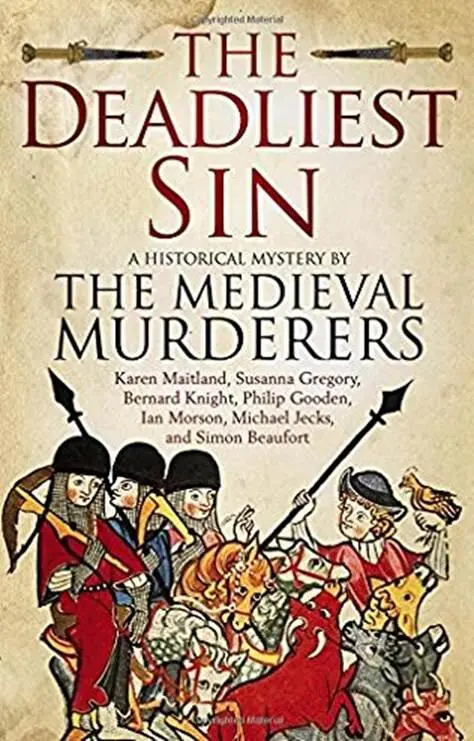
- Название:The Deadliest Sin
- Автор:
- Жанр:
- Год:неизвестен
- ISBN:нет данных
- Рейтинг книги:5 / 5. Голосов: 1
-
Избранное:Добавить в избранное
- Отзывы:
-
Ваша оценка:
The Deadliest Sin: краткое содержание, описание и аннотация
Предлагаем к чтению аннотацию, описание, краткое содержание или предисловие (зависит от того, что написал сам автор книги «The Deadliest Sin»). Если вы не нашли необходимую информацию о книге — напишите в комментариях, мы постараемся отыскать её.
And then there are those who hope that God's wrath might be averted by going on a pilgrimage. But if God was permitting his people to be punished by this plague, then it surely could only be because they had committed terrible sins?
So when a group of pilgrims are forced to seek shelter at an inn, their host suggests that the guests should tell their tales. He dares them to tell their stories of sin, so that it might emerge which one is the best.That is, the worst…
The Deadliest Sin — читать онлайн бесплатно полную книгу (весь текст) целиком
Ниже представлен текст книги, разбитый по страницам. Система сохранения места последней прочитанной страницы, позволяет с удобством читать онлайн бесплатно книгу «The Deadliest Sin», без необходимости каждый раз заново искать на чём Вы остановились. Поставьте закладку, и сможете в любой момент перейти на страницу, на которой закончили чтение.
Интервал:
Закладка:
The coroner’s first question was to confirm that the body had not been moved. No, not moved? Good. So, whose land was it on? On a boundary, marked by the stile. On one side were the fields farmed by the Raths, on the other those of the Carter family. Thomas Flytte was discovered exactly between the two. His head and upper part were hanging down on the Carter side, while his lower half, his legs, were dangling over the Rath portion. It took some time for this to be imparted to the coroner, with both William and Alfred eager to explain, and somehow nudge responsibility for the body towards the other’s territory.
The coroner rubbed his hands. Perhaps he was cold or perhaps he was thinking that having two families involved increased his chances of making a profit. Then he ordered Thomas Flytte to be lifted down from the stile and laid out on some sacking, which had been placed on the ground. The overnight delay had caused the countenance of the poor physician to grow more mottled and bloated, while the body itself had stiffened, making it awkward to handle. When he was stripped bare of his clothing and his shrunken frame exposed for his injuries to be openly witnessed and assessed, there were expressions of real grief from the crowd. They came strong from my mother, and from me too. I noticed that even the Carters were affected and that stern old William seemed almost moved.
The Thetford coroner asked if anyone present could say for certain who the corpse was, though everyone knew. My mother identified him as her cousin from Woolney. Her voice was low but steady now. The coroner proceeded to examine the body more closely and determined for himself that the cause of death was indeed the rope wrapped about the man’s neck. It had been tugged so tight that it bit deep into the flesh, which had swollen up and made the cord hard to unfasten. The coroner ordered the attendant who’d ridden with him to retrieve the rope, and I remember it came away from the corpse with a tearing sound. Then the coroner held it up as if daring someone to come forward and claim it. No one did, of course. He kept the rope but it was thin pickings. There were no goods he could confiscate here. Nevertheless, the coroner took – for himself, no doubt – the topaz brooch, which was in a pocket. I hope he managed to attract the King’s favour with it.
No one said so at the time but much later, after the coroner had departed, someone remarked that the length of rope looked like the piece that William Carter had displayed in the alehouse to prove that he had not stolen a woman’s purse. The length he’d picked up in the street, when he’d been seen by my father. Even though it had happened a year or more earlier, everyone remembered that moment. Even those who hadn’t been present had heard of it. What had happened to that bit of rope? William had thrown it to the alehouse floor in anger and disgust before he stalked out. But had someone retrieved that rope and stored it away to use many months later to squeeze the life out of a man? It didn’t seem likely, but somehow it linked the murder of Thomas Flytte to the Carter and the Rath families.
The body was removed and the coroner departed with his servant. The physician was buried in the churchyard. Master John gave no sign of gloating at the death of a rival but took extra care with his funeral devotions, sprinkling holy water on the grave to drive off the devils that might trouble the burial-place of a man who had died so suddenly and without being shriven. Both the Carters and the Raths paid for daily masses to be said for Thomas Flytte. You could see why my family should do this, but the piety of William Carter caused some comment, considering how tight-fisted he was. People thought he was trying to compensate somehow for the body being discovered on his land. All this while there was no sign of Reeve, the attendant and supposed son of Thomas.
If the keeper of the King’s peace had been in the area, he would have looked into the death. But he was not, and so the crime went without investigation.
You couldn’t stop people talking about it, though.
And the talk in the village was of who might have so hated or feared Thomas Flytte that he had assailed him and left him dead in that remote spot. Some people mentioned Hugh Tanner, the pedlar. We’d seen the argument between him and the physician while we were… resting… near the wash-house, Laurence and I, and it appeared that Hugh had lost no opportunity of venting his anger at Master Thomas to all those who stopped to examine his wares, calling him a fraud and so on. Was he responsible for the fatal attack on Thomas Flytte?
Then there was Mistress Travis, the cunning-woman. She had lost some of her custom because of the physician’s words. Furthermore, she was feared because she was a strange, strong woman – certainly strong enough to attack a man, and with enough power in her upper arms to wrap a cord round his neck. Some favoured the cunning-woman. Others whispered that the priest had spoken out in his sermons against physicians and men of science – and they knew that Master John was resentful because offerings that should have come the church’s way were being diverted to Master Thomas. But then they recalled the priest’s care with the funeral and they reproached themselves for speaking ill of a man of God. And then finally there was Reeve. As I said, almost no one knew that he was Thomas’s son but the fact that he was nowhere to be found after the murder was enough to cast suspicion on him.
One thing was apparent, though, or it would have been to anyone who thought carefully about the matter. The physician had not been murdered by a thief, for he had been left in possession of the topaz brooch, which the coroner had confiscated. It was possible that the murderer might have been intending to search for something to take but had been disturbed by the arrival of Laurence and me, coming from opposite directions. But if that was so then surely we would have glimpsed him… or her? We said nothing of how we’d discovered the body together, and I certainly said nothing of what I had discovered under the stand of trees near to the stile.
Not until later, when I told Laurence, and once I had we couldn’t stop talking. We talked about the murder and, after we’d finished, we talked about it again. It was less difficult for us to meet now. Our families were not so watchful and the days were longer, even if the sun rarely shone. Well, the summer wore on and the death of the physician continued to cast a cloud across Wenham, even though at least one other villager died during those months. His name was Robert Short, I remember. But he was an old man and he died naturally, while Thomas Flytte did not.
Still there was no sign of the King’s peace and it seemed that justice would never be done. The gossip and speculation about who the murderer might be began to die down. One person who was cleared of the crime was Hugh the pedlar. He returned to Wenham at the beginning of the autumn and reacted with surprise when he heard of the physician’s violent death.
It seemed he’d not stayed long in the village that market day but departed southwards. He admitted he’d known Thomas Flytte in another place, as he put it, and that he thought the doctor of physic was – not what he appeared to be. When pressed, he admitted that he’d encountered Thomas Flytte in London. (And I thought of the story I’d heard from my mother, about the physician and the courtier who kept company with projectors and forecasters and vagabonds. Was it possible that Hugh Tanner was one of them?) But Hugh held no grudge against the physician. If he’d called him a fraud it was only because he’d been called one himself in the first place. Let every man thrive as best he can under the eye of God, was his motto. If Flytte was dead, and by violence too, then he was sorry to hear it. There was such meekness about him and his hang-dog air that scarcely anyone believed he could have choked the life out of the doctor.
Читать дальшеИнтервал:
Закладка:
Похожие книги на «The Deadliest Sin»
Представляем Вашему вниманию похожие книги на «The Deadliest Sin» списком для выбора. Мы отобрали схожую по названию и смыслу литературу в надежде предоставить читателям больше вариантов отыскать новые, интересные, ещё непрочитанные произведения.





Обсуждение, отзывы о книге «The Deadliest Sin» и просто собственные мнения читателей. Оставьте ваши комментарии, напишите, что Вы думаете о произведении, его смысле или главных героях. Укажите что конкретно понравилось, а что нет, и почему Вы так считаете.