Michael Kurland - Professor Moriarty Omnibus
Здесь есть возможность читать онлайн «Michael Kurland - Professor Moriarty Omnibus» весь текст электронной книги совершенно бесплатно (целиком полную версию без сокращений). В некоторых случаях можно слушать аудио, скачать через торрент в формате fb2 и присутствует краткое содержание. Жанр: Исторический детектив, на английском языке. Описание произведения, (предисловие) а так же отзывы посетителей доступны на портале библиотеки ЛибКат.
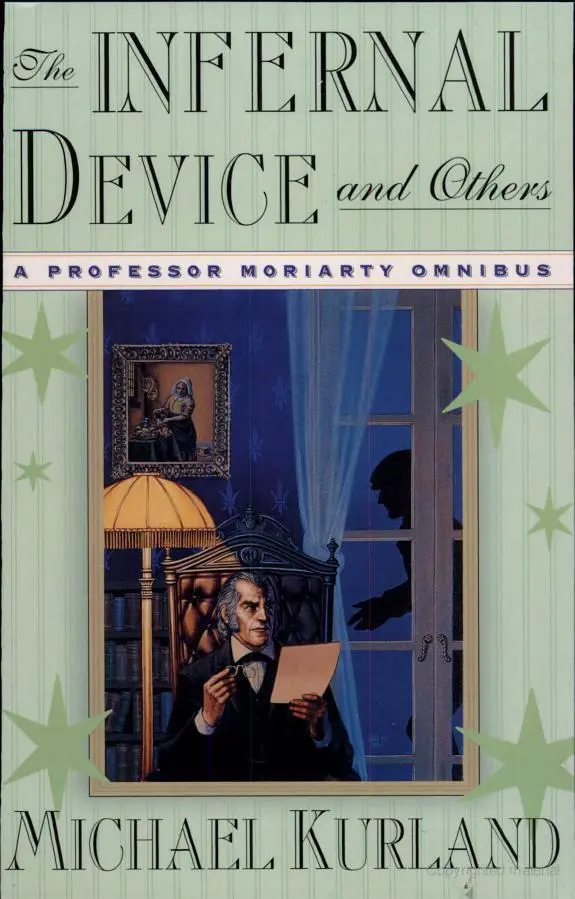
- Название:Professor Moriarty Omnibus
- Автор:
- Жанр:
- Год:неизвестен
- ISBN:нет данных
- Рейтинг книги:3 / 5. Голосов: 3
-
Избранное:Добавить в избранное
- Отзывы:
-
Ваша оценка:
Professor Moriarty Omnibus: краткое содержание, описание и аннотация
Предлагаем к чтению аннотацию, описание, краткое содержание или предисловие (зависит от того, что написал сам автор книги «Professor Moriarty Omnibus»). Если вы не нашли необходимую информацию о книге — напишите в комментариях, мы постараемся отыскать её.
-A dangerous adversary seeking to topple the British monarchy places Moriarty in mortal jeopardy, forcing him to collaborate with his nemesis Sherlock Holmes.
-A serial killer is stalking the cream of England's aristocracy, baffling both the police and Sherlock Holmes and leaving the powers in charge to play one last desperate card: Professor Moriarty.
-The first new Moriarty story in almost twenty years, it has never before appeared in print.
Professor Moriarty Omnibus — читать онлайн бесплатно полную книгу (весь текст) целиком
Ниже представлен текст книги, разбитый по страницам. Система сохранения места последней прочитанной страницы, позволяет с удобством читать онлайн бесплатно книгу «Professor Moriarty Omnibus», без необходимости каждый раз заново искать на чём Вы остановились. Поставьте закладку, и сможете в любой момент перейти на страницу, на которой закончили чтение.
Интервал:
Закладка:
Hands reached for him and held him up. A white basin appeared under his head, and he retched into it for what seemed several lifetimes. Then nothing more came up, and the retching changed to gasping, and the pounding of his racing heart overrode the pounding of his head. Slowly, very slowly, his heart calmed and his breathing slowed.
His eyes began to focus.
Guttural instructions were shouted, and more hands pulled Barnett to his feet. A bucket of cold water was brought and dumped over his head, then another, and a third.
Barnett shook his head and opened his eyes. Slowly the room and the people in it came into focus: the thin man with the crooked nose holding the bucket and grinning; the heavy man who had let him into the house; a man in a black suit sitting in the corner, his face hidden under a black cotton mask; a man with wire-rimmed glasses who looked like a cobbler or tailor talking softly to a man with a small mustache, who looked like a radical student even to the two books under his arm. None of them appeared interested in Barnett, except for the man with the bucket and the man behind the cotton mask.
The man behind the mask barked out a new set of instructions, and the man with the crooked nose put down the bucket and yanked Barnett over to a wooden chair. He pushed Barnett down and tied him quickly and expertly to the chair, his hands behind the back and one leg lashed to each of the chair's front legs. Barnett was too weak and sick even to protest out loud, much less resist the man who bound him.
The man behind the mask came over to glare down at Barnett. His eyes were hard behind the two thin slits. "We meet again," he said.
"Huh?" Barnett said weakly, still not sure what was happening. "What'sat?"
"The last time, I struck you over the head with a brass monkey. One of that English lieutenant's treasured possessions, no doubt. 'Hear no evil,' or some such conceit."
Barnett shook his head to clear his foggy vision and the pounding at his temples. "So you're the guy," he said thickly.
"I do apologize for your present condition," the masked man said solicitously. "I assure you you'll be all right in a few minutes. A pad saturated in chloric ether was applied over your nose and mouth to render you unconscious as you entered the house. But instead of collapsing, you fought like a madman, which resulted in your absorbing much more of the vapor than is good for you. It's your own fault, really."
"I fought?" Barnett remembered none of it.
"Those bruises on your arms were not gratuitous," the masked man said. "Nobody kicked you while you were down, Mr. Barnett."
"I don't remember," Barnett said. The fog around his brain was lifting and full awareness of his present position was creeping in to replace it. Barnett was not feeling too pleased with himself.
"It doesn't matter," the masked man said. "No one here holds a grudge against you. We are the ultimately rational men. We do what we must, and we allow ourselves neither remorse nor pleasure at our actions."
"That's very — sensible," Barnett said, twisting at his wrists to test the rope that bound them. There was no give, no slack, and no stretch in the rope. He relaxed.
"I am glad you feel that way," said the man behind the mask. "Then you will understand that what we are about to do is not out of malice but merely political necessity."
"What are you going to do?" Barnett asked. The headache was slowly lifting, but he could feel the pain in his bruised muscles now, and the soggy chill of his clothing, soaked from the buckets of water dumped over his head.
"It will be a glorious event!" the masked man said enthusiastically. "It will make the great sluggish mass of the British people aware of anarchy. It will be a new height. It will kill you, as you Americans so aptly put it."
"You mean that literally, I suppose," Barnett said.
"Oh, quite," the man behind the mask assured him. "We were hoping to get Professor Moriarty himself, but I'm afraid you will have to do. You and the girl."
"This was all a setup," Barnett said.
"When that gentleman over there," the masked man said, indicating the man with the slight mustache, " — let us call him — no, let him remain nameless — when that gentleman over there reported to me that he had lost his cap and that a pledge ticket was in the band, I at first castigated him severely. Then I realized that with proper management the pledge ticket would lead Professor Moriarty, or Sherlock Holmes — I had really hoped for one of the two — into my trap. It has at least produced you. I suppose it is too much to hope that the professor is going to attempt a rescue. I would like the chance to show him that I learn from my misjudgments."
"Any minute now," Barnett said.
The man behind the mask made a sound that was supposed to represent a laugh. "No, no," he said. "You have come here on your own. That is clear." He struck a thoughtful pose. "But you do have information of interest to me. How much Moriarty knows. What his source of information is. What his intentions are. You could tell me this."
It was Barnett's turn to laugh. "In return for what?"
"Your freedom."
Barnett laughed again. "How can you convince me that you will set me free once I've told you what you want to know?"
The man behind the mask thought this over. "My word, I suppose, isn't good enough?"
"Your word!" Barnett felt slightly hysterical. "Why, you've got all these poor fellows believing that you're on their side! You—"
The masked man slapped Barnett across the face, and then again, and again. Slow, deliberate slaps, delivered with all the man's force. "That is enough!" he said sharply. "You will not malign these brave men with your talk. Shortly you will no longer talk at all! You two— take him to the upper room! We must complete our preparations here."
The two men picked Barnett up, chair and all, one in front and one behind. They carried him up a flight of stairs and deposited him in a rear bedroom. Then they left, closing the door behind them.
-
"Hello!"
It was a girl's voice, and it came from behind him. Barnett tried to look around, but couldn't turn his head far enough. So he hopped the chair by jerking his body and applying torque to it, until he had turned enough to see. There was a young girl tied, spread-eagled, to the bed behind him.
"My God!" Barnett said.
"If you don't mind my asking," the girl said, "who are you?" Her voice was quite normal, and well-modulated, but there was panic in her eyes.
"My name is Benjamin Barnett. And you must be the Duke of Ipswich's daughter, Lady Catherine."
"Yes," she said. "Were you looking for me? Is anybody looking for me? What are they going to do with us, do you know?"
"Your abduction is not general knowledge," Barnett said, "but there are men — some very good men — out looking for you. What have they done to you? Why are you tied up like that?"
"I haven't been mistreated — beyond having been brought here in the first place, I mean. They've kept me locked up in a small room. They feed me twice a day. Usually bread, cheese, and wine. Once, for two days, they had hot food brought from somewhere. I tried leaving a message under the plate, assuming the service would be returned to whatever restaurant it came from. I heard nothing about it, but the next day I was back on bread, cheese, and wine. Then, a couple of hours ago, they dragged me in here and tied me like this. I have no idea what they intend to do. Do you? I've been imagining all sorts of horrid things."
"I'd rather not try to guess," Barnett said.
"A man with a great black mask over his face came in and stared down at me for a long time. Then he said that I was about to go down in the history of the struggle against bourgeois imperialist oppression, and I should be grateful to him. Then he laughed and stomped out of the room. What was he talking about?"
Читать дальшеИнтервал:
Закладка:
Похожие книги на «Professor Moriarty Omnibus»
Представляем Вашему вниманию похожие книги на «Professor Moriarty Omnibus» списком для выбора. Мы отобрали схожую по названию и смыслу литературу в надежде предоставить читателям больше вариантов отыскать новые, интересные, ещё непрочитанные произведения.


Обсуждение, отзывы о книге «Professor Moriarty Omnibus» и просто собственные мнения читателей. Оставьте ваши комментарии, напишите, что Вы думаете о произведении, его смысле или главных героях. Укажите что конкретно понравилось, а что нет, и почему Вы так считаете.