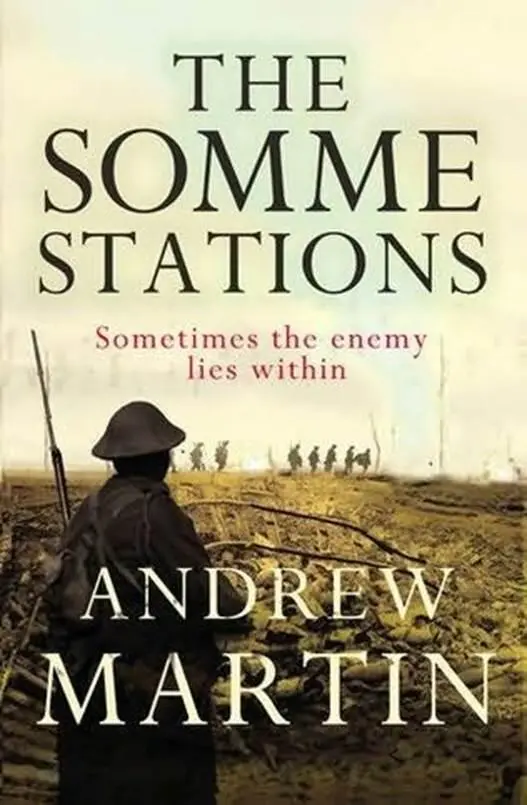
Andrew Martin - The Somme Stations
Здесь есть возможность читать онлайн «Andrew Martin - The Somme Stations» весь текст электронной книги совершенно бесплатно (целиком полную версию без сокращений). В некоторых случаях можно слушать аудио, скачать через торрент в формате fb2 и присутствует краткое содержание. Жанр: Исторический детектив, на английском языке. Описание произведения, (предисловие) а так же отзывы посетителей доступны на портале библиотеки ЛибКат.
- Название:The Somme Stations
- Автор:
- Жанр:
- Год:неизвестен
- ISBN:нет данных
- Рейтинг книги:4 / 5. Голосов: 1
-
Избранное:Добавить в избранное
- Отзывы:
-
Ваша оценка:
The Somme Stations: краткое содержание, описание и аннотация
Предлагаем к чтению аннотацию, описание, краткое содержание или предисловие (зависит от того, что написал сам автор книги «The Somme Stations»). Если вы не нашли необходимую информацию о книге — напишите в комментариях, мы постараемся отыскать её.
The Somme Stations — читать онлайн бесплатно полную книгу (весь текст) целиком
Ниже представлен текст книги, разбитый по страницам. Система сохранения места последней прочитанной страницы, позволяет с удобством читать онлайн бесплатно книгу «The Somme Stations», без необходимости каждый раз заново искать на чём Вы остановились. Поставьте закладку, и сможете в любой момент перейти на страницу, на которой закончили чтение.
Интервал:
Закладка:
‘Oamer is a mispronunciation of Homer, who is apparently taken to be a philosopher by the men of the York ticket office. They believe – and it’s very flattering, I must say – that I am on the philosophical side myself. Hence the name.’
‘Do you mind it, Corporal?’ asked William.
‘Not a bit of it. Homer is the greatest name in epic poetry, a figure comparable with Shakespeare. I am, or was, the deputy superintendent of a ticket office.’
‘But it’s a very big ticket office,’ said William, and Oamer flashed a grin at me over the kid’s head.
We came to the famous field – a recreation ground with a football pitch marked out, and a gang of seagulls parading in the centre circle. As I walked through the gates, I caught sight of our platoon officer, Second Lieutenant Quinn, and he was talking to a fellow officer and uttering, very slowly and deliberately, his favourite word, ‘Unfortunately… It’s not quite big enough.’
The ground was overlooked by hoardings for a shipping company; railway signals and masts lay beyond the boundary fence. An advance party of the battalion, quartered in a bell tent on the touchline, had made the ground ready for us. Among other entertainments was a line of sandbags with a long rope draped over, and a likely-looking sergeant standing by – that would be for tug of war. A track was marked out for the hundred-yard dash; a long sandpit had been dug – for the long jump, of which the army was very fond. But as they split off into their platoons, most of the blokes eyed the gibbet-like arrangement on the far touchline of the football pitch. From this dangled an over-sized scarecrow with a pasteboard disc for a face, and another disc lower down: the heart. Fifty yards in advance of this, neatly aligned on the grass, lay a line of rifles with bayonets fixed.
All the platoon sergeants were shouting (how had the North Eastern Railway thrown up men who could shout like that?) and it seemed we could make for our activity of choice. Whatever you chose, you had twenty minutes at it, and one option was ‘rest easy’ or some such cushy number. You’d sit and smoke in the drizzling rain and watch the others. I thought: the officers’ll look out for who goes there first, then they’ll be down on them for the rest of the bloody war.
The red hot types dashed straight over to the shooting range or the bayonet practice. Other tough nuts went for the tug of war. Young Tinsley was heading that way. Dawson walked past me with shoulders hunched. He was lighting a cigarette, trying to keep the rain off it.
‘Where you off to?’ I called after him.
‘Hazard a guess, mate,’ he said, turning round and grinning.
I explained my theory to him, and he did a sort of mock-frown, making his face very crumpled.
‘Trouble is, mate,’ he said, ‘I’ve already lit up, and it’s a Woodbine. Lovely smoke, is a Woodbine. Here, help yourself.’
And he held out the packet.
If there was one thing I’d learnt so far from the British Army, it was the value of a Woodbine, so I took one, and as Dawson trooped off to ‘Rest Easy’ together with every last slope-shouldered slacker of the battalion, I looked across the recreation ground. Most of the blokes criss-crossing the ground were younger than me, as were most of the officers.
I was beginning to think like the wife: in a pushing sort of way. Why shouldn’t I be sitting up there on a great, grey horse?
I puffed away at the Woodbine for a while, then set off for the shooting range. I was no cracksman, but a decent shot when I had my eye in. As I made off, there came a horrible penetrating scream – a man’s scream, which is the worst kind. It sent all the seagulls rising up from the boundary fence, to where they’d retreated upon our arrival, and it came from the direction of the bayonet practice. The instructor, bent practically double with bayonet to the fore, was charging at the straw figure, and every last man had stood still and was watching. The bayonet went right through the cardboard heart… and the instructor had no end of a job yanking it out again. There didn’t seem to be any established procedure for pulling a bayonet out of a man, and there was some laughter at this but not much, because most of the blokes had been put in mind of France all of a sudden.
When he’d recovered his weapon, the instructor steadied the dummy, and walked back to the line of blokes waiting their turn. First in line was the smallest and youngest man in the battalion, hardly a man at all: William. What kind of scream would he produce? He was handed his rifle, and I watched as he readied himself for his rush at the swinging scarecrow. But William had seen something amiss in the way the bayonet was fixed. With a crowd of blokes holding rifles behind him, and agitating at him to get on with it, he tried to shove the thing more firmly into its housing, which he did by directly grasping the blade. A sort of dismayed groan came from the blokes behind him; the man running the show dashed over to him, and the shout went up for medical orderlies. The kid was looking down at his hand, unable to credit the size of the gash he’d made there.
‘Oh mother,’ said a voice behind me. It was one of the Butler twins. ‘I’ll bet he’s sore,’ said the other one.
‘I’ll bet he’s sore as owt ,’ said the first, and they turned and grinned at each other.
Behind them stood their older brother. Most of the battalion had seen what had happened to the kid, but Oliver Butler wasn’t looking at the casualty. He was, as usual, eyeing me.

That evening, half of the battalion – A and B companies – had been given leave to go off into the town. Why them? The question was not to be asked. We were all at the mercy of the orderly corporals and the notices they pinned up in the dining hall. Some A and B blokes had been too tired after the march to take advantage, but most had gone, and come eight o’clock the reading room was practically deserted. A couple of blokes I didn’t know played a quiet game of cards, and the Butler twins sat opposite each other. They weren’t reading of course – I doubted they could. One – it might’ve been Andy – took out a Woodbine for himself, then passed one to Roy (if it was he).
Roy said, ‘Fine style, Andy-lad,’ then struck a match.
His brother, taking the light, said ‘Fine style, Roy-boy,’ in return.
They always did that when they smoked together. A little further along sat young William Harvey, reading with a bandaged hand. He looked particularly small, just then, the reading room being massive, like all the others. The place was filled with the sound of the droning wind, and the electroliers swung in time with the surging of the sea.
William sat on one chair with his feet on another, and a magazine across his lap. When he saw me, he took his feet down, just as though I did have a stripe on my arm.
‘How’s your hand, son?’ I said, wondering whether they’d had to sew it, and he just nodded, evidently not over the shock yet. His bandage was stained with iodine. He stood up and made towards the door, moving at about half his usual pace. I walked over to where he’d been sitting, and I saw that it was the latest number of the North Eastern Railway Journal that he’d been reading. This was now almost entirely given over to the war, and had very little about the ordinary workings of the railway. You’d think the editors had been waiting all along for an excuse to drop railway subjects. Young William had evidently been reading the roll of honour, as mentioned on the march by Scholes, for he’d left the magazine open at that page. I picked it up, and read of the glorious deaths of railwaymen who’d gone to France at the earliest opportunity, prior to the formation of the battalion. Private Willetts, a labourer at Darlington Locomotive Works… a bullet had gone through his cap. Well, it hadn’t only gone through his cap. There’d been the small matter of his head as well. But in the case of a Private Harrison, a shunter at York, the writer had written more plainly. Harrison had been ‘blown up at Le Cateau’. But that wasn’t quite the end of it. They’d amputated both legs… but he’d pegged out anyway. There was in addition a photographic portrait of a bloke who’d stopped something at Mons. He was reported ‘as well as could be expected’, but I doubted that he still looked as he did in the portrait.
Читать дальшеИнтервал:
Закладка:
Похожие книги на «The Somme Stations»
Представляем Вашему вниманию похожие книги на «The Somme Stations» списком для выбора. Мы отобрали схожую по названию и смыслу литературу в надежде предоставить читателям больше вариантов отыскать новые, интересные, ещё непрочитанные произведения.


Обсуждение, отзывы о книге «The Somme Stations» и просто собственные мнения читателей. Оставьте ваши комментарии, напишите, что Вы думаете о произведении, его смысле или главных героях. Укажите что конкретно понравилось, а что нет, и почему Вы так считаете.