Andrew Martin - The Somme Stations
Здесь есть возможность читать онлайн «Andrew Martin - The Somme Stations» весь текст электронной книги совершенно бесплатно (целиком полную версию без сокращений). В некоторых случаях можно слушать аудио, скачать через торрент в формате fb2 и присутствует краткое содержание. Жанр: Исторический детектив, на английском языке. Описание произведения, (предисловие) а так же отзывы посетителей доступны на портале библиотеки ЛибКат.
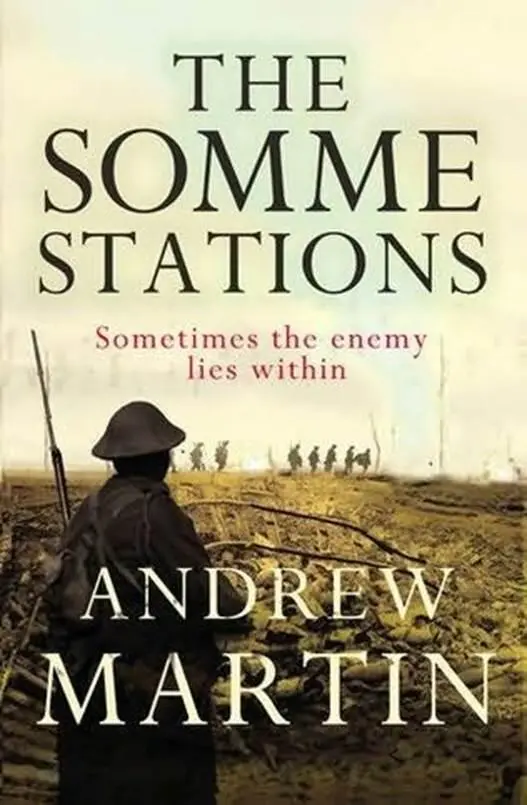
- Название:The Somme Stations
- Автор:
- Жанр:
- Год:неизвестен
- ISBN:нет данных
- Рейтинг книги:4 / 5. Голосов: 1
-
Избранное:Добавить в избранное
- Отзывы:
-
Ваша оценка:
The Somme Stations: краткое содержание, описание и аннотация
Предлагаем к чтению аннотацию, описание, краткое содержание или предисловие (зависит от того, что написал сам автор книги «The Somme Stations»). Если вы не нашли необходимую информацию о книге — напишите в комментариях, мы постараемся отыскать её.
The Somme Stations — читать онлайн бесплатно полную книгу (весь текст) целиком
Ниже представлен текст книги, разбитый по страницам. Система сохранения места последней прочитанной страницы, позволяет с удобством читать онлайн бесплатно книгу «The Somme Stations», без необходимости каждый раз заново искать на чём Вы остановились. Поставьте закладку, и сможете в любой момент перейти на страницу, на которой закончили чтение.
Интервал:
Закладка:
In the second half of 1915, we all expected our ‘order for the front’ every day, and even the most obviously fretful men – such as Scholes – wanted to get out there just so the waiting would be over. When, in late October, Oamer strolled up to me in the washroom and said, ‘Confidentially, old man, we’re out of here next week’, I thought we were for France at last, but he meant only another billeting stint, this one at Spurn Head.
But Spurn Head would prove to be different. Everything that happened to us in France would be in direct consequence of events on that weird peninsula.
Spurn: November 1915
Spurn Head is about three miles long and in places not more than fifty yards across. On any map of Britain, they have a job making it thin enough without just drawing a single line. On one side is the North Sea, which (what with one thing and another) the army had stopped calling ‘the German Sea’; on the other is the Humber Estuary. But what you saw if you stood on Spurn was just flat, shining sea, and if any ships happened to be on it, then they looked to be much higher than you were. At the northern end of Spurn stood the village of Kilnsea, and on the beach hard by, a huge, elevated bonfire burned day and night – a beacon for ships in a great iron goblet. It would warm you up from fifty yards off, that brute would.
The German navy had lately opened up with its twelve-inch guns on Scarborough, Whitby and the Hartlepools, and the army brass was now attempting to make safe the entire east coast. Accordingly, the Royal Engineers were going to secure Spurn Head, and so the Humber Estuary. This meant constructing gun batteries, which were to be linked with a standard-gauge military railway running along Spurn.
We went there as a section, detachment or working party, I’m not sure which. Our section commander (if that’s what we were) was Corporal Prendergast, in other words Oamer. As far as I was concerned we were just a splinter of ‘E’ Platoon, various bits of which had been fired from Alexandra Dock in the direction of the east coast, all under the overall command of Captain Quinn.
At Hull we’d entrained for a spot called Patrington, which is the nearest railhead to Spurn, and which proudly stands in the centre of a network of mud roads. There, in late afternoon, we’d boarded two open wagonettes, and as these bumped their way east we sat first in greatcoats, then greatcoats and horse blankets – for the sea wind is murder in that territory. We saw the beacon from five miles off, growing brighter and bigger as the dusk fell.
Captain Quinn was in the first wagonette with Oamer, the two kids and one of the Butler twins: Andy. I was in the second with Dawson, Scholes, Oliver Butler and Roy Butler. At Patrington station, Oamer had deliberately separated the twins, and this, I knew, was done at the prompting of Quinn, who thought it bad for morale that they should be so thick with one another and hardly speak to anyone else.
I turned to Roy:
‘What do you reckon’s in store for us here, then?’
I knew I’d have to wait for my answer, and the wagonette jolted on for a good hundred yards more before he began, ‘Should think…’
‘What?’
‘Bull,’ he said, and it was something to get even that out of him.
‘But what kind of work ?’ I asked Roy, who was gazing away over the fields towards the beacon.
Oliver Butler, who always watched closely my attempts to draw out either of his brothers, eyed me for a space after I’d given up. Then he said, ‘Pick and shovel stunt – ten to one.’ He had a copy of the Press on his lap. He was a big reader of that paper for some reason – had it on subscription whereas the rest of us would just pick up the copies we saw lying about. I read, ‘York Officer’s Big Pike’. It seemed to me that the paper was starting to lay off the actual fighting, ever since the battle of Loos, the month before, which had been the first to involve the New Armies, the Kitchener boys I mean, sorts like us.
Word was, it had been a calamity. We’d used poison gas shells which meant the brass was getting desperate and that the war reports would no longer be able to call this a ‘perfidious German method of warfare’.
To my right sat Scholes, who’d been silent since Hull. In his gloved hand, he held a sheaf of papers with music on them. He could read music just like words. You’d see him singing to himself as he did it. The week before, he and a shunter from Leeds who played the piano had given a concert in the reading room at Alexandra Dock, and I’d gone along just in case nobody else did. I was quite done in, so it had put me to sleep, but in a pleasant sort of way.
Bernie Dawson was sitting over opposite, alongside Oliver Butler. He’d been fishing about in his pack for a while, and now produced a canteen and a metal cup. He poured himself a tea, and drank it down fast; he poured another and offered it first to me. I took a swig, and Roy Butler most unexpectedly spoke up again.
‘Owt like?’ he said, meaning he wanted a belt of it for himself.
I handed him the cup and he downed it in a gulp.
The clouds in this place were like nothing I’d seen – like great black arrows swooping in from the sea. Presently, Roy Butler remembered about the cup, and passed it back to Dawson with a nod.
‘Anytime, mate,’ said Dawson, restoring the cup to his pack. He sat back in the bouncing wagonette, and pulled his blanket more tightly around him. ‘Talk about a hole,’ he said, taking in the strange beauty all around. Roy Butler was lighting a cigarette. He smoked more than his twin brother, I believed, and even though he usually appeared equally nerveless, he was more inclined to do so at anxious moments, so I had perhaps got him worried with my questions about our Spurn duty. I credited him with being brighter than his brother, and I fancied that, if kept apart from him for long enough, he would eventually become normal.
‘All these fields,’ Dawson said to Oliver Butler, ‘… could be just the place for some field telephones. You might be mucking in with the RE boys, Ollie.’
‘We’ll be digging their bloody latrines,’ said Butler. ‘You just wait.’
‘Here,’ said Dawson, ‘where are we billeted?’
‘At a farm, according to Oamer,’ I said.
Suddenly leaning forward, Dawson enquired, ‘At a farm house , I hope he said.’
Well, the place was Cobble Farm. Quinn was in the farmhouse, the rest of us in the barn. For the first two weeks I never saw the farmer, name of Lowther, but sometimes at five in the morning I would hear the roar of a great petrol-driven tractor. The grub was served out to us from the back door of the farmhouse by Mrs Lowther, who was friendly enough, but wouldn’t have the rank and file in her house. There were no animals to be seen, only half a dozen cats, and the whole place was clarted with wet mud – shone with it when there was any light in the sky, which there was for about three hours a day.
On the first morning, Quinn paraded us in the farmyard; then he started in on a little speech, with many a hesitation, and a glance towards the wide farmyard gate and the dead straight mud road stretching away to the beacon, burning even then at eleven o’clock on a rainy Tuesday morning like an advertisement for hell. Our time in the Alexandra Dock, Quinn said, had made soldiers of us. We may not realise it, but he could see that we were very different men. The work we were about to commence was of vital importance, but he hoped we would also enjoy and learn from it. It would be hard work, and he’d warned Mrs Lowther that it would put an edge on our appetites. (At this he grinned at us all, which meant he had told a joke.) He gave another glance over to the gate, and the smile gradually disappeared. I knew what was coming:
Читать дальшеИнтервал:
Закладка:
Похожие книги на «The Somme Stations»
Представляем Вашему вниманию похожие книги на «The Somme Stations» списком для выбора. Мы отобрали схожую по названию и смыслу литературу в надежде предоставить читателям больше вариантов отыскать новые, интересные, ещё непрочитанные произведения.




Обсуждение, отзывы о книге «The Somme Stations» и просто собственные мнения читателей. Оставьте ваши комментарии, напишите, что Вы думаете о произведении, его смысле или главных героях. Укажите что конкретно понравилось, а что нет, и почему Вы так считаете.