Brian Freeman - Marathon
Здесь есть возможность читать онлайн «Brian Freeman - Marathon» весь текст электронной книги совершенно бесплатно (целиком полную версию без сокращений). В некоторых случаях можно слушать аудио, скачать через торрент в формате fb2 и присутствует краткое содержание. Город: New York, Год выпуска: 2017, ISBN: 2017, Издательство: Quercus, Жанр: Детектив, на английском языке. Описание произведения, (предисловие) а так же отзывы посетителей доступны на портале библиотеки ЛибКат.
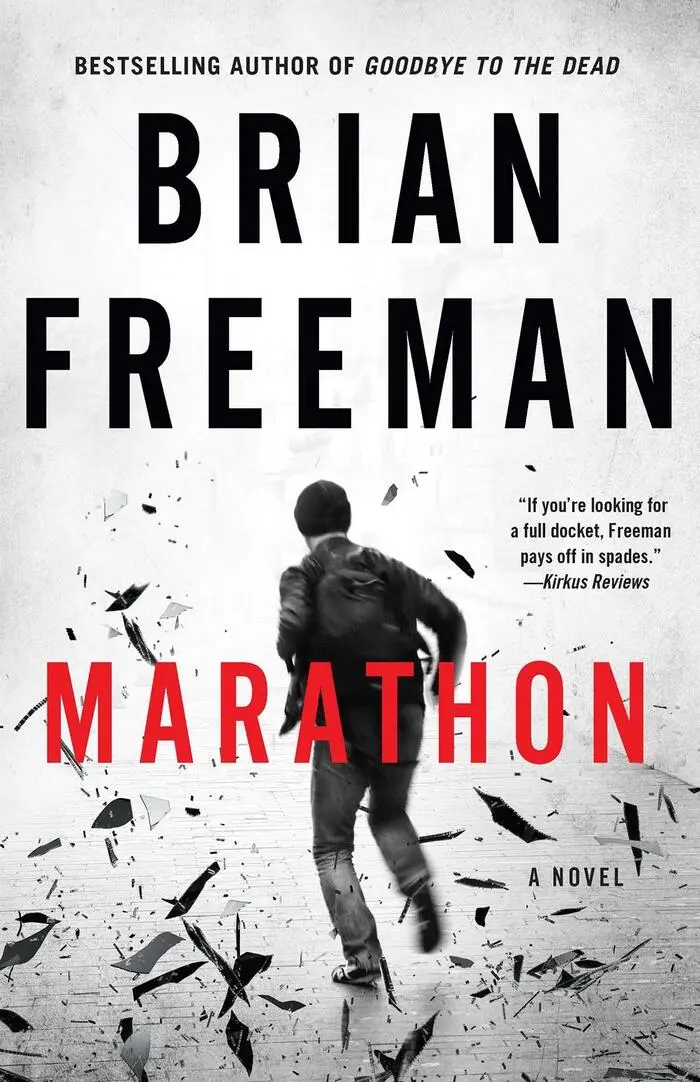
- Название:Marathon
- Автор:
- Издательство:Quercus
- Жанр:
- Год:2017
- Город:New York
- ISBN:978-1-68144-241-9
- Рейтинг книги:4 / 5. Голосов: 1
-
Избранное:Добавить в избранное
- Отзывы:
-
Ваша оценка:
Marathon: краткое содержание, описание и аннотация
Предлагаем к чтению аннотацию, описание, краткое содержание или предисловие (зависит от того, что написал сам автор книги «Marathon»). Если вы не нашли необходимую информацию о книге — напишите в комментариях, мы постараемся отыскать её.
Within minutes, Jonathan Stride, Serena Dial, and Maggie Bei are at work with the FBI to find the terrorists behind the tragedy. As social media feeds a flood of rumors and misinformation, one spectator remembers being jostled by a young man with a backpack not far from the bomb site. He spots a Muslim man in a tourist’s photo of the event and is convinced that this was the man who bumped into him in the crowd — but now the man’s backpack is missing.
When he tweets the photo to the public, the young man, Khan Rashid, becomes the most wanted man in the city. And the manhunt is on.
But are the answers behind the Duluth bombing more complex than anyone realizes? And can Stride, Serena, and Maggie find the truth before more innocent people are killed?
Marathon — читать онлайн бесплатно полную книгу (весь текст) целиком
Ниже представлен текст книги, разбитый по страницам. Система сохранения места последней прочитанной страницы, позволяет с удобством читать онлайн бесплатно книгу «Marathon», без необходимости каждый раз заново искать на чём Вы остановились. Поставьте закладку, и сможете в любой момент перейти на страницу, на которой закончили чтение.
Интервал:
Закладка:
“Rashid went to the market to get a bag of shredded coconut. We found it on the ground outside the store. I know it’s just a little thread, but when you pull on those threads, things start to unravel. Why was Khan Rashid running out to get coconut on the day after he bombed the marathon? It doesn’t make sense.”
“Dzhokhar Tsarnaev hung out in the dorms after Boston like nothing had happened,” Durkin said. “With all due respect, Stride, you’re being naïve.”
“Durkin,” Maloney murmured, with an admonition in his tone.
“No, it’s okay,” Stride replied. “She may well be right. It looks like Rashid shot Officer Kenzie, and if that’s true, he’s obviously not the man he appeared to be on the outside. I just don’t think we have the whole picture yet.”
“Well, we need to examine every aspect of their lives to see where there may have been radical influences on the Rashids,” Maloney said. “In the meantime, the priority is to find them. Lieutenant, talk to your source again. If someone in the Muslim community is helping them, we need to find out who.”
“I will.”
“What about the death of Officer Kenzie?” Maloney asked. “Has the autopsy been completed?”
Stride nodded. “Yes, the medical examiner recovered the bullet that killed him. Typically, we’d send it to the Bureau of Criminal Apprehension in Saint Paul for analysis, but your people wanted it done at the FBI lab.”
“The bullet and the weapons from the scene are being hand-carried to Quantico by one of our agents,” Durkin added. “It’s top priority. We should have more information tomorrow.”
Maloney nodded. “Good. Is there anything else?”
“I have a question about the marathon photos,” Stride said. “One of my people talked to the witness who first brought Rashid to our attention. Michael Malville. He’s convinced he saw Rashid with a backpack on Superior Street a few minutes before the bombing. I was wondering if we’d located any photo or video evidence to confirm it.”
Maloney shook his head. “No.”
“What about in Canal Park itself? Do we have any photos of Rashid arriving there with a backpack?”
Maloney and Durkin exchanged glances.
“The investigation in Canal Park has been troublesome,” Maloney replied.
“How so?” Stride asked.
“I’m sure you know that the marathon maintains a high-definition camera on the roof of their building that captures images along the street. So we have excellent coverage of the entire area throughout the marathon. We’ve been through it numerous times from the beginning of the day through the bombing and the aftermath. That’s in addition to materials provided by the public.”
“And?”
“And nobody with the right type of backpack went inside the Duluth Outdoor Company shop. Not one. We didn’t know what to make of it until Durkin pointed out something we hadn’t immediately realized.”
“The shop has a back door,” Durkin interjected. “It was open throughout the morning for people coming in from the alley.”
“There’s no camera coverage back there,” Stride said.
Maloney nodded. “Unfortunately, that’s right. For the moment, our theory is that the bomber brought in the backpack from the alley and left it near the front door. Then he simply walked out into the crowd. It makes suspect identification extremely difficult, which is why the information from Mr. Malville is important. He says Rashid had a backpack.”
“Except we have no photographs of Rashid to confirm it,” Stride pointed out.
“That’s true,” Maloney said, “but we do have this.”
He leafed through the pages of his legal pad and extracted a piece of shiny photo paper. He pushed it across the conference table to Stride.
Stride picked up the photo.
It showed Khan Rashid emerging from the doorway of the Duluth Outdoor Company shop on the morning of the marathon.
26
“Curt Dickes,” Serena said to Cat in exasperation. “Do we really have to talk to Curt Dickes?”
Cat grinned. The open top of Serena’s Mustang swirled her chestnut hair as they headed north on London Road past the Glensheen Historic Estate.
“Hey, I know you don’t like Curt, but he knows the score with all the street people. If anyone has seen Eagle lately, it’s Curt.”
“I don’t like him because he was the one who pimped you out and nearly got you killed,” Serena said. “Remember?”
“Oh, yeah, but he’s still a nice guy.”
Serena shook her head. There was no talking to Cat about Curt Dickes. She kept going back to him like a beautiful bee buzzing around a mangy flower.
Curt wasn’t really dangerous. He was mostly an irrepressible scam artist, and he’d been that way since he was fifteen years old. Every month, he wound up at police headquarters because of a different con game he was running on convention-goers at the DECC. Once it was “Canadian” Viagra made from ground-up Flintstone vitamins. Another time it was half-price tickets to a free folk concert at Amazing Grace. If he’d devoted half the energy toward honest work that he put toward his schemes, he probably would have wound up as a billionaire entrepreneur. However, Curt and honest work never found themselves in the same city at the same time.
“There!” Cat called. “There’s the sign!”
Serena spotted a hand-painted sign on the highway shoulder near the scenic bypass toward Two Harbors. She couldn’t help but remember that this was the marathon route, leading along the lakeshore between the two towns. On Saturday, she’d run past this very spot. She could still feel the drizzle on her face and hear the in-and-out of her breath and see the midnight blue of the lake sticking by her like a friend.
The sign on the highway said in stencil:
CRAFT BEER
And below it, scrawled in heavy marker:
Yes, we are OPEN !
Serena turned onto the road that led toward Brighton Beach. She followed it until the trees opened up at the sun-swept lake, where waves bubbled against a tiny strip of rocky beach. From this angle, the city was invisible, making the lake look endless. She parked her Mustang between a Subaru Forester camper and a Prius. On the beach, two children splashed in the cold water, and a woman about her own age lounged on the rocks with a paperback book. Beyond the family, she could see two men farther along the beach, drinking from red Solo cups. They stood beside a kid in a yellow canvas chair that was planted a foot deep into the lake.
Curt Dickes.
“Hey, Curt!” Cat shouted. Serena didn’t like the excitement she heard in the girl’s voice.
The teenager ran for the beach, and Curt, recognizing her, nearly toppled backward in his chair as he scrambled to get up. Serena followed, with her badge clearly visible on her belt. As she neared the water, the two beer drinkers spotted the badge and did a quick-march back toward the Prius.
Curt splashed from the water and hugged Cat. He was surrounded by half a dozen coolers of various sizes and colors, and two giant bags of plastic cups dangled from the arms of his canvas chair.
“Serena!” Curt said to her with a big smile. “Or should I say Mrs. Stride? Congrats on the big wedding! Mazel tov!”
Serena tried not to laugh. The strange thing about Curt was that he always seemed genuinely happy to see the police, even when they were about to bust him.
He was twenty-six years old and built like a stalk of skinny asparagus. His black hair was greased back and hung down to his shoulders. His skin oozed musk cologne that somehow overpowered all the fresh smells of the lake. He wore baggy jean shorts and nothing else, other than a wolf tattoo on his forearm and piercings through both nipples.
Читать дальшеИнтервал:
Закладка:
Похожие книги на «Marathon»
Представляем Вашему вниманию похожие книги на «Marathon» списком для выбора. Мы отобрали схожую по названию и смыслу литературу в надежде предоставить читателям больше вариантов отыскать новые, интересные, ещё непрочитанные произведения.

Обсуждение, отзывы о книге «Marathon» и просто собственные мнения читателей. Оставьте ваши комментарии, напишите, что Вы думаете о произведении, его смысле или главных героях. Укажите что конкретно понравилось, а что нет, и почему Вы так считаете.