Brian Freeman - Marathon
Здесь есть возможность читать онлайн «Brian Freeman - Marathon» весь текст электронной книги совершенно бесплатно (целиком полную версию без сокращений). В некоторых случаях можно слушать аудио, скачать через торрент в формате fb2 и присутствует краткое содержание. Город: New York, Год выпуска: 2017, ISBN: 2017, Издательство: Quercus, Жанр: Детектив, на английском языке. Описание произведения, (предисловие) а так же отзывы посетителей доступны на портале библиотеки ЛибКат.
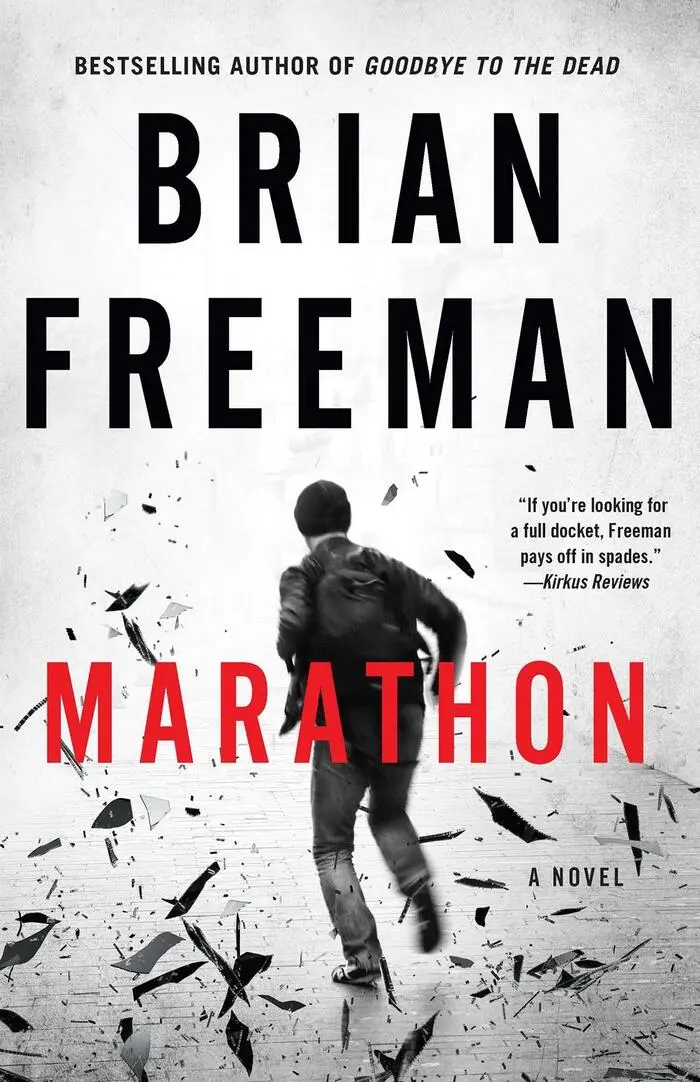
- Название:Marathon
- Автор:
- Издательство:Quercus
- Жанр:
- Год:2017
- Город:New York
- ISBN:978-1-68144-241-9
- Рейтинг книги:4 / 5. Голосов: 1
-
Избранное:Добавить в избранное
- Отзывы:
-
Ваша оценка:
Marathon: краткое содержание, описание и аннотация
Предлагаем к чтению аннотацию, описание, краткое содержание или предисловие (зависит от того, что написал сам автор книги «Marathon»). Если вы не нашли необходимую информацию о книге — напишите в комментариях, мы постараемся отыскать её.
Within minutes, Jonathan Stride, Serena Dial, and Maggie Bei are at work with the FBI to find the terrorists behind the tragedy. As social media feeds a flood of rumors and misinformation, one spectator remembers being jostled by a young man with a backpack not far from the bomb site. He spots a Muslim man in a tourist’s photo of the event and is convinced that this was the man who bumped into him in the crowd — but now the man’s backpack is missing.
When he tweets the photo to the public, the young man, Khan Rashid, becomes the most wanted man in the city. And the manhunt is on.
But are the answers behind the Duluth bombing more complex than anyone realizes? And can Stride, Serena, and Maggie find the truth before more innocent people are killed?
Marathon — читать онлайн бесплатно полную книгу (весь текст) целиком
Ниже представлен текст книги, разбитый по страницам. Система сохранения места последней прочитанной страницы, позволяет с удобством читать онлайн бесплатно книгу «Marathon», без необходимости каждый раз заново искать на чём Вы остановились. Поставьте закладку, и сможете в любой момент перейти на страницу, на которой закончили чтение.
Интервал:
Закладка:
“I will.”
“I’m sorry that I doubted you,” Khan said.
Malik gave him the strangest of looks and didn’t reply. Then he disappeared into the shadows, and Khan heard the rear door open and close.
25
“I missed,” Agent Durkin told Stride. “I missed twice .”
He thought she wanted him to blame her. To yell. To swear. To tell her that he was going to ask Agent Maloney to call for her gun and her badge. Beating herself up wasn’t enough. She wanted others to do it, too. Durkin was the kind of agent who had a hard time dealing with her own mistakes. He’d felt the same way for a long time.
“It happens, Durkin,” Stride said.
“Not to me. I’m a great shot. I don’t miss.”
“The range isn’t the same as real life — you know that. All the conditions were against you. It was dark. It was pouring. You had trees between you and Rashid. You’d been running flat-out across the cemetery.”
“I’m not looking for excuses,” she told him.
“Those aren’t excuses. They’re facts.”
“I missed,” she repeated, “and because of that, Rashid had a chance to shoot Officer Kenzie and get away.”
“His death isn’t your fault,” Stride told her.
Durkin was silent. She sat at the end of a small conference table, and Stride sat across from her. For now, they were the only two people in the room. The air-conditioning hummed over their heads. The small meeting room had been loaded up with whiteboards and computers and equipped with videoconferencing. They’d been waiting for Agent Maloney to join them for half an hour.
“I know you don’t like me,” Durkin said, “so why are you trying to be nice to me?”
Stride shrugged. “I’ve been there. We all have things we’d like to take back. It would really be nice if we were superheroes like Mitch Rapp or Jack Reacher, but we’re not.”
“This was the first time I had to fire my gun at an active scene,” Durkin told him. “It’s not what I expected.”
“No, it’s not.”
“Have you?” she asked.
“A few times.”
“Killed anyone?”
“No.”
“I always thought I’d be up to it,” Durkin said. “You do what you have to do, right? Now I wonder if...” She stopped.
“What?” Stride asked. He could see a crack in her tough shell.
“I wonder if I missed because, deep down, I was afraid of killing someone.”
“It’s easy to second-guess what happens in a split second. Don’t make it a judgment on what kind of agent you are.”
“An agent has to be able to take a life when it’s necessary,” Durkin said.
“Right, but anyone who says it’s easy... Well, I wouldn’t want them on my team.”
Durkin looked as if she wanted to thank him, but at that moment, the door opened, and Special Agent Maloney entered the conference room. He carried a foam cup of coffee, a crisp new legal pad, and two Uni-ball pens. Somewhere in the past day, he’d managed to get a haircut.
At her boss’s entrance, Agent Durkin’s face hardened like concrete, all emotion gone.
“I’ve already been on the phone today with the mayor, the governor, and the president,” Maloney told them as he sat down. “I don’t have any answers for them, and I don’t like being in that situation. Let’s review the status of the local police issues.”
Maloney was all business. Stride liked that about him.
“Have there been any confirmed sightings of Khan Rashid since last night?” Maloney asked.
“We’ve been investigating dozens of calls to the tip line all day,” Stride replied, “but so far, nothing has panned out. We’ve got an intense search going on inside the perimeter we established last night, but there’s a lot of wooded areas and empty land up there. He could have slipped through our roadblocks, and if he did, he could be anywhere now. The good news is, his photo is all over the news and social media. It will be tough for him to move around without being spotted.”
“What about his support network?”
“His wife is his only local adult relative. As far as we can tell, he doesn’t have many close friends.”
“Other than Malik Noon,” Durkin interjected.
Stride nodded. “We’re looking for him, too.”
“Rashid’s wife and kid didn’t disappear on their own,” Durkin added. “They had help. Somebody’s hiding them. Maybe Rashid, too.”
“Lieutenant?” Maloney asked. “Do you agree?”
“Yes, Ahdia Rashid didn’t take her car when she left. I can’t believe she got far on foot with a young boy without help. Particularly at night in the middle of a storm.”
“Did anyone reach out to her before she disappeared?”
“There were no calls in or out of her land line or cell phone yesterday evening. Her cell stopped pinging right around the time of the manhunt for Khan. It hasn’t been on the network since.”
“They could have burners,” Durkin said.
Stride frowned. “Maybe, but that assumes Ahdia was part of the conspiracy.”
“Muslim wives aren’t necessarily innocent little flowers,” Durkin reminded him. “Remember San Bernardino? If they were in this together, they had to know that a moment like this was likely to come. Look at their house — right on the edge of a heavily wooded area. It’s easy to escape to some prearranged meeting point.”
“You could say that about half the homes in Duluth,” Stride said. “So far, there’s no evidence of radicalization with Ahdia Rashid. She works at Cirrus. We checked in there this morning. Her co-workers have nothing but good things to say about her. Same with her neighbors. They describe her as sunny, friendly, outgoing. No arguments, no religious disputes.”
“That doesn’t mean a thing,” Durkin said.
Maloney nodded. “Unfortunately, Agent Durkin is right. Looks can be deceiving. What have we found out about Khan Rashid? Do we know anything more?”
“He’s quiet,” Stride said. “Neighbors say he keeps to himself. His behavior didn’t raise any red flags with them.”
“Religious?” Maloney asked.
“Very, but no indications of extremism. My source insists we’re wrong about Khan.”
Maloney absorbed this information without reacting. He sat up straight in the chair. He never leaned back. He never tapped a finger or a foot.
“The search of the Rashid house this morning revealed nothing of interest,” Maloney told them. “We’re still examining their computer for evidence of radical contacts, but there were no signs of explosives or bomb-making material anywhere on the property.”
“Any weapons?” Stride asked.
“None.”
Stride shook his head. “Khan didn’t even have a concealed-carry permit. I have to say, this couple doesn’t fit the typical terrorist profile.”
“Perhaps, but that doesn’t make them innocent,” Maloney said. “Rashid was friends with the man your source identified. Malik Noon. If Noon was radicalized, he could have recruited Rashid and possibly his wife, too. It takes a while for people to spot a change in someone’s behavior, especially if they’re trying to hide it.”
Stride knew that was true. He’d known plenty of killers who’d shown a benign face to the world. They had kids. They went to work. They smiled at their friends. And then, in their dark hearts, they planned and executed terrible deeds. He knew all that, but this crime still didn’t make sense.
He thought about what Haq had told him on the phone. “ He’s not your man, Jonathan.”
“You look troubled, Lieutenant,” Maloney said.
“I am.”
“Why is that?”
“Honestly?” Stride said. “It’s the coconut.”
Maloney’s mustache wrinkled with puzzlement. “I’m sorry?”
Читать дальшеИнтервал:
Закладка:
Похожие книги на «Marathon»
Представляем Вашему вниманию похожие книги на «Marathon» списком для выбора. Мы отобрали схожую по названию и смыслу литературу в надежде предоставить читателям больше вариантов отыскать новые, интересные, ещё непрочитанные произведения.




Обсуждение, отзывы о книге «Marathon» и просто собственные мнения читателей. Оставьте ваши комментарии, напишите, что Вы думаете о произведении, его смысле или главных героях. Укажите что конкретно понравилось, а что нет, и почему Вы так считаете.