Brian Freeman - Marathon
Здесь есть возможность читать онлайн «Brian Freeman - Marathon» весь текст электронной книги совершенно бесплатно (целиком полную версию без сокращений). В некоторых случаях можно слушать аудио, скачать через торрент в формате fb2 и присутствует краткое содержание. Город: New York, Год выпуска: 2017, ISBN: 2017, Издательство: Quercus, Жанр: Детектив, на английском языке. Описание произведения, (предисловие) а так же отзывы посетителей доступны на портале библиотеки ЛибКат.
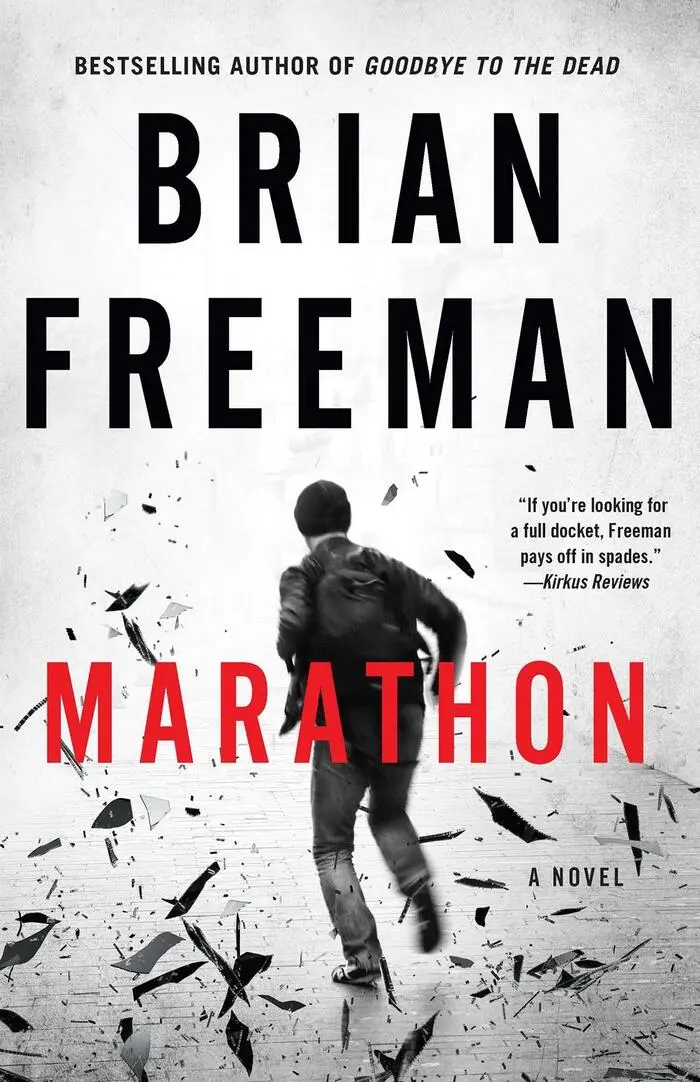
- Название:Marathon
- Автор:
- Издательство:Quercus
- Жанр:
- Год:2017
- Город:New York
- ISBN:978-1-68144-241-9
- Рейтинг книги:4 / 5. Голосов: 1
-
Избранное:Добавить в избранное
- Отзывы:
-
Ваша оценка:
Marathon: краткое содержание, описание и аннотация
Предлагаем к чтению аннотацию, описание, краткое содержание или предисловие (зависит от того, что написал сам автор книги «Marathon»). Если вы не нашли необходимую информацию о книге — напишите в комментариях, мы постараемся отыскать её.
Within minutes, Jonathan Stride, Serena Dial, and Maggie Bei are at work with the FBI to find the terrorists behind the tragedy. As social media feeds a flood of rumors and misinformation, one spectator remembers being jostled by a young man with a backpack not far from the bomb site. He spots a Muslim man in a tourist’s photo of the event and is convinced that this was the man who bumped into him in the crowd — but now the man’s backpack is missing.
When he tweets the photo to the public, the young man, Khan Rashid, becomes the most wanted man in the city. And the manhunt is on.
But are the answers behind the Duluth bombing more complex than anyone realizes? And can Stride, Serena, and Maggie find the truth before more innocent people are killed?
Marathon — читать онлайн бесплатно полную книгу (весь текст) целиком
Ниже представлен текст книги, разбитый по страницам. Система сохранения места последней прочитанной страницы, позволяет с удобством читать онлайн бесплатно книгу «Marathon», без необходимости каждый раз заново искать на чём Вы остановились. Поставьте закладку, и сможете в любой момент перейти на страницу, на которой закончили чтение.
Интервал:
Закладка:
When he stopped to listen, he heard a drumbeat of thunder and the slap of the downpour through the trees. The volume of the storm drowned out everything else.
Kenzie was scared. People thought cops weren’t bothered by fear, but that was crazy. If you were a human being running into danger, you got scared, and the only thing you could do was live with it and not let it stop you. He was still learning that trick. He could feel the speed of his heartbeat; he could feel a tremble in his muscles that he tried to quiet. He told himself: Don’t stop. Stay focused.
He slowed to a walk in the northeastern corner of the cemetery. His tree-trunk body shuddered in the wind. Lightning was his only light. Otherwise, the night was black. He left the path and marched onto the sodden grass, past dozens of marble stones. His boots sank into the ground with each step. Low branches from the evergreens brushed his hair.
Blackness. Nothing but blackness.
Then lightning sizzled practically over his head, followed immediately by deafening thunder that shook the ground and made him twitch. He heard a crack, and close by, he smelled burnt wood. He was momentarily blinded, but in a split second, he saw the landscape of the cemetery spread out in front of him. He saw the chain-link fence that marked the eastern border of Forest Hill, and beyond it, the dirt road that split the graveyards in two.
The lightning vanished, the rain poured down his face, but he blinked and saw something else, too.
Not even thirty yards away, a man was running directly at him.
Behind him, Khan saw a flashlight sweeping back and forth across the cemetery. Whoever was chasing him was on foot now, pursuing him among the headstones. He ran, but between the lightning strikes, he found it almost impossible to dodge the nearly invisible tombstones in his way. His clothes were soaked. His ankle was twisted. He pushed water from his glasses with his thumbs, but the world was a blur.
He heard a shout, but in the storm, he couldn’t make out the words.
Ahead of him, he stumbled up to a fence on the border of the graveyard. The mesh of the fence was low but slippery, and the top was unfinished, with sharp barbs twisted into forks. He tried to kick it down with his shoe, but the fence didn’t yield. The stone support pillars were too small to give him any leverage, so he backed up and charged the fence and threw himself over. His feet slipped in the tall grass as he left the ground. The claws of the fence-top raked his arm and tore his shirt, and he fell, bleeding, into the weeds on the other side. He pushed himself up and staggered into the middle of a dirt road.
Run .
Khan limped along the road, but he hadn’t gone twenty feet before he saw headlights beyond the curve and heard the whine of sirens. Turning back, he saw flashing red lights from the other end of the road, too. They were coming for him from both sides.
He thought about giving up. He stood, frozen, waiting for them to find him; then he panicked.
They’ll shoot me .
If he stayed there, he was dead.
He ran for the fence on the opposite shoulder. He pushed himself up and over, and he picked himself off the ground and ran again, into the heart of another graveyard. He made it to the nearest headstone and stopped, catching his breath. The police were closing in. The flashlight behind him looked like the searchlight of a prison.
Khan sucked air into his chest and charged forward.
Lightning cracked, as bright as the sun. Thunder exploded like a bomb. He covered his face, but he didn’t stop running.
In front of him, someone bellowed a warning.
“ Freeze! Police! Khan Rashid, put your hands in the air!”
Startled, Khan put a foot wrong and spilled forward. His body sprawled into the mud, and he landed hard on his shoulder. His head struck the earth; his glasses flew from his face. He crawled, his body sheltered by the headstones. His hands pawed the earth, hunting for his glasses. Without them, he was blind.
He heard the police officer in front of him shout again.
“ On your feet right now! Hands in the air!”
Khan’s fingers brushed against stiff plastic stuck in the grass. His glasses. He grabbed them by the temple, where they dangled from his right hand. He pushed himself up from the ground, his feet slipping. He stood there, wet and cold, with nowhere to run. The night was black, and he couldn’t see a thing.
Lightning.
Lightning erupted again, and he saw the blurry shape of a police officer not far away. By instinct, Khan went to put his glasses on. The frames glinted silver in the on-and-off illumination of lightning. His right hand moved higher.
And then he heard a shout. A female voice screamed from the fence behind him.
“ Gun! He has a gun! ”
Khan saw a pinpoint flame. The police officer in front of him fired.
Gayle Durkin leaped the first fence with the ease of a runner, and she was at the second fence leading into Forest Hill Cemetery when she heard the shout of a police officer, and she saw Khan spill to the ground. The police officer shouted again, and Durkin saw Khan scuttling in the grass like a crab.
Looking for something.
Something he grabbed. Something in his hand.
Everything happened at once. It was chaos. Police cars roared in from the left and right, sirens blaring, lights making a kaleidoscope on the dirt road. Lightning, like a comet, dazzled her. Thunder cracked like dynamite. She squinted through the pouring rain, seeing Khan standing up. A flash of silver glittered in his right hand. She saw his hand moving. Coming up. Pointing.
And then blackness again.
“ Gun! ” she screamed in warning. “ He has a gun! ”
Almost instantly, a shot cracked, its noise bouncing off the trees and headstones. Durkin dropped her flashlight and whipped her own gun into her hand and spun back to the fence. The aftereffects of lightning bloomed like orange neon in her eyes. Rain made a waterfall down her face.
“Light it up!” she shouted at the police as they got out of their cruisers. And then, to the darkness: “Rashid! Don’t move! Drop the gun!”
Another shot rose above the storm.
Everyone ducked. Durkin took cover behind a tree, but in the next second, she twisted, squatted, and aimed through the fence. Swirling red light reached into the graveyard. The trees loomed like giants, and the headstones were squat soldiers. She saw Rashid, and she squeezed off a shot.
He began to fall.
Durkin fired again.
The first shot from the police officer missed but left Khan frozen in place.
He tried to move, but his muscles refused his brain’s command. He heard the wail of police sirens and saw the carnival of red lights break up the darkness. And still he stood in the rain, his jaw slack, his arms and legs paralyzed, as the police officer in front of him fired again, his bullet missing wildly.
But Khan’s luck was running out.
The next shot came from behind him. It was so close that he heard it buzz his head and whine in his ear like a mosquito. Finally, he threw himself to the ground, just as another shot hit the marble of a headstone and ricocheted into the night.
Khan slithered forward. He snaked past the line of graves, where the stones protected him. He shoved his glasses back onto his face, and the night took focus. He crawled faster, and he thought about shouting, “Don’t shoot, stop shooting!” Instead, he kept his silence and pushed along the wet ground.
The cop in front of him had vanished.
He was just gone.
Behind him, Khan heard the noise of others leaping the fence, heading his way. He got to his feet, but he ran only two steps before he tripped and fell. When he looked sideways on the ground, he saw the face of a police officer staring at him, eyes wide, mouth open, mud on his cheek and chin.
Читать дальшеИнтервал:
Закладка:
Похожие книги на «Marathon»
Представляем Вашему вниманию похожие книги на «Marathon» списком для выбора. Мы отобрали схожую по названию и смыслу литературу в надежде предоставить читателям больше вариантов отыскать новые, интересные, ещё непрочитанные произведения.
Обсуждение, отзывы о книге «Marathon» и просто собственные мнения читателей. Оставьте ваши комментарии, напишите, что Вы думаете о произведении, его смысле или главных героях. Укажите что конкретно понравилось, а что нет, и почему Вы так считаете.