Morag Joss - Half Broken Things
Здесь есть возможность читать онлайн «Morag Joss - Half Broken Things» весь текст электронной книги совершенно бесплатно (целиком полную версию без сокращений). В некоторых случаях можно слушать аудио, скачать через торрент в формате fb2 и присутствует краткое содержание. Жанр: Детектив, на английском языке. Описание произведения, (предисловие) а так же отзывы посетителей доступны на портале библиотеки ЛибКат.
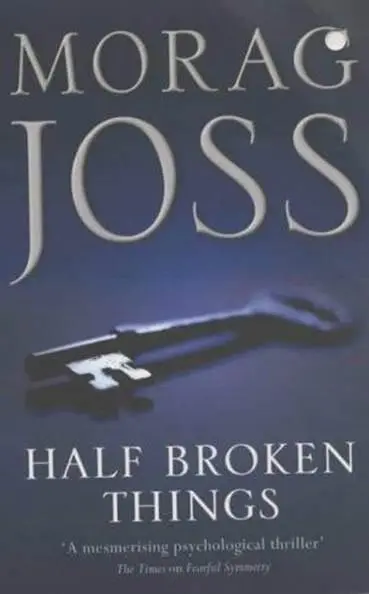
- Название:Half Broken Things
- Автор:
- Жанр:
- Год:неизвестен
- ISBN:нет данных
- Рейтинг книги:3 / 5. Голосов: 1
-
Избранное:Добавить в избранное
- Отзывы:
-
Ваша оценка:
Half Broken Things: краткое содержание, описание и аннотация
Предлагаем к чтению аннотацию, описание, краткое содержание или предисловие (зависит от того, что написал сам автор книги «Half Broken Things»). Если вы не нашли необходимую информацию о книге — напишите в комментариях, мы постараемся отыскать её.
Loners Jean, Micheal and Steph are drawn together to Walden Manor by a mixture of deceit, good luck and misfortune. There, they shape new lives, full of hope and happiness. When their idyll is threatened they discover their new lives are worth preserving. But at what cost?
Half Broken Things — читать онлайн бесплатно полную книгу (весь текст) целиком
Ниже представлен текст книги, разбитый по страницам. Система сохранения места последней прочитанной страницы, позволяет с удобством читать онлайн бесплатно книгу «Half Broken Things», без необходимости каждый раз заново искать на чём Вы остановились. Поставьте закладку, и сможете в любой момент перейти на страницу, на которой закончили чтение.
Интервал:
Закладка:
As he stood waiting for the telephone to be answered he watched the halo of light that blazed round her head. Her hair was smoothed and pinned up today, and she had dipped her head forwards and was resting her forehead against the glass. How was it possible that such a little thing, daylight slipping through a window and falling on the simple curve of a neck, could inspire him to vow to himself that he would never, ever leave her? Michael stared at her head. He could see the back of her earring. He had no idea what the earring itself looked like from the front (he supposed he ought to) but now he set himself to memorising every tiny detail of the back of the metal clip, the private pinch and squeeze of gold on her earlobe. It was delicious to him in a half-forbidden, unofficial way, that he should know the back of her ear. It was like being admitted backstage, surreptitiously and discreetly, to discover that the guile and artifice behind some spectacle was even more thrilling than what the audience saw. He understood both the earring and the ear; he could almost feel the nip as if it were his flesh the little claw was clinging to, or his own teeth tugging at the lobe. He pictured the skin beneath her hair from which her hundreds and hundreds of thousands of fair strands sprouted and grew. How many? And why? Why did they grow like that, unless to hang like long threads that she could collect up and brush and fix in this almost-falling-down way, exposing her neck, whose beauty almost stopped his heart? It was only hair and skin and skull, after all, she was made of the same things as everyone else on the planet. He imagined the fine white shell beneath the scalp, round and hard, and under the helmet of bone, the warm coiled brain that made her think and talk and move and laugh. The ordinariness, the miracle of her. The telephone was suddenly answered.
‘Ah, hello?’
Steph did not turn from the window.
‘Hello. Yes. We need some oil. Urgently, I’m afraid, we’re out. Yes, bit of a cold snap, took us unawares! Yes, it’s Standish-Cave, Walden Manor. That’s right.’
Michael sailed through the negotiations; fill up the tank, about 3,000 litres please, put the receipt through the door, and then he confirmed breezily that they could manage to wait until six o’clock. He thanked the person at the other end for helping them out of a spot. Just before he rang off the woman said, ‘And how’s your wife doing?’
‘Oh, oh. My wife? Oh, she’s, er…’ Michael looked up desperately at Steph, who turned just then and smiled at him, lifting and twisting a loose lock of her hair. Michael said, ‘Oh, she’s absolutely fine, thank you. Very well indeed.’
‘Oh, glad to hear it. Do tell her I was asking.’
Men were deceivers, ever. Shakespeare, but I can’t remember where from. Father would know. And only half right, because women aren’t above a bit of deception either. I have come to believe that just about anyone will deceive to get what they need, if they have no other way open to them. In that strict sense there is no difference between me, Michael and Steph, and Mr Hapgood (in other, crucial respects there is all the difference in the world). And people who think oh no, they could never do the kind of thing we did, well, perhaps they are just people who have never had to, and who lack the imagination to see that if one day they found themselves in the same circumstances, they probably would. People who have landed in another category, who have somehow got what they needed by easier means, are no different from us. No, that’s wrong, they are different. They are luckier, that is all. Not better.
What Mr Hapgood did was this. He came to see the clock the next afternoon after I’d got back from school. I thought it only polite to offer him a cup of tea in return for his the day before, and while I was making it he had a good look at the clock. He came into the kitchen while the tea was brewing and leaned against the draining board. He would have to go and consult somebody, an ‘associate in the trade,’ he said, but it was without doubt a fine clock. I poured out a third cup of tea and took it to Mother, who was in bed, and when I came back he asked all about her, and I found myself crying again. He said he understood perfectly because his mother was much the same, not at all well. He said we should make ourselves comfy in the sitting room because life could be very difficult and what we both needed was a little cuddle. I think he might actually have been right about that.
The next day Michael and Steph returned to the study, bringing with them the pile of unopened post that had been accruing in the library desk. They opened the bank statements, which showed that whatever the Standish-Caves were living on while they were away, it was not being drawn from the Household No 1 account. Twelve hundred pounds a month were going in, and the account was in credit for a little over six thousand. Outgoings amounted to rather less. There were direct debits for electricity, water, telephone and oil, and to the local authority for council tax. Jean Wade’s monthly salary was the only other regular payment. They guessed that the statements for other accounts, that the owners must be using, were being sent by the bank directly to them.
They began to feel clever. Steph found reams of specially printed Walden Manor stationery. In the filing cabinet they found previous letters from Oliver Standish-Cave to his bank so that they could copy the style exactly. Michael fed a sheet into the typewriter and together they began to compose their letter. Steph lost all sense of proportion and wanted to clean out the account.
But it’s a fortune, six thousand quid,’ she said. ‘Once we transfer all that lot into Jean’s account we’ll be laughing, won’t we?’
‘And then what? Suppose the bank thinks it’s a bit funny and investigates? We got to do something quiet, something that’ll just slide past them without them noticing. Just a little rise that nobody’ll notice, so it can go on and on, see? Look, Jean gets four hundred a month. We just make it six, it’ll make a big difference.’
The clatter of the typewriter keys sounded cheeky and illegal, and it was hard not to laugh. The extra would make a difference, but not all the difference. And Jean’s next payment was not due for three weeks in any case, Michael thought, as he watched Steph sign the letter. She was laughing a little too triumphantly, not really taking in that the problem had been eased, not solved. They would have to do something more.
Michael sifted again through the post. Among the other unopened letters were credit card statements which proved the existence of a credit card that had not been used since shortly before Christmas. But the statements did not give the card’s expiry date, and that was essential, Steph declared, before they could order things by telephone. She had stopped laughing.
‘If only we had the card,’ Michael said.
‘Or a chequebook,’ Steph said, looking round as if one might be lying to hand somewhere. Then they heard Jean’s soft footsteps downstairs, crossing the hall from the drawing room to the kitchen. She would be putting the kettle on, and soon would come upstairs to fetch the sleeping Miranda. Then she would call them both down to tea, for which she might have made scones or a cake, although there had been less of those lately. It might be just toast, then. Since her outburst the day before she seemed again to move in her own unhurried way, perhaps even a little more slowly, Steph had remarked last night. Getting on, she and Michael had agreed.
He would not, could not fail Jean over the money. Because Michael thought that her slowing down was not entirely to do with ageing; the tread of her feet seemed to have something to do with a simple absence of strain. Perhaps Jean had ceased to strive. It was strange, he thought, remembering his desperation over paying his fines, that while there was now more point to everything, life for all three of them had grown less effortful. It was not that the struggle to find enough to live on had lessened, but rather that there was no longer any need to outrun a lurking sense of futility about everything. The question is it worth it? did not arise any more. There was peace in Jean’s footsteps, the work of her hands, her look of concentration as she peered at recipe books. She was sedate, but still busy most of the time. Her self-appointed duties in the house undoubtedly made demands upon her energy; towards seven o’clock she would sink into the big chair in the kitchen, tired, and Michael would give her the glass of sherry which she always said was just what she needed. But it seemed to Michael that her energy was freely and willingly expended. She had no need to hoard any, to hold a little in reserve against the day when it would be required in the struggle just to stay cheerful. He recognised in her a picture of himself in his freezing flat and remembered the tight battles fought between himself and the persistent nag in his head, telling him that nothing was ever going to get any better. It was an almost forgotten picture, now abandoned in the old attic of his life before Steph had come, but looking over at Steph now he could tell, now he thought about it, that the same voices had nagged in her head too. They must none of them ever again have to squander energy trying to hold off the conviction that nothing they did made any difference.
Читать дальшеИнтервал:
Закладка:
Похожие книги на «Half Broken Things»
Представляем Вашему вниманию похожие книги на «Half Broken Things» списком для выбора. Мы отобрали схожую по названию и смыслу литературу в надежде предоставить читателям больше вариантов отыскать новые, интересные, ещё непрочитанные произведения.






Обсуждение, отзывы о книге «Half Broken Things» и просто собственные мнения читателей. Оставьте ваши комментарии, напишите, что Вы думаете о произведении, его смысле или главных героях. Укажите что конкретно понравилось, а что нет, и почему Вы так считаете.