Morag Joss - Half Broken Things
Здесь есть возможность читать онлайн «Morag Joss - Half Broken Things» весь текст электронной книги совершенно бесплатно (целиком полную версию без сокращений). В некоторых случаях можно слушать аудио, скачать через торрент в формате fb2 и присутствует краткое содержание. Жанр: Детектив, на английском языке. Описание произведения, (предисловие) а так же отзывы посетителей доступны на портале библиотеки ЛибКат.
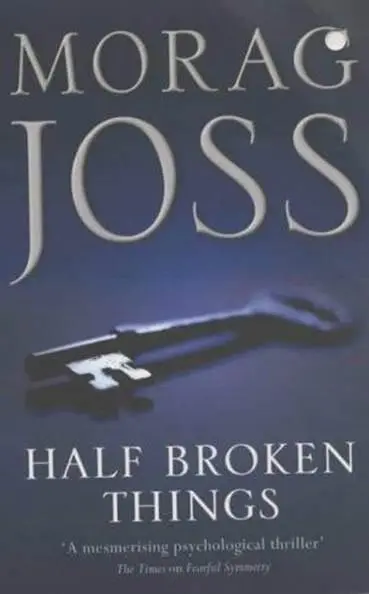
- Название:Half Broken Things
- Автор:
- Жанр:
- Год:неизвестен
- ISBN:нет данных
- Рейтинг книги:3 / 5. Голосов: 1
-
Избранное:Добавить в избранное
- Отзывы:
-
Ваша оценка:
Half Broken Things: краткое содержание, описание и аннотация
Предлагаем к чтению аннотацию, описание, краткое содержание или предисловие (зависит от того, что написал сам автор книги «Half Broken Things»). Если вы не нашли необходимую информацию о книге — напишите в комментариях, мы постараемся отыскать её.
Loners Jean, Micheal and Steph are drawn together to Walden Manor by a mixture of deceit, good luck and misfortune. There, they shape new lives, full of hope and happiness. When their idyll is threatened they discover their new lives are worth preserving. But at what cost?
Half Broken Things — читать онлайн бесплатно полную книгу (весь текст) целиком
Ниже представлен текст книги, разбитый по страницам. Система сохранения места последней прочитанной страницы, позволяет с удобством читать онлайн бесплатно книгу «Half Broken Things», без необходимости каждый раз заново искать на чём Вы остановились. Поставьте закладку, и сможете в любой момент перейти на страницу, на которой закончили чтение.
Интервал:
Закладка:
I suppose I never have been very skilled with money; I mean look at me and Father’s clock for a start. I found myself wishing that somebody like Michael had been around all those years ago to help me with the business of Father’s clock. Not Michael, of course, how could it have been? I was only sixteen myself. I mean somebody older than me at the time, who would have known what to do. Mother was useless, not that I would have consulted her in any case; we had by then set out our positions about me and university and I knew she would have done nothing whatsoever to help me get there. She did not single out that one thing to be useless over, she was useless in everything from that point on, because when Father died Mother simply declined to be of any further use. She declined even to get up much any more. I think at first it was mainly to make sure that I didn’t go off to college or indeed anywhere else. Whether or not she was actually ill at that point I cannot say, but she kept to her bed. Not their bed, note. She couldn’t abide to be in the bed she had shared with him (I did think to myself, well, she probably couldn’t abide it while he was alive) so she took the room at the back of the house, beyond the kitchen, that the previous owners had built on for a lodger. There was some money from somewhere that Father left to her, and that went on putting in a bathroom alongside. No, I was on my own over the clock.
I went to Hapgood’s in the High Street. It sold jewellery and clocks and also mended them, so I thought they would know about my clock, even though mine was an antique and they sold mostly new things. Mr Hapgood was about thirty, I suppose. He had a wide face, not like a grown-up’s at all, but even so I thought of him as old. He had sandy hair and sharp little teeth, and very careful hands, and he was kind. He asked me how a young lady like me came to have an antique longcase clock in the first place. It was only two weeks since the funeral and the question made me cry, and Mr Hapgood took me behind the counter and into the back of the shop. It was quite dark except for the space over the two long benches that were lit by angled lamps, and very warm, with the smell of an oil stove. He sat me down on a torn leather sofa, surrounded by boxes of bits of metal and cogs and sharp-looking tools, and made me a cup of tea. And he said he would come and see the clock if I gave him my address. I was grateful.
Steph and Michael shut themselves in the study, leaving Miranda, newly fed, with Jean in the kitchen. Now alone, they assumed the authority of the young taking responsibility for the supposedly incapable old. Michael could hardly admit to enjoying the slight sense of crisis that Jean’s collapse had brought, but there was something uniting in the idea that he and Steph were now being relied upon.
In the filing cabinet under Suppliers Michael found receipts and details of the oil supplier’s quarterly debit scheme.
’It couldn’t be easier! Simply ring to order your oil whenever you need it. As a valued direct debit account customer your payments will not fluctuate, whatever the current oil price. Then once a year we will work out the credit or debit on your account and arrange with you for part or full settlement!’
It did sound easy, but would they take an order by telephone from Michael? Could just anyone ring up and order oil for any address?
‘Say you’re the handyman,’ Steph suggested, but frowned. It might work, and it might not. What if the oil supplier would deal only with the customer direct? There were receipts going back five years, so presumably the suppliers knew Mr Standish-Cave, even if only as a voice on the telephone. ‘No, better not. No, you’ll have to say you’re him, Mr What’s-his-name.’
‘Well, that’s not a problem, is it?’ Michael said. ‘I can do voices, remember.’
‘Yes, I know that,’ Steph said witheringly, ‘but you’ve got to know what he sounds like first, haven’t you?’
‘He’ll be posh, that’s all. Won’t he?’
Steph looked even more withering and said, ‘That’s not the only problem anyway. What about a signature? They might want a signature, when they deliver.’
They fretted along these lines until she said firmly, ‘No, it’s too risky. We need to get hold of cash and just pay for the oil. What would it cost? We could sell some of the stuff here, couldn’t we?’
‘Jean wouldn’t like that. She likes to have all her things round her. Anyway, we need the oil now, today.’
‘Okay, but all this office stuff, she doesn’t need that. We could flog some of the stuff in here, for a start. The smaller bits, like them.’ She nodded towards the disconnected fax and answering machines and moved across to inspect them. Michael watched her dumbly, with nothing better to suggest.
‘Michael,’ she said, peering into the answering machine, ‘there’s a tape in here. Reckon it’s got what’s-his-name’s voice on it?’
Within half an hour Michael had produced a very passable impersonation of Oliver Standish-Cave, whose voice on the tape had sounded unsurprisingly public school, yet surprisingly pleasant. It was true that there was only his ’Hello. This is the office line at Walden Manor, 01249-588671. Please leave a message at the tone and we will return your call as soon as we can’ to go on, but with Steph’s encouragement Michael quickly found both the vowels and the correct pitch of assumed authority. Steph tried it too, until they both collapsed with laughter. Steph was finding that laughing hard could make her pee in her knickers, just a little, and when she told Michael this, he said, ‘Oh how absolutely frightful, for Heaven’s sake, woman, contain yourself’ in Oliver Standish-Cave’s voice, and they collapsed all over again.
‘But even if you phone up for the oil,’ Steph said, ‘we’ll need to sign something when it comes, won’t we? There’ll be stuff to sign some time.’ The thought sobered them again. Further rummaging in the filing cabinet produced any number of examples of the swirling, enormous signature on receipts and photocopies of letters.
‘Give it over here,’ Steph said, with determination. ‘I’m good at art, remember.’
And forgery, it emerged. The trick, she discovered, was not only to copy the shape of the signature but to work quickly. Oliver Standish-Cave had long ago given up signing his name in discernible letters; Steph had little trouble with the double hillocks of his first two initials and the huge, pretentious letter C that embraced them. Then all she needed to do was place, at just the right point, the long waving line of the rest of his name. It looked like a small rolling field, and one flick of the pen to dot the I of Standish became a bird tossed in the sky above it. She sat and practised at the desk, covering sheet after sheet of paper, while Michael carried on through the filing cabinet. Absorbed, they looked up at each other from time to time. Quiet elation at what they were doing hung in the air.
‘I think I’ve got it now,’ Steph said eventually, holding up a page for Michael to see. He shook his head in impressed disbelief and she turned pink with pleasure. ‘Go on, Michael, ring them. Say you won’t be in when they deliver and they should drop the receipt through the door. Then you can just send it back signed.’
Michael’s mouth had gone dry and his heart began to pound in his throat. For a moment he felt so dislocated that he was back in his old life, about to become some not-Michael or another from Crockford’s Directory of the Clergy, his entire body flooded with fear. He wondered about asking Steph to leave the room while he spoke, just in case he couldn’t do it. What if his Oliver voice gave way, or if he bottled out and slammed down the receiver? What if he burst into tears, or laughed? But he wanted her to stay and watch him, because he was doing it for her. It was for her, for all of them really, because now they were all- Steph, Jean, even Miranda, and he sensed it also in himself- growing blurred around the edges, more like one another. It was the resemblances he noticed, not the differences. They were becoming so alike in warmth, in little affectionate attentions to one another, that they were at times almost indistinguishable, fused into a trusting conglomerate of needs, all equally expressed and met. Even Miranda as she lay awake and motionless in her Moses basket reminded him of Jean’s smiled thanks when he brought in a load of logs, or tightened a washer on a tap, and he felt it, too, in Steph’s languid arms round his neck and it was there, too, when his mouth touched her skin. Perhaps that was what a family was, a sort of large healthy organism made up of smaller ones who did not have to survive everything on their own, or merely for their own selves’ sake. Nothing important that he now did or thought or felt could occur in the absence of these other people. Steph probably knew this already, as she somehow knew other things that he did not tell her, and so while he lifted the receiver and dialled, she stayed. She seemed also to understand that the joking part was over. She walked over to the window and looked out at the garden so that he could not see her face. She turned to him just once, to whisper, ‘Tell them we’ve run out and it’s urgent.’
Читать дальшеИнтервал:
Закладка:
Похожие книги на «Half Broken Things»
Представляем Вашему вниманию похожие книги на «Half Broken Things» списком для выбора. Мы отобрали схожую по названию и смыслу литературу в надежде предоставить читателям больше вариантов отыскать новые, интересные, ещё непрочитанные произведения.





Обсуждение, отзывы о книге «Half Broken Things» и просто собственные мнения читателей. Оставьте ваши комментарии, напишите, что Вы думаете о произведении, его смысле или главных героях. Укажите что конкретно понравилось, а что нет, и почему Вы так считаете.