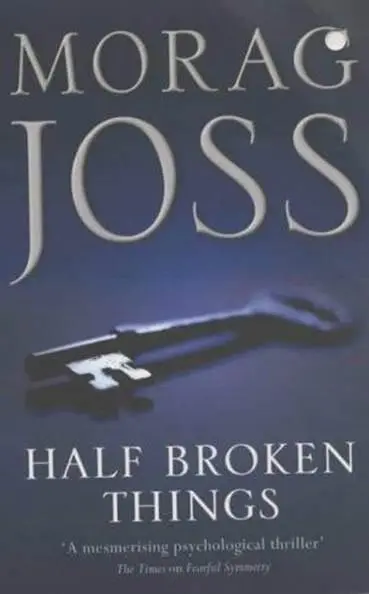
Morag Joss - Half Broken Things
Здесь есть возможность читать онлайн «Morag Joss - Half Broken Things» весь текст электронной книги совершенно бесплатно (целиком полную версию без сокращений). В некоторых случаях можно слушать аудио, скачать через торрент в формате fb2 и присутствует краткое содержание. Жанр: Детектив, на английском языке. Описание произведения, (предисловие) а так же отзывы посетителей доступны на портале библиотеки ЛибКат.
- Название:Half Broken Things
- Автор:
- Жанр:
- Год:неизвестен
- ISBN:нет данных
- Рейтинг книги:3 / 5. Голосов: 1
-
Избранное:Добавить в избранное
- Отзывы:
-
Ваша оценка:
Half Broken Things: краткое содержание, описание и аннотация
Предлагаем к чтению аннотацию, описание, краткое содержание или предисловие (зависит от того, что написал сам автор книги «Half Broken Things»). Если вы не нашли необходимую информацию о книге — напишите в комментариях, мы постараемся отыскать её.
Loners Jean, Micheal and Steph are drawn together to Walden Manor by a mixture of deceit, good luck and misfortune. There, they shape new lives, full of hope and happiness. When their idyll is threatened they discover their new lives are worth preserving. But at what cost?
Half Broken Things — читать онлайн бесплатно полную книгу (весь текст) целиком
Ниже представлен текст книги, разбитый по страницам. Система сохранения места последней прочитанной страницы, позволяет с удобством читать онлайн бесплатно книгу «Half Broken Things», без необходимости каждый раз заново искать на чём Вы остановились. Поставьте закладку, и сможете в любой момент перейти на страницу, на которой закончили чтение.
Интервал:
Закладка:
It would be the usual doddle. Michael had always been able to act; he had shown a real ability in drama, his teacher had said so. In fact, he might have become an actor. If he had spent those years anywhere other than in Beth’s house on that estate on the edge of Swindon he might have made it, but it was impossible to get started from a place like that. Beth had had no idea. But he had definitely had some sort of knack for acting, for forgetting altogether that he was Michael. Probably he had been born with it, because it was the one thing he could do that felt effortless and natural. He just shucked Michael off, left him somewhere and sailed away in his mind and his body, becoming somebody else. It was like taking a holiday from yourself, and always brought with it a whoosh of joy that would make him gasp.
People were wrong if they thought it was a game, though. It was a way of life. He owned clothes that he had picked up from stalls on Walcot Market, knowing they were not really for him but for one or other of the not-Michaels. He had shooting clothes, double-breasted suits, bomber jackets, flamboyant waistcoats- even a silk cummerbund- that he would never wear as Michael. Today, the unfashionably bright blue jeans, checked thick shirt and Timberland boots were helping him to be Jeff Stevenson, and as he drove along he rehearsed Jeff Stevenson phrases about the troublesome van for the benefit of the vicar, whose name was Gordon Brookes.
Gordon Brookes was waiting in the vicarage, which sat in the shadow of the church. From the window of the parish office at the front he could see down the churchyard to the lychgate, which needed re-thatching and where used needles and condoms had been found again two days ago. Sighing, he was trying to rearrange his restless dissatisfaction about the absence of his wife, coupled with the problem of his son, and re-mould them into the shape of the lychgate problem. The lychgate seemed to him, as he looked at it, more and more of an affectation. It wasn’t as if it was ever used, he thought petulantly. Coffins came in by the south door, even Wendy’s had, on one of those wheelie things, because all the hearses went straight round to the far side where the car park was. The lychgate had probably not been used properly since the last time a horse-drawn cart carrying a coffin stopped in the lane.
Jeff Stevenson was now three minutes late and the problem of his son Simon floated to the top of Gordon’s mind. The problem troubled him because although it was as yet still vague, it was not vague enough. Certainly Simon’s deciding that he needed to ‘make a contribution to global equality’ had seemed as flimsy as most of his previous notions about what he should do with his life. But his intention, announced a fortnight ago, that he and his wife and the new baby should embark on ‘a new life based on service to others’, was solidifying in a way that Gordon did not like. Simon was leaving in four weeks’ time, and his wife was refusing to go with him. This morning his daughter-in-law had been on the phone in tears, asking him to change Simon’s mind; Gordon had felt distressed for her but at the same time irritated. It was the sort of call that Wendy would have dealt with. And the ringing of the telephone had interrupted him in a mood of guilty introspection about Wendy, so that instead of agreeing with his daughter-in-law that Simon was simply running away from his responsibilities, he had heard himself suggest that perhaps, if a person feels a calling to higher responsibilities than the ordinary domestic ones, a wife might find her own happiness in supporting him in that calling. Wendy had been happy in her supporting role for thirty-eight years, he told her in a cracking voice, hoping very much that he was right. He had been met with silence. Then he had said that not for a moment did he underestimate the effort and difficulty, even sacrifice, that would be involved. ‘Oh no?’ his daughter-in-law had asked tearfully, and rung off.
Gordon sucked on his bottom lip, feeling misunderstood and a little peeved. Women were better at these things, that was all. It had been Wendy who made sure that Simon’s many lurchings in and out of physical and psychological health, education, employment and relationships remained, to Gordon, vague; with Wendy gone Gordon now felt in danger of having too much expected of him. This raised in him a mixture of fear and indignation because, having forgiven himself within a year of Simon’s birth for a detached paternal style which some might have called inadequacy, he no longer worried that inadequacy was what it was. Since Simon had been born he had devoted himself almost entirely to parish matters that, he had persuaded both Wendy and himself, were more deserving of his attention. He had wanted, he said, to set Simon an example of life and work that would be worth following.
So the lychgate, Gordon now considered, might be a problem whose time had come. The lychgate could be his next project. And for as long as it would demand his energy (Gordon was known by his parishioners to be terribly focused) he could not be expected to lavish the kind of attention that Wendy had had time for on the grandchild with an absent father. In fact, he thought, with Wendy gone, he needed a project. Gordon liked to be committed. Over the years, ‘commitment’ was what he had come to call the habitual and sustained expenditure of his energy on a range of projects of his own devising. ‘Commitment’ was the personal quality of which he was proudest in himself. He no longer noticed much about the church or his parishioners except the things he disliked, one of which was a lack of commitment. He was just thinking he might bring it into the sermon on Sunday and also get in something about the needles and condoms (obliquely, of course) when he saw a man, presumably Jeff Stevenson, standing under the lychgate, his head raised in apparent admiration of the timbering of the roof. What was the attraction? It was not nearly as interesting as the church- you could say it detracted from it- and it was only nineteenth century, Gordon thought, simultaneously deploring Jeff Stevenson’s taste and framing the first arguments he would have to meet and demolish on his way to reinstating the lychgate in the parish’s affections. Not wishing Jeff Stevenson to see him waiting at the window, Gordon turned, selected his deerstalker from several hats hanging in the hall, pulled on his jacket and set off from the front door of the vicarage to meet him.
‘Hello there! Gordon, how are you?’ Michael demanded, meeting him on the churchyard path and advancing with a handshake. Gordon submitted his hand, Michael seized it and grabbed Gordon’s wrist with his left hand. As he beamed at him and yanked his arm up and down, Michael was trying to see beyond the smeared glasses, which reminded him of the chip shop window at the top of his road on Snow Hill. He searched through the lenses for eye contact and fixed him with a look of concern. The hat was perching so ridiculously on Gordon Brookes’s head that he had to concentrate on not staring at it.
‘How are you doing, Gordon? I’m Jeff. Jeff Stevenson.’
‘Yes, yes, hello. You’re expected. Gordon Brookes.’ Gordon lifted the hat and replaced it. He always wore a hat of one sort or another; he thought of his hats as his little trademark. Oh, the vicar and his hats, he imagined people saying, affectionately casting their eyes upwards. He found it useful that a hat created an illusion of approachability and friendliness, and at the same time kept people away. Most people were wary of eccentricity, he had found. They seldom stopped him in the village to chat, for instance, unwilling to risk being thought, by association, as barmy as the man in the barmy hat. But clearly Jeff Stevenson was not most people. For one thing, he had a most persistent handshake.
Читать дальшеИнтервал:
Закладка:
Похожие книги на «Half Broken Things»
Представляем Вашему вниманию похожие книги на «Half Broken Things» списком для выбора. Мы отобрали схожую по названию и смыслу литературу в надежде предоставить читателям больше вариантов отыскать новые, интересные, ещё непрочитанные произведения.





Обсуждение, отзывы о книге «Half Broken Things» и просто собственные мнения читателей. Оставьте ваши комментарии, напишите, что Вы думаете о произведении, его смысле или главных героях. Укажите что конкретно понравилось, а что нет, и почему Вы так считаете.