Morag Joss - Half Broken Things
Здесь есть возможность читать онлайн «Morag Joss - Half Broken Things» весь текст электронной книги совершенно бесплатно (целиком полную версию без сокращений). В некоторых случаях можно слушать аудио, скачать через торрент в формате fb2 и присутствует краткое содержание. Жанр: Детектив, на английском языке. Описание произведения, (предисловие) а так же отзывы посетителей доступны на портале библиотеки ЛибКат.
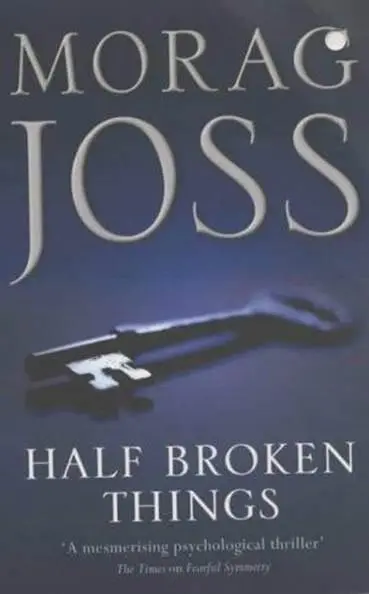
- Название:Half Broken Things
- Автор:
- Жанр:
- Год:неизвестен
- ISBN:нет данных
- Рейтинг книги:3 / 5. Голосов: 1
-
Избранное:Добавить в избранное
- Отзывы:
-
Ваша оценка:
Half Broken Things: краткое содержание, описание и аннотация
Предлагаем к чтению аннотацию, описание, краткое содержание или предисловие (зависит от того, что написал сам автор книги «Half Broken Things»). Если вы не нашли необходимую информацию о книге — напишите в комментариях, мы постараемся отыскать её.
Loners Jean, Micheal and Steph are drawn together to Walden Manor by a mixture of deceit, good luck and misfortune. There, they shape new lives, full of hope and happiness. When their idyll is threatened they discover their new lives are worth preserving. But at what cost?
Half Broken Things — читать онлайн бесплатно полную книгу (весь текст) целиком
Ниже представлен текст книги, разбитый по страницам. Система сохранения места последней прочитанной страницы, позволяет с удобством читать онлайн бесплатно книгу «Half Broken Things», без необходимости каждый раз заново искать на чём Вы остановились. Поставьте закладку, и сможете в любой момент перейти на страницу, на которой закончили чтение.
Интервал:
Закладка:
And as I watched the old clothes burn I thought how solitary I must look, a woman standing by a bonfire in an orchard in winter. Yet I was not lonely, for I knew that the house and all that it contained would be company enough until such time as my son should come to me.
February
Afew weeks later a stale sense of familiarity with what he was doing surfaced in Michael’s mind. He had had times like this before, times when dark and light became the same, when a part of him seemed to absent itself from the world that his body lived in and inhabit some ditch all of its own. Such times could come upon him without warning, but usually they followed something difficult such as his court appearance. And they were worse in the winter because around the end of the second week, when he might be feeling that he could wash or get out of bed, he would then have to overcome the cold and this extra battle could, as it had this time, delay him by several more days.
He was even thinner, because eating, like washing, was another thing that required unimaginable effort. When he absolutely had to, he would manage to trudge up to the shop and buy a half dozen or so cans of soup and a packet of bread. Over the next few days, as and when he became aware of a need to put something in his stomach, he would eat soup straight from the tin, cold. Neither the sweetish, half-rotten vegetal smell that came from it, the sticky feel of the soft lumps in his mouth nor the message his stomach would afterwards send, of being sickened rather than satisfied, seemed to have much to do with him. Nor did the accruing pile of opened and unfinished tins by the side of his bed, whose metallic stink soured the room.
As if bitterly half-in and half-out of an affair with death, he lay for days waiting to see if it would come to him, in the belief that he would let it. Uninvolved, he would put up no resistance, but nor would he seek it out. So he thought about being dead without planning suicide, which would have required of him a degree of inventiveness and purpose of which he was incapable. To engage with the problem of his body for long enough to bring about an end to its improbable beating, breathing, filling and emptying seemed overwhelmingly effortful; even the smallest deviation from habit required what felt like impossibly original thinking. And it was that, rather than pride or even a vestigial notion of decency, that made him get up when he needed to pee. Dimly he realised that a wet mattress might eventually force him to get out of bed and stay out, but his torpor was so deep that he would put off the moment until he could barely stand up straight and then, with a nearly bursting bladder, he would stumble to the bathroom.
This time he ate his soup perhaps once a day, and slept off and on. At intervals, over the top of his bedclothes, he stared at the television with the sound off. Because he did not have a television licence and guessed (for he had no idea how these things worked) that a detector van must pick up the noise somehow, he was in the habit of watching in silence. And as he was anyway unable to connect with anything he saw, the silence was also a protection against the incomprehensibility of what was happening on the screen. He watched faces: listening, talking, laughing, shouting, weeping; seeing not just strangers but beings whose functioning he observed but could neither understand nor imagine sharing. He watched and half-wondered why it was that he was so different, for it was obvious that he lacked some fundamental understanding that bound all of them together, and excluded him. Where they had opinions, hopes, ideas, peculiarities, quirks and eccentricities, he detected in himself neither feature, form nor preference. He was unbearably flat and weightless. When he slept he sometimes had dreams in which he was not a person at all, although what he might have been instead was never clear. In other people it seemed that a river flowed, some animating liquid seemed to bubble and burst along their veins whatever they were doing. His were dry, still, and silent. If he was filled with anything, it was dust. Michael sensed in himself an empty space that in other people was occupied by any number of reasons for living.
Early one morning before it was light, on the way back from the bathroom, he picked up his copy of Heidi from the floor and took it back to bed. It lay there next to him unopened for several more hours, but he touched the cover from time to time, and thought about the story. It was one of his favourites, along with David Copperfield, Oliver Twist and A Little Princess; books that he had been given years and years ago, in special editions for children, by Beth. She had been no reader herself so she had given them to him just to encourage his apparent interest in reading. In order to dislodge the thought of Beth, Michael sat up and opened the book. It pained him to recall how she had always tried to encourage him, without managing to understand him at all; she made such efforts with the books, with his acting. She even tried to explain away how he made up stories when everybody else said he told lies. He switched on the light by his bed, not to read but to look at the pictures. As long as he could stop Beth taking hold in his mind, he thought he might soon be all right. He knew it for certain when, having begun almost by accident to read the words, his favourite part of the story (where the gruff old Grandfather made Heidi a soft little bed all of her own in the hay loft) made him cry as it always did.
Later he got up, gathered together a change of clothes and knocked on Ken’s door across the walkway. Ken seemed grateful to see him. Michael had a bath and afterwards returned to Ken’s sitting room. The community nurse had been so Ken was doped up and not saying much, parked in his day chair in his usual combination of clothes and pyjamas with a thing on a cord round his neck that he could press if he fell, which rang an alarm somewhere. On the plastic hospital tray table next to him the nurse had left his sandwich lunch on a plate covered with cling film, the remote control for the television, yesterday’s Express and a jug of orange squash. A plastic cup with several tablets in it sat on a piece of paper with 12 O’CLOCK AFTER DINNER NOT BEFORE written on it. He seemed more bloated. His walking frame was within reach, though Michael noted that the commode chair was now positioned just behind Ken’s day chair and not in the bathroom, and the telephone had been pulled across the floor from its little table by the door so that he could reach it without getting up. Not that it ever rang. Michael was not feeling completely better, so while Ken dozed he dried his hair by the fierce gas fire, still unable to locate the space in himself that held any real pity. He did not ask if Ken had missed him. He would not have known what to do with the information, with the burden of having let him down, if Ken were to say he had. How he managed during Michael’s bad spells, when his popping in to chat or fetch his little bits of shopping came to an abrupt stop, was something they never discussed.
‘Got a big deal on today, Ken,’ he said. ‘In the Cotswolds. There’s some nice stuff going in the Cotswolds. Nurse coming back, is she?’
The nurse always came back at four thirty to wash Ken and get him ready for bed and Michael knew it, but his checking up struck a note of concern that seemed to please Ken. He nodded and croaked that he was a lucky chap, and that Michael was to mind how he went, and when he had dismissed him with a valiant lift of a hand, Michael took his leave.
The van got to Sherston under protest, but Michael was feeling so much better now that this seemed merely an added challenge. After all, a groan under the bonnet was not a thing that would trouble Jeff Stevenson, curate of St Mary’s, Burnham Norton. Michael had telephoned this time and spoken to the woman at the vicarage so the vicar was expecting Jeff Stevenson, and Michael, as he drove along, began to enjoy the transition from himself into Jeff.
Читать дальшеИнтервал:
Закладка:
Похожие книги на «Half Broken Things»
Представляем Вашему вниманию похожие книги на «Half Broken Things» списком для выбора. Мы отобрали схожую по названию и смыслу литературу в надежде предоставить читателям больше вариантов отыскать новые, интересные, ещё непрочитанные произведения.








Обсуждение, отзывы о книге «Half Broken Things» и просто собственные мнения читателей. Оставьте ваши комментарии, напишите, что Вы думаете о произведении, его смысле или главных героях. Укажите что конкретно понравилось, а что нет, и почему Вы так считаете.