Donna Leon - Beastly Things
Здесь есть возможность читать онлайн «Donna Leon - Beastly Things» весь текст электронной книги совершенно бесплатно (целиком полную версию без сокращений). В некоторых случаях можно слушать аудио, скачать через торрент в формате fb2 и присутствует краткое содержание. Жанр: Детектив, на английском языке. Описание произведения, (предисловие) а так же отзывы посетителей доступны на портале библиотеки ЛибКат.
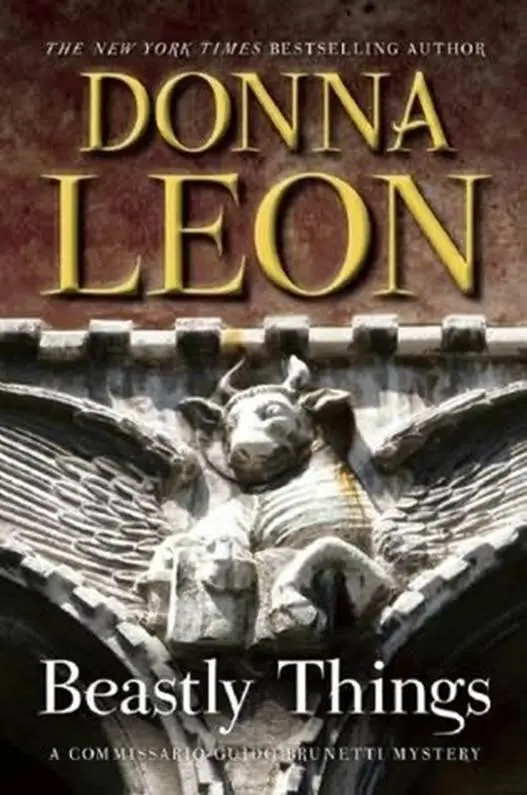
- Название:Beastly Things
- Автор:
- Жанр:
- Год:неизвестен
- ISBN:нет данных
- Рейтинг книги:5 / 5. Голосов: 1
-
Избранное:Добавить в избранное
- Отзывы:
-
Ваша оценка:
Beastly Things: краткое содержание, описание и аннотация
Предлагаем к чтению аннотацию, описание, краткое содержание или предисловие (зависит от того, что написал сам автор книги «Beastly Things»). Если вы не нашли необходимую информацию о книге — напишите в комментариях, мы постараемся отыскать её.
Brunetti soon realises why he remembers the dead man, and asks Signorina Elettra if she can help him find footage of a farmers’ protest the previous autumn. But what was his involvement with the protest, and what does it have to do with his murder? Acting on the fragile lead, Brunetti and Inspector Vianello set out to uncover the man’s identity. Their investigation eventually takes them to a slaughterhouse on the mainland, where they discover the origin of the crime, and the world of blackmail and corruption that surrounds it.
Both a gripping case and a harrowing exploration of the dark side of Italy’s meat industry, Donna Leon’s latest novel is a compelling addition to the Brunetti series.
Beastly Things — читать онлайн бесплатно полную книгу (весь текст) целиком
Ниже представлен текст книги, разбитый по страницам. Система сохранения места последней прочитанной страницы, позволяет с удобством читать онлайн бесплатно книгу «Beastly Things», без необходимости каждый раз заново искать на чём Вы остановились. Поставьте закладку, и сможете в любой момент перейти на страницу, на которой закончили чтение.
Интервал:
Закладка:
Turning to Vianello and responding to his continued lack of enthusiasm, Brunetti said, though he was aware of how disgruntled he sounded, ‘It’s the first thing we’ve had that might be a reason to kill him.’
It wasn’t until they were on the causeway and the city was in sight that Vianello permitted himself to say, ‘Even if Patta doesn’t like it as a possibility, I think I prefer assault.’
Brunetti returned his attention to the water on the right side of the car.
As soon as the boat pulled up in front of the Questura, Brunetti and Vianello stepped on to the landing and walked into the building. They entered Signorina Elettra’s office together, an arrival that seemed to register on her face as a twin delight.
‘You’ve come for Papetti?’ she asked, the question suggesting that, if they had, they’d come to the right place.
‘Yes,’ Brunetti answered. ‘Tell us.’
‘Dottor Papetti is married to the daughter of Maurizio De Rivera,’ she said, which information Vianello greeted with a low whistle, Brunetti with a whispered ‘Ah.’
‘I take your noises as indication that you are aware of her father’s position and power,’ she said.
And who in the North-east was not? Brunetti asked himself. De Rivera was to construction what Thyssen was to steel: the family name sufficed to conjure the product, was almost synonymous with it. The daughter, his only child – unless some other had been slipped into the family while the gossip columnists were heavily sedated – had spent a good deal of her youth under the very public influence of various substances as illegal as they were harmful.
‘When was the fire?’ Vianello asked.
‘Ten, eleven years ago,’ Brunetti answered, referring to the fire in her apartment in Rome from which the daughter – he could no longer remember her name – had been saved at the cost of the lives of three firefighters. The public feeding frenzy had lasted months, during which she disappeared from the news, only to reappear a year or so later as a volunteer at some soup kitchen or shelter, apparently having undergone a transformative experience as a result of having been saved at the cost of three lives. But then she had again disappeared from the papers and thus from the public consciousness.
No transformative experience, however, had affected her father, nor his reputation. Speculation continued about his company’s repeated winning of contracts for municipal and provincial building projects, especially in the South. And it was in that part of the country that his company’s bid was also often the only one to be made.
There were other rumours about him, but those were only rumours.
After giving them time to consider this information, Signorina Elettra went on, ‘I’ve also found an internal memo in which Papetti requests that Borelli be hired, and at that salary.’ She seemed barely able to contain her delight at having discovered this.
‘If what I think what might be going on is actually going on, then, given what is said about his father-in-law, Signor Papetti is a very brave man,’ Vianello said.
‘Or a very stupid one,’ Brunetti countered.
‘Or both,’ suggested Signorina Elettra.
‘De Rivera’s never been convicted of anything,’ Vianello said in a neutral voice.
‘Neither have many of our politicians and cabinet ministers,’ Signorina Elettra added.
Brunetti was tempted to say that none of the three of them had ever been convicted, either, and what did that prove? Instead, he said, ‘Shall we merely agree that Papetti’s relationship with Signorina Borelli is one he might not want his father-in-law to hear about?’ Vianello nodded. Signorina Elettra smiled.
‘What else did you find out about him?’ Brunetti went on.
‘They live very well, he and his wife and their children.’
‘What’s her name? I’ve forgotten,’ Vianello interrupted.
‘Natasha,’ Signorina Elettra said evenly.
‘Of course,’ the Inspector said. ‘I knew it was something fake.’
As if the Inspector had not spoken, she went on. ‘He has almost two million Euros in various investments, their home is worth at least that, he drives one of their two Mercedes SUVs, and they often go on vacation.’
‘It could be De Rivera’s money,’ Brunetti suggested.
Primly, as if cautioning an over-eager student, Signorina Elettra said, ‘The accounts are in his name only. And they are not in this country.’
‘I stand corrected,’ Brunetti said, then asked, ‘Signorina Borelli? Anything else about her?’
‘Though she was making less than twenty-five thousand Euros a year at Tekknomed, she somehow managed to buy, during the years she worked there, two apartments in Venice and one in Mestre. She lives in the one in Mestre and rents the ones in Venice to tourists.’
‘And Tekknomed chose not to bring charges against her when she left,’ said a reflective Brunetti. ‘She must have known a great deal about their accounts.’ Then, to Signorina Elettra, ‘Her bank accounts?’
‘I’m continuing my researches, Signore,’ she said primly.
‘Is there any evidence that her relationship with Papetti is sexual?’
She allowed herself a cool glance. ‘It’s impossible to find those things in the records, sir.’
‘Yes, of course,’ Brunetti answered. ‘Continue your researches, then.’ To Vianello, he said, ‘I want to talk to Papetti.’
‘You have the endurance to go back to the mainland?’ Vianello asked with a smile.
‘I’d like to talk to him before more time passes.’
‘If you go, you should go alone,’ Vianello said. ‘It’s less threatening.’ He took a step towards Signorina Elettra and asked, ‘Do you think we could have a look at the records of the macello at Preganziol while the Commissario is away?’
Her response was an exercise in modesty. ‘I could try.’
Leaving them to it, Brunetti went downstairs and out to the boat.
27
BRUNETTI MARVELLED AGAIN at how it was possible for people to live like this: driving around in cars, getting stuck behind long columns of other cars, eternal victims of the vagaries of traffic. And the air, and the noise, and the overwhelming ugliness of what he passed. No wonder drivers were prone to violence: how could they not be?
Signorina Elettra had called and made an appointment with Dottor Papetti, explaining that Commissario Brunetti was on the mainland that day and could easily stop by to talk to him about Dottor Nava: luckily, Dottor Papetti had no appointments that afternoon and would be in his office. She explained that Dottor Brunetti knew the way to the slaughterhouse.
Though the driver took Brunetti the same way, he recognized little of what they passed, road-memory or road-skill not being a talent he had acquired. He thought he’d seen one of the villas, but from a distance many of them looked the same. He did, however, recognize the lane that led to the slaughterhouse and then the gates behind which it stood. And, though it seemed less strong now, Brunetti also recognized the smell that swept at him from the back of the building.
This time it was Dottor Papetti who met him at the door. He was a tall man with receding hair that exaggerated the narrowness of his face and head. His eyes were round and dark and belonged on a fatter face. The lips were thin and drawn back in a formulaic smile. The shoulders of his suit were padded in a way that was out of fashion but that still managed to disguise his thinness. Brunetti glanced down and saw that his shoes were handmade; the narrowness of his feet probably made this necessary.
After surprising Brunetti with the strength of his handshake, Papetti suggested they go to his office. Papetti walked along beside him with the free-jointed motion of a heron in water; his head, on an inordinately long neck, shoved forward with every step. Neither man spoke; intermittent noises came from the back of the building.
Читать дальшеИнтервал:
Закладка:
Похожие книги на «Beastly Things»
Представляем Вашему вниманию похожие книги на «Beastly Things» списком для выбора. Мы отобрали схожую по названию и смыслу литературу в надежде предоставить читателям больше вариантов отыскать новые, интересные, ещё непрочитанные произведения.



Обсуждение, отзывы о книге «Beastly Things» и просто собственные мнения читателей. Оставьте ваши комментарии, напишите, что Вы думаете о произведении, его смысле или главных героях. Укажите что конкретно понравилось, а что нет, и почему Вы так считаете.