Donna Leon - Beastly Things
Здесь есть возможность читать онлайн «Donna Leon - Beastly Things» весь текст электронной книги совершенно бесплатно (целиком полную версию без сокращений). В некоторых случаях можно слушать аудио, скачать через торрент в формате fb2 и присутствует краткое содержание. Жанр: Детектив, на английском языке. Описание произведения, (предисловие) а так же отзывы посетителей доступны на портале библиотеки ЛибКат.
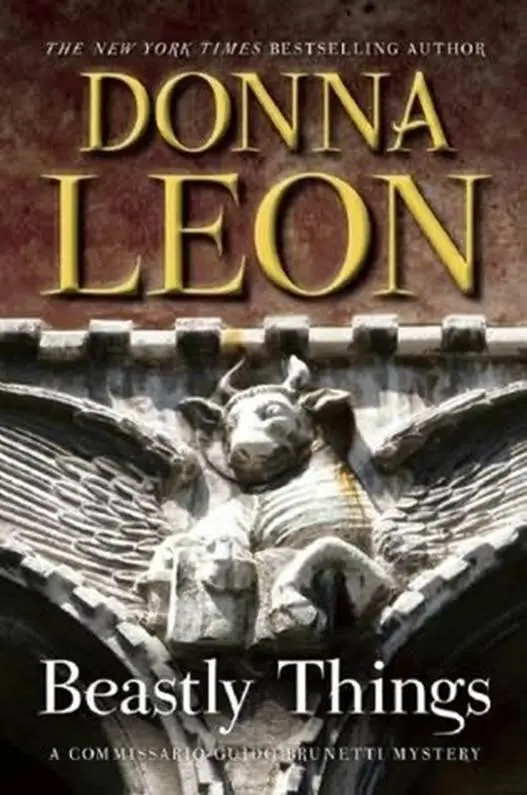
- Название:Beastly Things
- Автор:
- Жанр:
- Год:неизвестен
- ISBN:нет данных
- Рейтинг книги:5 / 5. Голосов: 1
-
Избранное:Добавить в избранное
- Отзывы:
-
Ваша оценка:
Beastly Things: краткое содержание, описание и аннотация
Предлагаем к чтению аннотацию, описание, краткое содержание или предисловие (зависит от того, что написал сам автор книги «Beastly Things»). Если вы не нашли необходимую информацию о книге — напишите в комментариях, мы постараемся отыскать её.
Brunetti soon realises why he remembers the dead man, and asks Signorina Elettra if she can help him find footage of a farmers’ protest the previous autumn. But what was his involvement with the protest, and what does it have to do with his murder? Acting on the fragile lead, Brunetti and Inspector Vianello set out to uncover the man’s identity. Their investigation eventually takes them to a slaughterhouse on the mainland, where they discover the origin of the crime, and the world of blackmail and corruption that surrounds it.
Both a gripping case and a harrowing exploration of the dark side of Italy’s meat industry, Donna Leon’s latest novel is a compelling addition to the Brunetti series.
Beastly Things — читать онлайн бесплатно полную книгу (весь текст) целиком
Ниже представлен текст книги, разбитый по страницам. Система сохранения места последней прочитанной страницы, позволяет с удобством читать онлайн бесплатно книгу «Beastly Things», без необходимости каждый раз заново искать на чём Вы остановились. Поставьте закладку, и сможете в любой момент перейти на страницу, на которой закончили чтение.
Интервал:
Закладка:
Even with the slowness of her reactions, her hesitation was visible. She touched her watch again, and for a moment he thought she was going to wind it, but then she said, eyes still on her watch, ‘Not to me.’
Brunetti was about to ask, when he thought better of it and lifted his chin towards Vianello.
‘To your son, Signora?’ the Inspector asked.
‘Yes. To Teo.’
‘Could you tell us what it was?’
‘He was telling Teo a bedtime story one night after he brought him home. This was about three weeks ago.’ She let that drift away. ‘He always did that when they came home.’ The last word stopped her. She coughed, then she went on. ‘It was always a story or a book about an animal. This one – he must have made it up because we don’t have any book like that – was about a dog who wasn’t very brave. Things frightened him: cats frightened him, other dogs did, too. In the story he’s kidnapped by robbers, who want to train him to help them. They train him to befriend people who are walking on the path through the forest. When the people see this big friendly dog start to walk along with them, they feel safe and keep walking deeper and deeper into the forest. The robbers tell him that, at a certain point, he has to run away, so then they can hurt the people and rob them.
‘But even though he’s a coward, he’s still a dog, and he can never let bad things happen to people. So after all that training, when the robbers finally take him out to help them rob someone, the dog acts like a real dog and turns on the robbers and barks and growls at them – he even bites one of them, though not very hard – until the police come and arrest them. And the man they were going to rob takes the dog back to his old home and tells the family what a good dog he is. They take him back in and they love him, even though he’s still not really a very brave dog.’
‘Why do you think of the story, Signora?’ Vianello asked gently when he understood that she was finished.
‘Because, when the story was over, Andrea told Teo that he should always remember the story and never let anyone do bad things to people because that’s the worst thing you can ever do.’ She stopped and took a deep breath. ‘But then I came into the room, and he stopped talking.’
She tried to laugh at herself, but it came out as a cough. ‘I mention it because he seemed so serious when he was telling the story. He really wanted Teo to learn that lesson: you never let bad things happen to people, even if the robbers threaten you.’
She gave in to temptation and grabbed the towel. She no longer tried to fold or straighten it but twisted it in her hands as though it were something she wanted to destroy.
However curious he might still have been about the Borelli woman, Brunetti knew it was folly to ask. Instead, he got to his feet and thanked Signora Doni. When she offered to show them to the door, he declined, and they left her to the rags of memory.
26
‘WHAT DID YOU make of her?’ Brunetti asked as they walked toward the unmarked car parked at the kerb.
‘My guess is she’s never going to forgive herself, or if she does, it will take a long time.’
‘For what?’
‘For not having listened to him.’
‘Not for having thrown him out?’
Vianello shrugged. ‘To a woman like that, it’s what he deserved. But not to listen to him when he asked her to: that’s what’s going to haunt her.’
‘I’d say it already does,’ Brunetti said.
‘Yes. And the rest of what she said?’
Brunetti got into the back seat with Vianello and told the driver to take them back to Piazzale Roma. As the car pulled away from the kerb, he said, ‘You mean his saying that taking the job there ruined everything?’
‘Yes,’ Vianello said, and then added, ‘I don’t think we should forget about the woman.’
‘Perhaps,’ Brunetti said, his memory running back over the conversation with Nava’s widow.
‘Then what else?’
‘Lots of things can ruin a job. You hate your boss or the people you work with. Or they hate you. You hate the work,’ Brunetti suggested, then added, ‘But none of that makes sense, if you think of the story he told his son.’
‘Couldn’t it just have been a story?’
‘Would you tell one of your kids a story like that?’ Brunetti asked.
Vianello considered this for a moment and then answered, ‘Probably not. I’m not good at stories with morals.’
‘Neither are most kids, I’d say,’ Brunetti added.
Vianello laughed at this. ‘Mine always like the ones where the well-behaved little girl ends up being eaten by the lion and the bad kids get to eat all the chocolate cake.’
‘Mine did, too,’ Brunetti agreed. Then, back to what was bothering him, he asked, ‘So why tell him such a story?’
‘Maybe because he knew his wife would be listening?’
‘Perhaps,’ Brunetti said.
‘In which case?’ Vianello asked.
‘In which case, he was trying to tell her something.’
‘Without having to tell her.’
Brunetti sighed. ‘How many times have we all done that?’
‘And what was he trying to tell her?’
‘That he was in a situation where he was being told to do bad things to people, and he thought it was wrong and didn’t want to do it.’
‘People, not animals?’ Vianello asked.
‘That’s what he said. If he’d wanted to talk about animals, he would have told a story about an animal that had to hurt other animals. Kids have literal minds.’
‘You think they care when they’re told not to do bad things to people?’ Vianello asked, sounding not at all convinced.
‘If they trust the person telling them, I think they do,’ Brunetti said.
‘So how does a veterinarian do bad things to people except by hurting their pets?’
‘It was the job at the macello that troubled him,’ Brunetti insisted.
‘You saw the butchers. It wouldn’t be easy to cause them pain.’
With that, the two men stopped talking. The ride continued, up on to the overpasses that led from Mestre to the bridge. Then in front of the rows of factories to the right, past the smokestacks that spewed out God knows what for human consumption.
A possibility came to Brunetti, and he said it aloud: ‘For human consumption.’
‘What?’ Vianello asked, his attention summoned back from the giant digital thermometer on the Gazzettino building.
‘For human consumption,’ Brunetti repeated. ‘That’s what he did at the macello . He inspected the animals that were brought in and he inspected the meat that they became. He decided what was acceptable to be sold as food; he declared it fit for human consumption.’ His mind on the story Nava had told his son, Brunetti repeated, ‘His job was to see that nothing bad happened to people.’
When Vianello said nothing, Brunetti added, ‘To keep them from eating bad meat.’ Vianello didn’t grace this with an answer, and Brunetti asked, ‘How much does a cow weigh?’
Vianello still did not answer.
From the front seat, the driver said, ‘My brother-in-law’s a farmer, Commissario: a good cow weighs up to seven hundred kilos.’
‘How much of it can be turned into meat?’
‘I’m not sure, Commissario, but I’d guess about half.’
‘Think about it, Lorenzo,’ Brunetti said. ‘If he refused them or condemned them or did whatever it was a veterinarian is supposed to do, the farmer would lose everything.’
In the face of Vianello’s silence, Brunetti asked the driver, ‘How much do they get a kilo?’
‘I don’t know for sure, Commissario. My brother-in-law always calculates that a cow is worth fifteen hundred Euros. Maybe a bit more, but that’s the figure he uses.’
Читать дальшеИнтервал:
Закладка:
Похожие книги на «Beastly Things»
Представляем Вашему вниманию похожие книги на «Beastly Things» списком для выбора. Мы отобрали схожую по названию и смыслу литературу в надежде предоставить читателям больше вариантов отыскать новые, интересные, ещё непрочитанные произведения.




Обсуждение, отзывы о книге «Beastly Things» и просто собственные мнения читателей. Оставьте ваши комментарии, напишите, что Вы думаете о произведении, его смысле или главных героях. Укажите что конкретно понравилось, а что нет, и почему Вы так считаете.