Donna Leon - Beastly Things
Здесь есть возможность читать онлайн «Donna Leon - Beastly Things» весь текст электронной книги совершенно бесплатно (целиком полную версию без сокращений). В некоторых случаях можно слушать аудио, скачать через торрент в формате fb2 и присутствует краткое содержание. Жанр: Детектив, на английском языке. Описание произведения, (предисловие) а так же отзывы посетителей доступны на портале библиотеки ЛибКат.
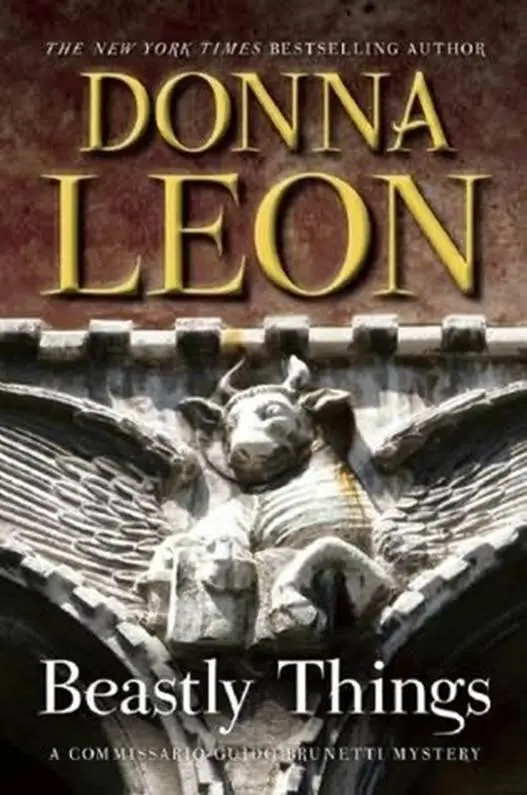
- Название:Beastly Things
- Автор:
- Жанр:
- Год:неизвестен
- ISBN:нет данных
- Рейтинг книги:5 / 5. Голосов: 1
-
Избранное:Добавить в избранное
- Отзывы:
-
Ваша оценка:
Beastly Things: краткое содержание, описание и аннотация
Предлагаем к чтению аннотацию, описание, краткое содержание или предисловие (зависит от того, что написал сам автор книги «Beastly Things»). Если вы не нашли необходимую информацию о книге — напишите в комментариях, мы постараемся отыскать её.
Brunetti soon realises why he remembers the dead man, and asks Signorina Elettra if she can help him find footage of a farmers’ protest the previous autumn. But what was his involvement with the protest, and what does it have to do with his murder? Acting on the fragile lead, Brunetti and Inspector Vianello set out to uncover the man’s identity. Their investigation eventually takes them to a slaughterhouse on the mainland, where they discover the origin of the crime, and the world of blackmail and corruption that surrounds it.
Both a gripping case and a harrowing exploration of the dark side of Italy’s meat industry, Donna Leon’s latest novel is a compelling addition to the Brunetti series.
Beastly Things — читать онлайн бесплатно полную книгу (весь текст) целиком
Ниже представлен текст книги, разбитый по страницам. Система сохранения места последней прочитанной страницы, позволяет с удобством читать онлайн бесплатно книгу «Beastly Things», без необходимости каждый раз заново искать на чём Вы остановились. Поставьте закладку, и сможете в любой момент перейти на страницу, на которой закончили чтение.
Интервал:
Закладка:
Caught by memory, Vianello placed his glass on the table, his sandwiches forgotten. ‘He told me he had an uncle who starved to death. They found him in his barn one morning, in the winter.’
Brunetti, who had heard similar stories when he was a boy, asked nothing.
Vianello looked across at Brunetti and smiled. ‘But it doesn’t help anything, does it, talking about these things?’ He picked up one of his sandwiches, took a tentative bite, as if to remind himself what eating was, apparently liked it, and finished the tramezzino in two more quick bites. And then the other.
‘I’m curious about this Borelli woman,’ Brunetti said.
‘Signorina Elettra will find whatever there is,’ Vianello observed, repeating one of the Seven Pillars of Wisdom of the Questura.
Brunetti finished his wine and set down his glass. ‘Patta wouldn’t like it to have been a robbery,’ he said, repeating another one. ‘Let’s go back.’
21
THE RELIEF OF sitting and talking while eating and drinking restored their spirits, and when they left the bar, it seemed the lingering odour was gone from their jackets. Walking along the riva , Brunetti said he would ask Signorina Elettra to have a look into the life of Signorina Borelli. Vianello offered to see what there was to be found out about Papetti, the director of the slaughterhouse, both from official sources and from ‘friends on the mainland’, whatever that might mean. When they entered the Questura, the Inspector went into the officers’ room and Brunetti continued up to Patta’s office.
Signorina Elettra was behind her computer, her arms raised over her head, hands clasped. ‘I hope I’m not disturbing you,’ Brunetti said as he came in.
‘Not at all, Dottore,’ she said, lowering her arms but continuing to wiggle her fingers as she did so. ‘I’ve been sitting behind this screen all day, and I suppose I’m tired of it.’
Had his son said he was tired of eating, or Paola said she was tired of reading, Brunetti could have been no more astonished. He wanted to ask if she was tired of… but he failed to find the word that adequately named what she did all day. Snooping? Unearthing? Breaking the law?
‘Is there something else you’d rather do?’ he asked.
‘Is that a polite question or a real question, Signore?’
‘I believe it’s a real one,’ Brunetti admitted.
She ran her hand through her hair and considered his question. ‘I suppose if I had to choose a profession, I’d like to have been an archaeologist.’
‘Archaeologist?’ he could only repeat. Oh, the secret dream of so many people he knew.
She put on her most public smile and voice. ‘Of course, only if I could make sensational discoveries and become very, very famous.’
Aside from Carter and Schliemann, Brunetti thought, few archaeologists became famous.
Refusing to believe her about this part of her desire, he asked, with audible scepticism, ‘Only for fame?’
She was silent a long time, considering, then smiled and admitted, ‘No, not really. I’d like to find the pretty trinkets, of course – that’s the only reason archaeologists become famous – but what I’d really like to know is how people lived their daily lives and how much they were like us. Or different, in fact. Though I’m not sure it’s archaeology that tells us that.’
Brunetti, who believed that it wasn’t and that literature had far more to tell about how people were and lived, nodded. ‘What do you look at in the museums?’ he asked. ‘The beautiful pieces or the belt loops?’
‘That’s what’s so perplexing,’ she answered. ‘So much of their everyday stuff was beautiful that I never know what to look at. Belt loops, hairpins, even the clay dishes they ate from.’ She thought about this and then added, ‘Or maybe we consider them beautiful only because they’re handmade, and we’re so accustomed to seeing mass-produced things that we say they’re beautiful only because each one is different and because we’ve come to place a higher value on handmade objects.’
She gave a quick laugh and then added, ‘I suspect most of them would be willing to trade their beautiful clay drinking cup for a glass jam jar with a lid, or their hand-carved ivory comb for a dozen machine-made needles.’
To show that he agreed, he upped the ante and said, ‘They’d probably give you anything you asked for in exchange for a washing machine.’
She laughed again. ‘ I’d give you anything you asked for in exchange for a washing machine.’ Then, suddenly serious, she added, ‘I suspect that most people – at least women – would be willing to renounce their right to vote in exchange for a washing machine. God knows I would.’
Brunetti at first thought she was joking, pushing things over the top as was her wont, but then he realized she was not.
‘Would you really?’ he asked, incredulous.
‘For a vote in this country? Absolutely.’
‘And in some other country?’ he asked.
This time she ran the fingers of both hands through her hair and lowered her head. She sat as though she were watching the names of the nations of the world scroll by on the surface of her desk. Finally she looked up and said, all playfulness removed from her voice, ‘I’m afraid I would.’
Rejoinder or comment had he none, and so he said, ‘I’ve got some things I’d like you to find, Signorina.’
Instantly, she ceased being a statue representing the demise of democracy and was transformed into her usual efficient self. He gave her Giulia Borelli’s name and explained her relationship to the murdered man and her job at the slaughterhouse. Though he had little doubt of Vianello’s competence, Brunetti did remember that Signorina Elettra was the master, Vianello only the apprentice, and so he added the names of Papetti and Bianchi, explaining who each of them was.
‘Is the press going to hound us about this, do you think?’ he asked.
‘Oh, they’ve got the uncle, now,’ she said. ‘So no one writes. No one calls.’ Her allusion to the murder case that was currently convulsing the country was clear: a murder within the confines of a close-knit family, with parents and relatives telling different stories about the victim and the accused. Each new day brought additions and subtractions to the list of perpetrators; the press and television were gorged with people willing to be interviewed. It seemed that each day also brought a new photo of some mournful-faced member of the same family holding up a photo of the sweet young victim; then by the next day the photo-holder had been transformed by the revelations of yet another relative from mourner to suspect.
The coffee in the bars was flavoured by the story; one could not ride a boat without hearing it discussed. In the early stages, a month ago, when the young woman first disappeared, the policeman in Brunetti wanted to stand on the boat landings and shout, ‘It was someone in the family’, but he had kept a rigorous, professional silence. Now, when the subject arose, as it did everywhere, he refused to feign surprise at the new discoveries and did his best to change the subject.
Thus, even with Signorina Elettra, he didn’t bother to engage and said, instead, ‘If anyone from the press does call, direct them to the Vice-Questore, would you?’
‘Of course, Commissario.’
He had been curt; of course he had been curt, but he had not wanted to be sucked into yet another discussion of the crime. It troubled him that many people had so readily come to treat murder as a kind of savage joke, to which the only response was grotesque humour. Perhaps this reaction was no more than magic thinking, a manifestation of the hope that laughter would keep it from happening again, or from happening to the person who laughed.
Читать дальшеИнтервал:
Закладка:
Похожие книги на «Beastly Things»
Представляем Вашему вниманию похожие книги на «Beastly Things» списком для выбора. Мы отобрали схожую по названию и смыслу литературу в надежде предоставить читателям больше вариантов отыскать новые, интересные, ещё непрочитанные произведения.



Обсуждение, отзывы о книге «Beastly Things» и просто собственные мнения читателей. Оставьте ваши комментарии, напишите, что Вы думаете о произведении, его смысле или главных героях. Укажите что конкретно понравилось, а что нет, и почему Вы так считаете.