Donna Leon - Beastly Things
Здесь есть возможность читать онлайн «Donna Leon - Beastly Things» весь текст электронной книги совершенно бесплатно (целиком полную версию без сокращений). В некоторых случаях можно слушать аудио, скачать через торрент в формате fb2 и присутствует краткое содержание. Жанр: Детектив, на английском языке. Описание произведения, (предисловие) а так же отзывы посетителей доступны на портале библиотеки ЛибКат.
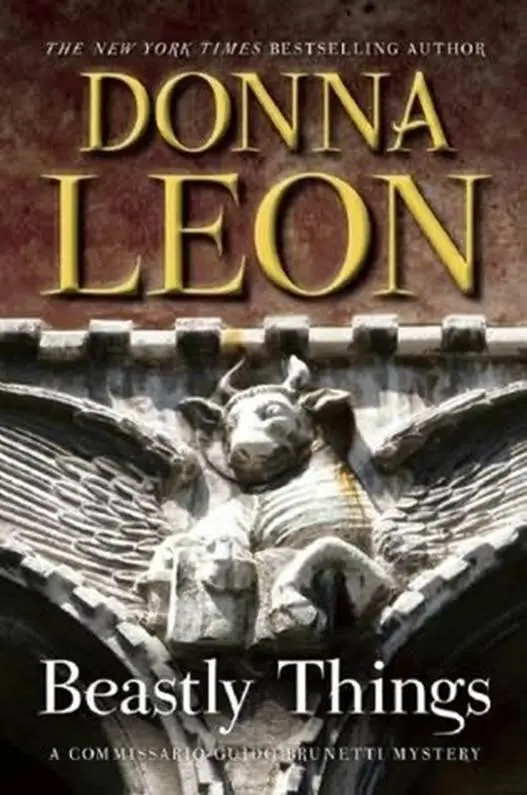
- Название:Beastly Things
- Автор:
- Жанр:
- Год:неизвестен
- ISBN:нет данных
- Рейтинг книги:5 / 5. Голосов: 1
-
Избранное:Добавить в избранное
- Отзывы:
-
Ваша оценка:
Beastly Things: краткое содержание, описание и аннотация
Предлагаем к чтению аннотацию, описание, краткое содержание или предисловие (зависит от того, что написал сам автор книги «Beastly Things»). Если вы не нашли необходимую информацию о книге — напишите в комментариях, мы постараемся отыскать её.
Brunetti soon realises why he remembers the dead man, and asks Signorina Elettra if she can help him find footage of a farmers’ protest the previous autumn. But what was his involvement with the protest, and what does it have to do with his murder? Acting on the fragile lead, Brunetti and Inspector Vianello set out to uncover the man’s identity. Their investigation eventually takes them to a slaughterhouse on the mainland, where they discover the origin of the crime, and the world of blackmail and corruption that surrounds it.
Both a gripping case and a harrowing exploration of the dark side of Italy’s meat industry, Donna Leon’s latest novel is a compelling addition to the Brunetti series.
Beastly Things — читать онлайн бесплатно полную книгу (весь текст) целиком
Ниже представлен текст книги, разбитый по страницам. Система сохранения места последней прочитанной страницы, позволяет с удобством читать онлайн бесплатно книгу «Beastly Things», без необходимости каждый раз заново искать на чём Вы остановились. Поставьте закладку, и сможете в любой момент перейти на страницу, на которой закончили чтение.
Интервал:
Закладка:
‘You deny suggesting it?’ Patta asked, level-voiced.
‘Vice-Questore,’ Brunetti said in his calmest, most reasonable voice, ‘it doesn’t matter where they got the idea.’ Knowing the crannies and dark corners of Patta’s brain as he did, Brunetti went on to say, ‘If you think about it, “personal vendetta” is far better than the idea that it was random assault.’ He was careful to keep his eyes on the paper and pay no attention to Patta as he said this, speaking as though he were engaged in idle reflection. It probably didn’t matter to Patta that a man had been stabbed and tossed into a canal, so long as the man was a local. Had he been a tourist, then the crime would have disturbed Patta, and had the victim been a tourist from a wealthy European country, there was no saying how strong the Vice-Questore’s response would have been.
‘Possibly,’ Patta said grudgingly; Brunetti translated this immediately into an unspoken ‘You’re probably right.’ He folded the paper closed, and set it in front of Patta. He pasted a look of dutiful eagerness across his face.
‘What have you done?’ Patta finally asked.
‘I spoke to his wife. His widow.’
‘And?’ Patta asked, but he said it in such a way that Brunetti decided that this was not the day to continue sparring with Patta.
‘She told me they were separated; there’s no question she wanted a divorce. He was involved with a woman colleague. Not at his clinic but at the macello where he worked: it’s just outside of Preganziol.’ He paused to give Patta the opportunity to ask questions, but his superior merely nodded. ‘His wife said he was troubled.’
‘Other than with this woman?’ Patta asked.
‘So it would seem from what she said, or from the way she said it. I wanted to get a sense of the place.’ More than that, Brunetti could not bring himself to say.
‘And?’
‘It’s not a nice place: they kill animals and cut them up,’ Brunetti said bluntly. ‘I spoke to the woman who must have been his lover.’
Before he could continue, Patta cut him off, demanding, ‘You didn’t tell her you know about their affair, did you?’
‘No, sir.’
‘What did you tell her?’
‘That he was dead.’
‘How did she react?’
Brunetti had been thinking about this for some time. ‘She was angry that it took us so long to tell her, but she didn’t say anything particular about him.’
‘No reason to, really, I suppose,’ Patta said. Then, seeing Brunetti’s reaction and displaying a remarkable sensitivity to it, Patta hastened to add, ‘From her point of view, that is.’ Returning to his usual self, he demanded, ‘What’s a woman doing working there, anyway?’
‘I don’t know, sir,’ Brunetti said, ignoring this echo of his own thoughts.
‘It doesn’t sound like you got much information,’ Patta said, sounding gratified to be able to say it.
Brunetti had, on the contrary, got too much information, but this was not something he wanted to discuss with Patta or, indeed, with anyone. He contented himself with giving Patta a serious look, then said, ‘I suppose you’re right, Vice-Questore. I didn’t learn much about what he did out there, nor how this woman might enter into things. If at all.’ He was suddenly too tired and – much as it disgusted him to admit it – too hungry to dispute things with Patta. He allowed his gaze to drift towards the window of Patta’s office, the one that looked out on the same campo as his.
He was suddenly tempted to ask Patta if he had ever considered the view from his window as a metaphor for the difference between himself and Brunetti. They both looked at the same thing, but because Brunetti’s view came from a higher place, it was better. No, perhaps wiser not to ask Patta this.
‘Well, get busy with it, then,’ Patta said in the voice he used when urged to be a mover of men and a creator of dynamic action.
Brunetti knew from long experience that this was the voice that was most in need of deference, and so he answered, ‘ Sì, Dottore ,’ and got to his feet.
Downstairs, Vianello was at his desk. He was not reading, nor talking with his colleagues nor on the phone. He sat at his desk, motionless and silent, apparently deep in consideration of its surface. When Brunetti came in, the other men in the room looked at him uneasily, almost as if they feared he was coming to take Vianello away because of something he had done.
Brunetti stopped at the desk of Masiero and asked in a normal voice if he had had any luck with the break-ins to the cars parked in the Municipal Garage at Piazzale Roma. The officer told him that, the night before, three of the video cameras in the garage had been vandalized, and six cars had been broken into.
Though he was not involved in the case and had no interest in it, Brunetti continued to question the officer about it, speaking more loudly than he ordinarily would. As Masiero explained his theory that the thefts must be the work of someone who worked there or of someone who parked his car there, Brunetti kept the edge of his attention on Vianello, who remained still and silent.
Brunetti was about to suggest disguising or camouflaging the cameras when he sensed motion from Vianello, and a moment later the Inspector was at his side. ‘Yes, a coffee would be good.’
Without another word to Masiero, Brunetti left the squad room and led the way down to the front door and then along the riva towards the bar up near the bridge. Neither had much to say, though Vianello did observe dully that it would probably be easier simply to check the schedule of the people working at the garage for the nights of the thefts. That failing, he went on, it would be easy enough to check the computer list of those who had used their entrance cards to park or remove their cars on the nights in question.
They entered the bar and, united in their hunger, stood and studied the tramezzini on offer. Bambola asked what they would like. Brunetti asked for a tomato and egg and a tomato and mozzarella. Vianello said he’d have the same. Both asked for white wine and took their glasses to the booth at the far end of the bar.
It was only a moment before Bambola was there with the sandwiches. Ignoring them, Vianello drank half his wine; Brunetti did the same, then nodded to Bambola, holding up his glass and pointing to Vianello’s.
He set his glass down and picked up one of the tramezzini , not bothering to see which it was. Hunger demanded haste, not consideration. Less mayonnaise than Sergio used, Brunetti determined with the first bite, and all the better for that. He finished his glass and handed it to the returning Bambola.
‘Well?’ Brunetti finally said as the barman went off with the empty glasses.
‘What did Patta say?’ Vianello asked, then smiled at Brunetti’s look. ‘Alvise saw you going in.’
‘He told me to get on with it, without specifying what he meant. I take it to mean the Borelli woman.’
‘It didn’t look like a place a woman would want to be,’ Vianello said, echoing his and Patta’s thought while somehow managing to make it sound less objectionable. Then the Inspector surprised him by saying, ‘My grandfather was a farmer.’
‘I thought he was Venetian,’ Brunetti said, one thing making the other impossible.
‘Not until he was almost twenty. He came here just before the First World War. My mother’s father. His family was starving to death on a farm in Friuli, so they took the middle boy and sent him to the city to work. But he grew up on a farm. I remember, when I was a kid, he used to tell me stories about what it was like to work under a padrone . The man who owned the farm would ride over on his horse every day and count the eggs, or at least count the chickens and then demand more eggs if he didn’t get the number he thought was right.’ Vianello looked out the window of the bar at the people walking up and down the bridge. ‘Think of it: the guy owned most of the farms in the region, and he spent his time counting eggs.’ He shook his head at the thought and added, ‘He told me the only thing they could do, sometimes, was drink some of the milk while it was set out to settle overnight.’
Читать дальшеИнтервал:
Закладка:
Похожие книги на «Beastly Things»
Представляем Вашему вниманию похожие книги на «Beastly Things» списком для выбора. Мы отобрали схожую по названию и смыслу литературу в надежде предоставить читателям больше вариантов отыскать новые, интересные, ещё непрочитанные произведения.





Обсуждение, отзывы о книге «Beastly Things» и просто собственные мнения читателей. Оставьте ваши комментарии, напишите, что Вы думаете о произведении, его смысле или главных героях. Укажите что конкретно понравилось, а что нет, и почему Вы так считаете.