Donna Leon - Beastly Things
Здесь есть возможность читать онлайн «Donna Leon - Beastly Things» весь текст электронной книги совершенно бесплатно (целиком полную версию без сокращений). В некоторых случаях можно слушать аудио, скачать через торрент в формате fb2 и присутствует краткое содержание. Жанр: Детектив, на английском языке. Описание произведения, (предисловие) а так же отзывы посетителей доступны на портале библиотеки ЛибКат.
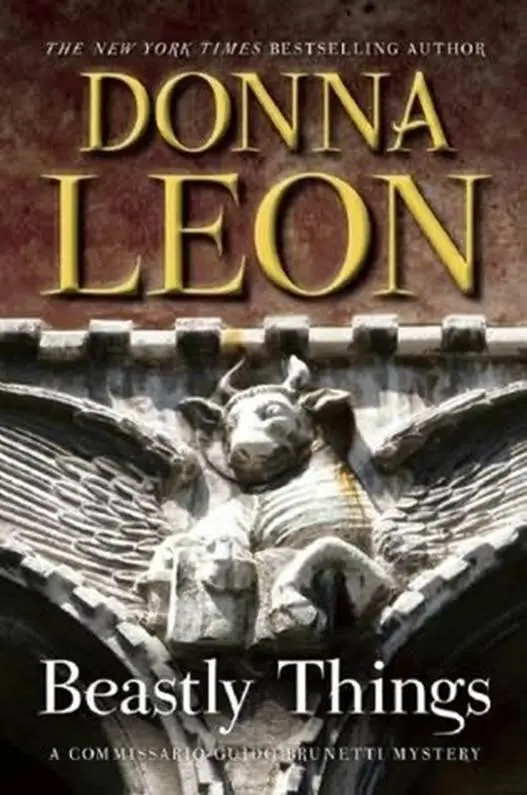
- Название:Beastly Things
- Автор:
- Жанр:
- Год:неизвестен
- ISBN:нет данных
- Рейтинг книги:5 / 5. Голосов: 1
-
Избранное:Добавить в избранное
- Отзывы:
-
Ваша оценка:
Beastly Things: краткое содержание, описание и аннотация
Предлагаем к чтению аннотацию, описание, краткое содержание или предисловие (зависит от того, что написал сам автор книги «Beastly Things»). Если вы не нашли необходимую информацию о книге — напишите в комментариях, мы постараемся отыскать её.
Brunetti soon realises why he remembers the dead man, and asks Signorina Elettra if she can help him find footage of a farmers’ protest the previous autumn. But what was his involvement with the protest, and what does it have to do with his murder? Acting on the fragile lead, Brunetti and Inspector Vianello set out to uncover the man’s identity. Their investigation eventually takes them to a slaughterhouse on the mainland, where they discover the origin of the crime, and the world of blackmail and corruption that surrounds it.
Both a gripping case and a harrowing exploration of the dark side of Italy’s meat industry, Donna Leon’s latest novel is a compelling addition to the Brunetti series.
Beastly Things — читать онлайн бесплатно полную книгу (весь текст) целиком
Ниже представлен текст книги, разбитый по страницам. Система сохранения места последней прочитанной страницы, позволяет с удобством читать онлайн бесплатно книгу «Beastly Things», без необходимости каждый раз заново искать на чём Вы остановились. Поставьте закладку, и сможете в любой момент перейти на страницу, на которой закончили чтение.
Интервал:
Закладка:
He considered himself a broadly read man, and yet much of this he had not known. The destruction of the rain forest to clear it for cattle: of course, he knew about that. Mad Cow and Foot and Mouth: he was familiar with them, as well, with their coming and their going. Only it seemed they were not gone, not really.
Brunetti’s ignorance had evaporated as he read the long account of a South American rancher who had attended an animal husbandry programme at a university in the United States. He painted a picture of animals that were born sick, kept alive only by massive doses of antibiotics, made productive by equal doses of hormones, and who died still sick. The writer ended the article by stating that he would never eat beef unless it was one of his own animals and he had overseen its raising and slaughter. Like Paola, who had heard too much that day about books, Brunetti suddenly decided he had read too much about beef. Soon before seven, he left his office, went downstairs and wrote a note for Foa, asking about the tides, and left the Questura; he started towards home, passing eventually through no-longer-crowded Campo Santa Maria Formosa. Campo San Bortolo was busy, but he had no trouble crossing it, nor were there many people on the bridge.
He arrived in an empty apartment before seven-thirty, took off his jacket and shoes, went down to the bedroom and retrieved his copy of the plays of Aeschylus – he didn’t know what force had driven him back to read them again – and sprawled himself on the sofa in Paola’s study, eager to read a book in which there was no risk of sentimentality – only bleak human truth – and eager to tell Paola about the cows.
Agamemnon was in the midst of greeting his wife after his decades-long absence by telling her that her speech of welcome, like his absence, had been much prolonged, and the hair on the back of Brunetti’s neck had begun to rise at the man’s folly, when he heard Paola’s key in the lock. What would she do, he wondered, if he were to betray her, shame her, and bring a new lover into their home? Less than Clytemnestra did, he suspected, and without physical violence. But he had no doubt that she would do her best to destroy him with words and with the power of her family, and he was sure she would leave him with nothing.
He heard her set down some shopping bags by the door. While hanging up her jacket, she would see his. He called her name, and she called back that she’d be there in a minute. Then he heard the rustle of the plastic bags and her footsteps retreating towards the kitchen.
She wouldn’t do it for jealousy, he knew, but from injured pride and a sense of honour betrayed. Her father, with a phone call, would see that he was quietly transferred to some stagnant, Mafia-infested village in Sicily; she’d have every sign of him out of the apartment in a day. Even his books. And she’d never speak his name again; perhaps with the children, though they’d know enough not to name him or ask about him. Why did knowing this make him so happy?
She was back, carrying two glasses of prosecco. He had been so preoccupied with their separation and her revenge that he had not heard the pop of the cork, though it was a sound that had the beauty of music for Brunetti.
Paola handed him a glass and tapped his knee until he pulled his feet up and made room for her. He sipped. ‘This is the champagne,’ he said.
‘I know,’ she said, sipping in her turn. ‘I felt I deserved a reward.’
‘What for?’
‘Suffering fools.’
‘Gladly?’
She gave a snort of contempt. ‘Listening to their nonsense and pretending to pay attention to it or pretending to think their idiotic ideas are worthy of discussion.’
‘The thing about good books?’
She pushed her hair back with one hand, scratched idly at the base of her skull. In profile, she was the same woman he had met and loved decades ago. The blonde hair was touched with white, but it was hard to see unless one were very close. Nose, chin, line of the mouth: they were all the same. Seen from the front, he knew, there were creases around her eyes and at the corners of her mouth, but she could still cause heads to turn on the street or at a dinner party.
She took a deep swallow and flopped against the back of the sofa, careful not to spill any wine. ‘I don’t know why I bother to keep teaching,’ she said, and Brunetti did not remark that it was because she loved it. ‘I could stop. We own the house, and you make enough to support us both.’ And if things got rough, he did not say, they could always pawn the Canaletto in the kitchen. Let her talk, let her get rid of it.
‘What would you do, lie on the sofa all day in your pyjamas and read?’ he asked.
She patted his knee with her free hand. ‘You pretty much prevent my taking up residence on the sofa, don’t you?’
‘But what would you do?’ he asked, suddenly serious.
She took another sip, then said, ‘That’s the problem, of course. If you quit, you could always be a security guard and walk around all night sticking little pieces of paper into the doorways of houses and stores to show you’d been there. But no one’s going to ask me to come and talk to them about the English novel, are they?’
‘Probably not,’ he agreed.
‘Might as well live,’ she confused him by saying, but he was so eager to talk about the cows that he did not ask her to explain what she had said.
‘How much do you know about cows?’ he asked.
‘Oh, my God. Not another one,’ she said and sank down on the sofa, her hand pressed to her eyes.
11
‘WHAT DO YOU mean, “Another one”?’ he asked, though what he really wanted to know was whom she included among them.
‘As I have told you at least twelve thousand times in the last decades: don’t be smart with me, Guido Brunetti,’ she said with exaggerated severity. ‘You know exactly who they are: Chiara, Signorina Elettra, and Vianello. And from what you’ve said, I suspect those last two will soon have the Questura declared a no-meat zone.’
After what he had read that afternoon, Brunetti thought this might not be such a bad thing. ‘They’re just the lunatic fringe, though other people there are beginning to think about it, too,’ he offered.
‘If you ever set foot in a supermarket and saw what people are buying, you wouldn’t say that, believe me.’
The few times he had had that experience, Brunetti had – he confessed to himself – been fascinated by what he saw people buying, given the probability that they intended to eat those things. So rarely did he shop for groceries that Brunetti had been uncertain as to the nature of some of the products he saw and could not work out whether they were meant for consumption or for some other domestic purpose; scouring sinks, perhaps.
He remembered, as a boy, being sent to the store to get, for example, a half-kilo of limon beans. He had come home carrying them in the cylinder of newspaper in which the shopkeeper had wrapped them. But now they came in a clear plastic package bound with a bow of golden ribbon, and it was impossible to buy less than a kilo. His mother had lit the fire in the kitchen with the newspaper: the plastic and the bow went into the garbage after their fifteen minutes of freedom from the shelves.
‘We don’t eat as much meat as we used to,’ he said.
‘That’s only because Chiara’s too young to leave home.’
‘Is that what she’d do?’
‘Or stop eating,’ Paola declared.
‘She’s really that convinced?’
‘Yes.’
‘How about you?’ he asked. It was Paola, after all, who decided what they would eat every day.
She finished her champagne and twirled the glass between her palms, as though hoping to start a fire with it.
Читать дальшеИнтервал:
Закладка:
Похожие книги на «Beastly Things»
Представляем Вашему вниманию похожие книги на «Beastly Things» списком для выбора. Мы отобрали схожую по названию и смыслу литературу в надежде предоставить читателям больше вариантов отыскать новые, интересные, ещё непрочитанные произведения.





Обсуждение, отзывы о книге «Beastly Things» и просто собственные мнения читателей. Оставьте ваши комментарии, напишите, что Вы думаете о произведении, его смысле или главных героях. Укажите что конкретно понравилось, а что нет, и почему Вы так считаете.