Donna Leon - Beastly Things
Здесь есть возможность читать онлайн «Donna Leon - Beastly Things» весь текст электронной книги совершенно бесплатно (целиком полную версию без сокращений). В некоторых случаях можно слушать аудио, скачать через торрент в формате fb2 и присутствует краткое содержание. Жанр: Детектив, на английском языке. Описание произведения, (предисловие) а так же отзывы посетителей доступны на портале библиотеки ЛибКат.
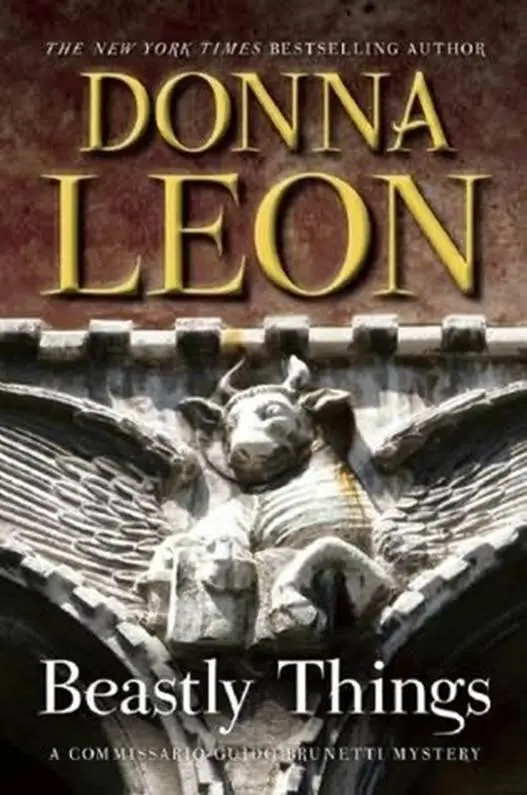
- Название:Beastly Things
- Автор:
- Жанр:
- Год:неизвестен
- ISBN:нет данных
- Рейтинг книги:5 / 5. Голосов: 1
-
Избранное:Добавить в избранное
- Отзывы:
-
Ваша оценка:
Beastly Things: краткое содержание, описание и аннотация
Предлагаем к чтению аннотацию, описание, краткое содержание или предисловие (зависит от того, что написал сам автор книги «Beastly Things»). Если вы не нашли необходимую информацию о книге — напишите в комментариях, мы постараемся отыскать её.
Brunetti soon realises why he remembers the dead man, and asks Signorina Elettra if she can help him find footage of a farmers’ protest the previous autumn. But what was his involvement with the protest, and what does it have to do with his murder? Acting on the fragile lead, Brunetti and Inspector Vianello set out to uncover the man’s identity. Their investigation eventually takes them to a slaughterhouse on the mainland, where they discover the origin of the crime, and the world of blackmail and corruption that surrounds it.
Both a gripping case and a harrowing exploration of the dark side of Italy’s meat industry, Donna Leon’s latest novel is a compelling addition to the Brunetti series.
Beastly Things — читать онлайн бесплатно полную книгу (весь текст) целиком
Ниже представлен текст книги, разбитый по страницам. Система сохранения места последней прочитанной страницы, позволяет с удобством читать онлайн бесплатно книгу «Beastly Things», без необходимости каждый раз заново искать на чём Вы остановились. Поставьте закладку, и сможете в любой момент перейти на страницу, на которой закончили чтение.
Интервал:
Закладка:
‘Half a million?’ Chiara repeated, stunned by the number. As if comment or question were useless, she could only repeat, ‘Half a million.’
‘Actually, I think it was more. Maybe six hundred thousand, but it depends on who you read.’ Brunetti took another sip, replaced his glass, and said, ‘That’s not counting civilians, I think.’
‘Jesus on the cross,’ Raffi whispered.
Paola shot him a sharp glance, but it was clear to all of them that astonishment, not blasphemy, had provoked the remark.
‘That’s twelve Venices,’ Raffi said in a small, astonished voice.
Brunetti, in his desire for clarity, even statistical clarity, said, ‘Since it was only young men between the ages of sixteen and twenty-five or so, it’s far more than that. It would go a long way to depopulating much of the Veneto in the next generation.’ After a moment’s reflection, he added, ‘Which is pretty much what it did.’ He remembered, then, listening as a child as his paternal grandmother chatted with her friends, a recurring topic their good luck in having found a man to marry – a good man or a bad man – when so many of their friends had never been able to find a husband. And he thought of the war memorials he had seen in the North, up near Asiago and above Merano, listing the names of the ‘Heroes of the Nation’, so often long lists of men with the same surname, all dead in the snow and the mud, their lives cast away to gain a metre of barren land or a medal for a general’s chest.
‘Cadorna,’ he said, naming the supreme commander of that benighted campaign.
‘We were told he was a hero,’ Raffi said.
Brunetti closed his eyes for a moment.
‘At least that’s what we were told in liceo , that he held off the attack of the Austrian invader.’
It was with some effort that Brunetti quelled the impulse to ask if the same teachers praised the brave Italian troops who had quelled the invading Ethiopians or the invading Libyans. He contented himself with saying only, ‘Italy declared war on Austria.’
‘Why?’ Raffi demanded, looking as though he could not believe this.
‘Why do countries ever declare war?’ Paola broke in to ask. ‘To get land, to grab natural resources, to maintain their power.’ It came to Brunetti to wonder why there was such fuss when parents explained the mechanism of sex to their children. Wasn’t it far more dangerous for parents to explain to them the mechanism of power?
He intervened. ‘You’re talking about aggressive war, I assume. Not like Poland, the last time?’
‘Of course not,’ Paola agreed. ‘Or Belgium, or Holland, or France. They were invaded and they fought back.’ Looking at the children, she said, ‘And your father’s right: we did declare war on Austria.’
‘But why?’ Raffi repeated.
‘I’ve always assumed from what I read that it was to get back land the Austrians had taken, or been given, in the past,’ Paola answered.
‘But how do you know who it belongs to?’ Chiara asked.
Seeing that their plates were empty – Raffi having managed to clean his during some lightning pause in the conversation – Paola held up her hands in the manner of a soccer umpire calling ‘Time’. ‘I want to beg the indulgence of everyone here,’ she said, meeting their eyes one by one. ‘I spent my morning in the apparently futile attempt to defend the idea that some books are better than others, so I cannot bear a second serious discussion, certainly not at this table, not while I’m eating my lunch. And so I suggest we change the topic to something frivolous and stupid like liposuction or break dancing.’
Raffi started to protest, but Paola cut him off by saying, ‘There are calamari in umido with peas to follow – and finocchio al forno for Chiara – and then there is a crostata di fragole, but it will be given only to those who are subject to my will.’
Brunetti watched Raffi consider his options. His mother always made more finocchio than one person could eat, and this was the best season for fragole. ‘My only joy in life,’ he said, picking up his plate and preparing to take it to the sink, ‘is to live in abject subservience to the will of my parents.’
Paola turned to Brunetti. ‘Guido, you read all those Romans: which goddess was it who gave birth to a snake?’
‘None of them, I fear.’
‘Left it to us humans, then.’
10
FOR ALL BRUNETTI managed to achieve at the Questura that afternoon, he might as well have stayed at home for the rest of the day. Foa, he learned at four, had been chosen to accompany the Questore and a delegation from Parliament on a tour of the MOSE project – that money-guzzler that would, or would not, save the city from acqua alta – and then to dinner in Pellestrina. ‘This is why no one’s ever in Rome to vote,’ Brunetti muttered to himself when he hung up from receiving this news. He knew he could easily call the office of the Magistrate of the Waters and ask the question about the tides, but he preferred to keep within the confines of the Questura any precise information about the nature of the investigation.
He spoke briefly with Patta, who said that he, in the absence of the Questore, had spoken to the press and given the usual assurances that there was every expectation of a speedy arrest in the case and that they were following various leads. Things had been slow for the last month – few major crimes in the region – so the famished press was bound to fall upon this one. And how refreshing readers would find it to have a male victim for a change; it had been open season on women since the beginning of the year: one a day had been murdered in Italy, usually by the ex boyfriend or husband, the killer – according to the press – always driven by a ‘ raptus di gelosia ’, which excuse was sure to appear as the main pillar of the subsequent defence. If Brunetti ever lost his temper with Scarpa and did him a deliberate injury, he would surely plead a raptus di gelosia , though he was hard pressed to think of a reason why he would feel jealous of the Lieutenant.
Pucetti called after six to say he had had a technical problem but had just managed to isolate some still photos from the first video and was sure to have the prints within an hour or so. Brunetti told him that the following morning would do.
He resisted the urge to call Signorina Elettra and ask what success she had had with her friend in the health office, sure that she would let him know as soon as she learned anything, but no less impatient for that.
Becalmed, Brunetti flicked on his computer and tapped in mucche , wondering what Vianello and Signorina Elettra found so objectionable in those poor beasts. His family was Venetian as far back as anyone could remember, and then well beyond, so there was no atavistic memory of a great-great somebody who had kept a cow in the barn behind the house and thus no explanation for the sympathy Brunetti felt for them. He had never milked one; to the best of his memory had never done more than touch the noses of friendly cattle safely behind fences when they went walking in the mountains. Paola, even more fully urban than he, admitted that they frightened her, but Brunetti had never been able to understand this. They were, he believed, perfect milk machines: grass went in one end and milk came out the other: it was ever so.
He chose an article at random from those listed and began to read. After an hour, a shaken Brunetti turned off the computer, made a steeple of his palms and pressed his lips against it. So that was it, and that was why intermittently vegetarian Chiara, though she would occasionally backslide when in the presence of a roast chicken, adamantly refused to eat beef. And Vianello and Signorina Elettra. He wondered how it was that he had not known all of this. Surely everything he had just read was public knowledge; to some people it was common knowledge.
Читать дальшеИнтервал:
Закладка:
Похожие книги на «Beastly Things»
Представляем Вашему вниманию похожие книги на «Beastly Things» списком для выбора. Мы отобрали схожую по названию и смыслу литературу в надежде предоставить читателям больше вариантов отыскать новые, интересные, ещё непрочитанные произведения.

Обсуждение, отзывы о книге «Beastly Things» и просто собственные мнения читателей. Оставьте ваши комментарии, напишите, что Вы думаете о произведении, его смысле или главных героях. Укажите что конкретно понравилось, а что нет, и почему Вы так считаете.