Thomas Adcock - Brooklyn Noir 3 - Nothing but the Truth
Здесь есть возможность читать онлайн «Thomas Adcock - Brooklyn Noir 3 - Nothing but the Truth» весь текст электронной книги совершенно бесплатно (целиком полную версию без сокращений). В некоторых случаях можно слушать аудио, скачать через торрент в формате fb2 и присутствует краткое содержание. Город: New York, Год выпуска: 2008, ISBN: 2008, Издательство: Akashic Books, Жанр: Детектив, на английском языке. Описание произведения, (предисловие) а так же отзывы посетителей доступны на портале библиотеки ЛибКат.
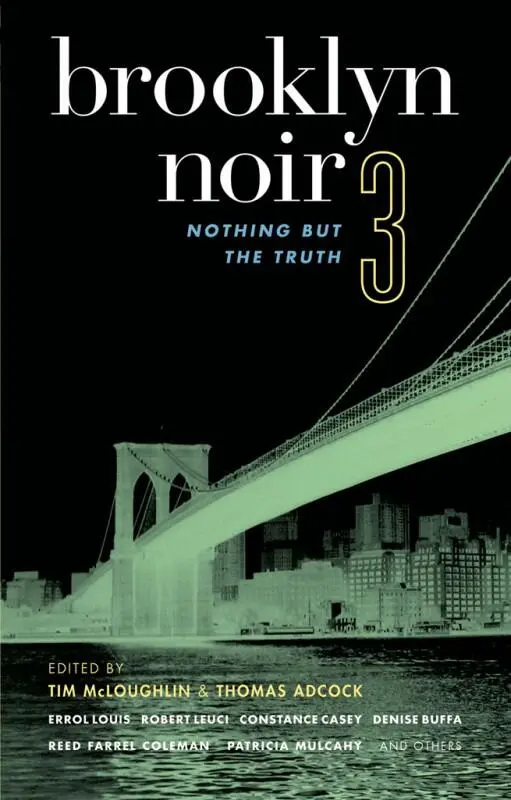
- Название:Brooklyn Noir 3: Nothing but the Truth
- Автор:
- Издательство:Akashic Books
- Жанр:
- Год:2008
- Город:New York
- ISBN:978-1-933354-14-9
- Рейтинг книги:3 / 5. Голосов: 1
-
Избранное:Добавить в избранное
- Отзывы:
-
Ваша оценка:
Brooklyn Noir 3: Nothing but the Truth: краткое содержание, описание и аннотация
Предлагаем к чтению аннотацию, описание, краткое содержание или предисловие (зависит от того, что написал сам автор книги «Brooklyn Noir 3: Nothing but the Truth»). Если вы не нашли необходимую информацию о книге — напишите в комментариях, мы постараемся отыскать её.
. This volume presents the first nonfiction collection in the series, curated by acclaimed novelists Tim McLoughlin and Thomas Adcock.
Brand-new stories by: Robert Leuci, Dennis Hawkins, Tim McLoughlin, Thomas Adcock, Errol Louis, Denise Buffa, Patricia Mulcahy, C. J. Sullivan, Reed Farrel Coleman, Aileen Gallagher, Christopher Musella, Kim Sykes, Robert Knightly, Jess Korman, Constance Casey, and Rosemarie Yu.
Brooklyn Noir 3: Nothing but the Truth — читать онлайн бесплатно полную книгу (весь текст) целиком
Ниже представлен текст книги, разбитый по страницам. Система сохранения места последней прочитанной страницы, позволяет с удобством читать онлайн бесплатно книгу «Brooklyn Noir 3: Nothing but the Truth», без необходимости каждый раз заново искать на чём Вы остановились. Поставьте закладку, и сможете в любой момент перейти на страницу, на которой закончили чтение.
Интервал:
Закладка:
“Plymouth Church was called, by some, the Grand Central Depot ” she began, with a strong, pleasant-sounding voice. “Beecher encouraged his congregation to purchase the freedom of actual slaves in order to draw attention to it. We’ve found evidence of at least eleven mock slave auctions in our files. We can tell by the financial records of the church. Pinky was the most famous. She was nine years old, and auctioned here just before the war. The church returned her to her grandmother.”
I looked around the large room. It reminded me of an Elizabethan theater with its crescent-shaped seating and no center aisle. Stained-glass windows flanked the second-floor balcony depicting famous leaders of the time, including Beecher, his sister, and Abraham Lincoln. A pleasant change I thought from the bloody crucifixion scenes found in most churches. When I asked how she came to be the historian for Plymouth, which was renamed Plymouth Church of the Pilgrims after a merger in 1934, she said, “I realized one day that something had to be done about the history of our church.” Her voice resonated off the high ceiling. “There was too much of it here.”
Lois had a presence and ease about her delivery that made me ask if she was a performer. “I used to sing professionally.” She tilted her head modestly to one side. The light caught a small flame of gray hair above her forehead. “I was a soprano. I would sing all over the city. I sang at Mother Zion up in Harlem for fourteen years. I started in 1967, or was it ’66? I’d have to check to be sure.
“At the time, Adam Clayton Powell, who preached at Abyssinian Baptist Church, didn’t like the idea of me singing in Harlem. In one of his sermons, he complained about me: Those black churches that hire white sopranos...” The memory amused her and me. “But soon after, Mother Zion’s choir went to sing at Abyssinian. Reverend Powell walked up to me and shook my hand and he said, ‘Welcome to Harlem.’”
All this time I had been talking to Lois about history and not realizing that she was a part of it herself.
I asked her if I could stand on the platform where Pinky stood. To my surprise, she said yes. I climbed the few steps up to the small stage, which was about four feet wide and eight feet long and covered in red carpet. Lois stood off to the side and told me about the baptismal recently discovered under the pulpit there, but the pounding in my chest rose to my ears and drummed out her words. The church was empty except for Lois and me; I crossed my arms protectively in front of myself. I couldn’t help but cast my eyes down, like Pinky’s were in the drawing. I felt exposed, vulnerable, and frightened. Mock or real, it must have been awful having your life in the hands of complete strangers, even well-meaning ones. I wanted to get down off the stage.
Lois completed the tour by showing me the basement under the church. A flight of stairs took us down to it. I ran my hand along the brick walls, piecing together yet another part of the puzzle. There were no records of who was hidden here, of course. Thanks to the Fugitive Slave Act of 1850, the federal government could be called in to aid in the arrest and return of slaves to their masters. Runaways and those who assisted them were careful not to leave tracks — yet still I wanted to discover some mark, anything left behind; though I was sure that if such evidence existed, Lois would have found it long ago, as would the rats. “I have to stomp my feet on occasion before coming down here. That usually scares them off,” she said.
The basement was neat and clean considering we were under the church. There were three openings that led underneath separate parts of the building. The entrance to one of them was covered with an iron fire door that led beneath an addition that was built after a fire in the 1920s. Another was blocked by fallen debris and construction material, making it impossible to go inside; but the third opening was unobstructed. Lois switched on a light and I could see the brick pillars that held up the foundation. The dirt floor was strewn with rocks but there was plenty of room to hide.
“One day, the workmen for Con Edison discovered a tunnel under the street next to the church, but they filled it in before we were called.” Lois’s stricken face mirrored my own. “It was unfortunate. It could have given us valuable information.”
Knowing history, and having a physical place to connect it to, is a magical combination. It binds you to that place in time in a way books and films on their own can never do. To be where a momentous event happened, to sit were Lincoln sat, to walk were Harriet Tubman walked, brings the past present, so that for a moment their pain and sacrifice, victories and losses, are yours. Their mistakes are ours not to repeat, and their triumphs to advance upon. It’s why the Holocaust Memorial Museum keeps the shoes from the concentration camps, why we mark where George Washington slept, and why I asked to stand where a slave girl named Pinky once stood. Keeping these artifacts and preserving these places honors our past and is essential to our future.
After I left Plymouth Church, I walked through Brooklyn Heights on streets named after some of the earliest Dutch and English settlers — Hicks, Remsen, Boerum — landowners who made their fortunes in no small part from the efforts of slave labor. The homes are beautiful, pristine, like the homes on Duffield Street once were. Brooklyn Heights is a historic district, with well-documented evidence of its past. It is where, during the revolutionary war, George Washington and his men fought the British and where homes stood through which Harriet Tubman scuttled fugitive slaves to safety during the Civil War. Washington and Tubman couldn’t be more different, and yet their defiant spirit, their determination to do what needed to be done against a formidable enemy, is a large part of what Brooklyn is made of.
“May I have your attention, please?” said a young man who looked like he had just begun shaving that morning. I was on the train headed for Bedford-Stuyvesant. “I don’t mean to disturb you, but I’m selling candy this morning.” I buried my face in my newspaper. Others busied themselves with electronic devices or fiddled inside their purses. “And I’m not selling them for a basketball team or for a school. I’m selling them for myself. Me ,” he said tenaciously. I looked up from my paper. I hadn’t heard this one before. “And I plan on spending my money wisely and in a responsible manner. Thank you.”
As our train pulled into the Utica Avenue station, an older gentleman, a black Muslim dressed in a long white tunic, called the kid over. “I don’t want the candy,” he said. “Take the dollar.” He shoved the money into the kid’s hand with as much cockiness as the kid had shown delivering his speech. Such a display of industriousness and pluck was a perfect introduction to my next destination.
African American historical landmarks are disappearing at an alarming rate. Too often what is left can only be imagined, but sometimes we get lucky. Weeksville was one of the earliest free African American communities, the center of intellectual, cultural, and economic life in Brooklyn. At its peak during the 1860s and ’70s, five hundred to seven hundred prosperous African American families lived there. Susan Smith McKinney-Steward, the first female African American doctor in New York State, and Moses P. Cobb, Brooklyn’s first black policeman, were among them. Some of the homes and churches were key stops on the Underground Railroad, undocumented of course; and there were at least two forgotten newspapers, the Freedman’s Torchlight and the People’s Journal . But despite that history, the four remaining structures of Weeksville had been scheduled to be torn down in 1968 in order to build more housing projects. Thankfully, they were saved by the efforts of James Hurley and Joseph Haynes, an historian and an amateur pilot, armed with an old map and a plane. They flew over the area and spotted an unfamiliar lane and several dilapidated homes partially hidden by overgrown weeds.
Читать дальшеИнтервал:
Закладка:
Похожие книги на «Brooklyn Noir 3: Nothing but the Truth»
Представляем Вашему вниманию похожие книги на «Brooklyn Noir 3: Nothing but the Truth» списком для выбора. Мы отобрали схожую по названию и смыслу литературу в надежде предоставить читателям больше вариантов отыскать новые, интересные, ещё непрочитанные произведения.


Обсуждение, отзывы о книге «Brooklyn Noir 3: Nothing but the Truth» и просто собственные мнения читателей. Оставьте ваши комментарии, напишите, что Вы думаете о произведении, его смысле или главных героях. Укажите что конкретно понравилось, а что нет, и почему Вы так считаете.