Thomas Adcock - Brooklyn Noir 3 - Nothing but the Truth
Здесь есть возможность читать онлайн «Thomas Adcock - Brooklyn Noir 3 - Nothing but the Truth» весь текст электронной книги совершенно бесплатно (целиком полную версию без сокращений). В некоторых случаях можно слушать аудио, скачать через торрент в формате fb2 и присутствует краткое содержание. Город: New York, Год выпуска: 2008, ISBN: 2008, Издательство: Akashic Books, Жанр: Детектив, на английском языке. Описание произведения, (предисловие) а так же отзывы посетителей доступны на портале библиотеки ЛибКат.
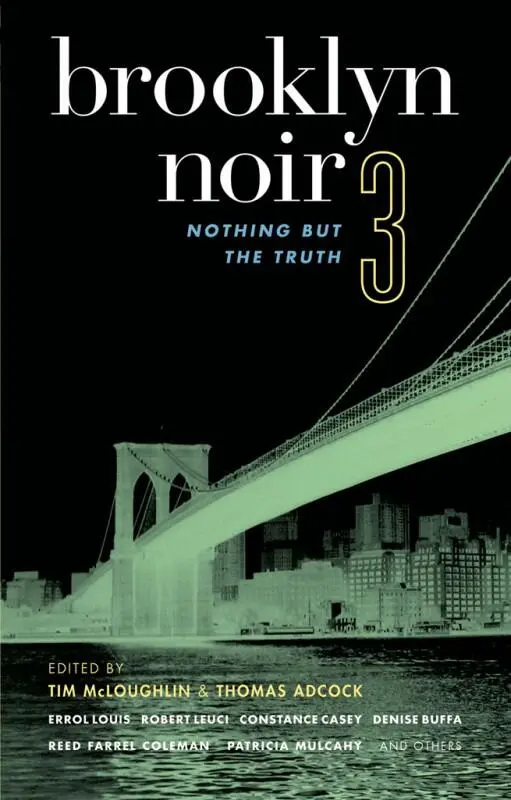
- Название:Brooklyn Noir 3: Nothing but the Truth
- Автор:
- Издательство:Akashic Books
- Жанр:
- Год:2008
- Город:New York
- ISBN:978-1-933354-14-9
- Рейтинг книги:3 / 5. Голосов: 1
-
Избранное:Добавить в избранное
- Отзывы:
-
Ваша оценка:
Brooklyn Noir 3: Nothing but the Truth: краткое содержание, описание и аннотация
Предлагаем к чтению аннотацию, описание, краткое содержание или предисловие (зависит от того, что написал сам автор книги «Brooklyn Noir 3: Nothing but the Truth»). Если вы не нашли необходимую информацию о книге — напишите в комментариях, мы постараемся отыскать её.
. This volume presents the first nonfiction collection in the series, curated by acclaimed novelists Tim McLoughlin and Thomas Adcock.
Brand-new stories by: Robert Leuci, Dennis Hawkins, Tim McLoughlin, Thomas Adcock, Errol Louis, Denise Buffa, Patricia Mulcahy, C. J. Sullivan, Reed Farrel Coleman, Aileen Gallagher, Christopher Musella, Kim Sykes, Robert Knightly, Jess Korman, Constance Casey, and Rosemarie Yu.
Brooklyn Noir 3: Nothing but the Truth — читать онлайн бесплатно полную книгу (весь текст) целиком
Ниже представлен текст книги, разбитый по страницам. Система сохранения места последней прочитанной страницы, позволяет с удобством читать онлайн бесплатно книгу «Brooklyn Noir 3: Nothing but the Truth», без необходимости каждый раз заново искать на чём Вы остановились. Поставьте закладку, и сможете в любой момент перейти на страницу, на которой закончили чтение.
Интервал:
Закладка:
The librarian scolded me. “See, this is why we have to be wary when reading history. We have to ask who wrote it and what their motives were. You can’t change history because you don’t like what you find.”
Of course he was right, but I was not going to Staten Island. The building where Keckly lived had been torn down, and it wasn’t going to help me to look at what I was sure by now was an office building or a parking lot.
Researching the everyday lives of African Americans in the nineteenth century and earlier is like putting together a puzzle with almost all of the pieces missing. You get accustomed to seeing words and phrases such as, “most likely happened,” “probably,” and “no conclusive evidence.” Keckly’s memoir made it a bit easier. As a slave, she had learned how to read and write, and she freed herself and her son by paying off her owners. She achieved some fame as a seamstress and a companion to Mary Todd Lincoln. Even then, what was written in her book, Behind the Scenes: Thirty Years a Slave and Four Years in the White House , seemed to me to have been composed mostly for white consumption during a time when few African Americans could read, or even purchase a book. I wanted to know about the daily life of a black woman in the 1860s, which was how I ended up at the library going through government and police records and reading old newspapers. But whenever I do something like this, I inevitably find myself taken in a completely different direction than where I started. That’s what happened when I began with 14 Carroll Place and ended up at the Underground Railroad homes on Duffield Street.
Olga was carrying heavy bags, so we walked slowly past the wig and pawn shops and the Rastafarians selling incense on rickety card tables. Without any regard to aesthetics, storefronts selling everything from french fries to sneakers were jammed next to each other. As we walked, a young woman raced by us talking on her cell phone. She was beautiful and she knew it. Her tight pants showed off her perfect figure and I marveled at her ability to walk in such pointy-toed, highheeled shoes. Everyone within twenty feet of her could hear her conversation. “Yo, meet me on Fulton by the Duane Reade!... Fulton Street!” It is hard to imagine that this Fulton Street was once a dirt road on which Harriet Tubman led escaped slaves to safe houses. The crowd around us was dense. Olga stopped to make sure I took it all in. Once again, she peeked at me over her shades. Downtown Brooklyn was undergoing major reconstruction. It was only a matter of time before even this stretch of consumer distraction became gentrified. I was going to ask what she thought about that, but we had arrived at the corner of Fulton and Flatbush.
In 2005, the city conamed this section of Fulton Street Harriet Ross Tubman Avenue in honor of the African American abolitionist who ferried slaves from the South to freedom in the North. Olga followed my gaze up at the signage. I was sure she was going to comment on the fact that Ms. Tubman had to share billing. I wondered about that myself since Robert Fulton, the steamboat inventor, also had streets named for him in Manhattan and elsewhere. She set her bags on the sidewalk without taking her eyes off the signs. Her red-and-white striped hat covered all of her hair except for fuzzy gray and black curls poking out at the sides.
“Look at the sign,” Olga said. “What do you see?” Fulton’s green metal sign hung above the one for Harriet Ross Tubman. Her lips curled into a half smile. I was missing her point. “But what else do you see? Look closer.” Fulton Street had been written in all caps and Harriet Ross Tubman’s wasn’t. If her full name had been in all caps, I thought, the sign would probably be too long and snap off in a stiff wind. But I said nothing. I played dumb.
“His name is capitalized!” she said, her finger pointing to the sign like a first grade teacher. “Except for the first letters, her name is in lower case! And you see, she is at the bottom. He is at the top. They call us minority. What does minority mean? It means less than, not as good as. That’s what they want us to believe. Minority. It’s in the dictionary. Look it up.”
On the corner of Atlantic Avenue and Fulton/Tubman, I listened to Olga’s tutorials on racism and capitalism. She told me about her family, how she is the only one to live and work in the states. How her children are back on the island of St. Vincent protecting the family land. I asked her where she worked, but she was vague, still unsure if she could trust me. I looked down at her bags and saw that they were filled with books. Occasionally, someone passed by and called out a greeting to her and she would respond, but she never lost her train of thought, moving from African land grabs to the biogenetic seeds that corporations are sending to the Caribbean and South America.
“They send us seeds that grow the vegetables for one season and then we have to buy the seeds again for the next year! Non-fertile seeds! These men are smart but evil. They are enemies of nature.”
All was going well until she moved on to religion, starting with Abraham and the Egyptian slaves and what was left out of the Old and New Testaments. It had nothing to do with Olga. It was me. When anyone starts talking religion, my eyes begin to glaze over and I want to run away screaming. It’s the fault of my Baptist upbringing in Louisiana that promised rewards only after you were dead. I politely interrupted Olga, thanked her for her insight, and told her that I had to get to the library before it closed, which was true. She gave me one of those half smiles again, this one with all sorts of meaning behind it. The one I went away with was, Can you handle what I’ve just told you?
At the Brooklyn Public Library, I was given a file labeled Plymouth Church . Inside of it I discovered a newspaper drawing of Henry Ward Beecher, the famous abolitionist minister standing before his congregation with a young girl at his side. The description under it read, Reverend Henry Ward Beecher auctioning “Pinky” slave girl . I had heard of Beecher, mostly because of his sister, Harriet Beecher Stowe, who wrote Uncle Tom’s Cabin , but who was Pinky? What happened to her? In the drawing her long hair fell below her waist. Her features were Caucasian, except for a small rounded nose that hinted at Africa. Elizabeth Keckly would have to wait, I thought. I left the library and headed back to Brooklyn Heights.
Like most Americans, when I think of slavery I think of the South, which is why I was shocked to discover that in 1790, according to the first U.S. Census, Brooklyn was the second largest slave-holding city after Charleston, South Carolina, the center of the slave trade. In 1860, Abraham Lincoln came to Plymouth Church in Brooklyn to hear Henry Ward Beecher preach against the evils of slavery, which had been abolished for more than three decades in the state.
Lois Rosebrooks led myself, a young man, and his uncle to pew 89 where Abraham Lincoln sat in 1860, the day before he gave his antislavery speech at Cooper Union; the speech that would help win him the Republican nomination and set the stage for the Civil War. The young man sat in the pew while his uncle snapped a picture of his beaming face. Lois gave a brief talk about the day Lincoln visited Plymouth and then they left. The young man was on his way to college and had to catch a plane. Once they were gone, Lois and I settled in. This time, I took the seat were Lincoln had sat and imagined his long legs, his knees knocking against the pew in front of me.
Lois didn’t look anything like what her card said she was: Director of History Ministry Services. She was wearing a short-sleeved blue housedress with colorful flowers embroidered around the neck. Her reddish-brown hair was styled nicely, just below her ears. It was as if she were in her own home and any minute would offer me cookies and a cup of tea. I glanced down at her feet, half expecting slippers, but saw instead sensible black shoes. Her eyes sparkled when I told her I wanted to know about the mock slave auctions. It was obvious that she loved her job.
Читать дальшеИнтервал:
Закладка:
Похожие книги на «Brooklyn Noir 3: Nothing but the Truth»
Представляем Вашему вниманию похожие книги на «Brooklyn Noir 3: Nothing but the Truth» списком для выбора. Мы отобрали схожую по названию и смыслу литературу в надежде предоставить читателям больше вариантов отыскать новые, интересные, ещё непрочитанные произведения.

Обсуждение, отзывы о книге «Brooklyn Noir 3: Nothing but the Truth» и просто собственные мнения читателей. Оставьте ваши комментарии, напишите, что Вы думаете о произведении, его смысле или главных героях. Укажите что конкретно понравилось, а что нет, и почему Вы так считаете.