Robert Flint - Theism
Здесь есть возможность читать онлайн «Robert Flint - Theism» — ознакомительный отрывок электронной книги совершенно бесплатно, а после прочтения отрывка купить полную версию. В некоторых случаях можно слушать аудио, скачать через торрент в формате fb2 и присутствует краткое содержание. Жанр: foreign_antique, foreign_prose, на английском языке. Описание произведения, (предисловие) а так же отзывы посетителей доступны на портале библиотеки ЛибКат.
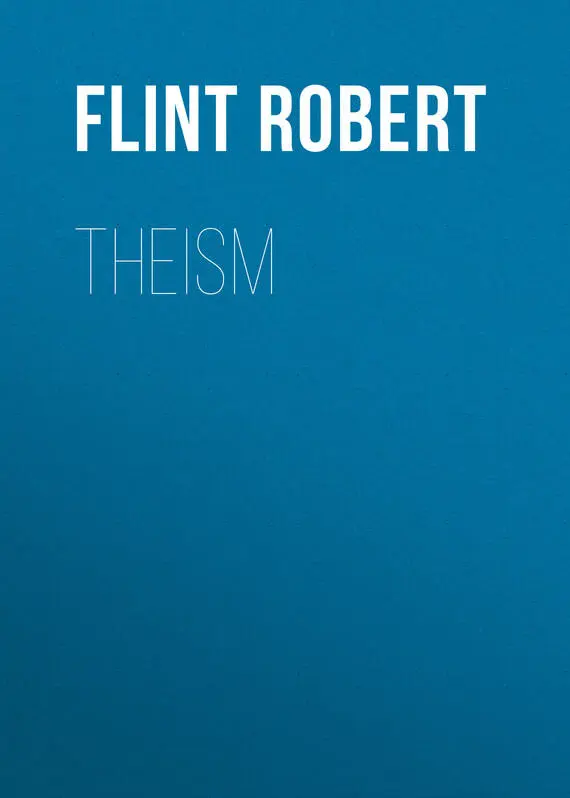
- Название:Theism
- Автор:
- Жанр:
- Год:неизвестен
- ISBN:нет данных
- Рейтинг книги:4 / 5. Голосов: 1
-
Избранное:Добавить в избранное
- Отзывы:
-
Ваша оценка:
Theism: краткое содержание, описание и аннотация
Предлагаем к чтению аннотацию, описание, краткое содержание или предисловие (зависит от того, что написал сам автор книги «Theism»). Если вы не нашли необходимую информацию о книге — напишите в комментариях, мы постараемся отыскать её.
Theism — читать онлайн ознакомительный отрывок
Ниже представлен текст книги, разбитый по страницам. Система сохранения места последней прочитанной страницы, позволяет с удобством читать онлайн бесплатно книгу «Theism», без необходимости каждый раз заново искать на чём Вы остановились. Поставьте закладку, и сможете в любой момент перейти на страницу, на которой закончили чтение.
Интервал:
Закладка:
Theism is the doctrine that the universe owes its existence, and continuance in existence, to the reason and will of a self-existent Being, who is infinitely powerful, wise, and good. It is the doctrine that nature has a Creator and Preserver, the nations a Governor, men a heavenly Father and Judge. It is a doctrine which has a long history behind it, and it is desirable that we should understand how we are related to that history.
Theism is very far from coextensive with religion. Religion is spread over the whole earth; theism only over a comparatively small portion of it. There are but three theistic religions – the Mosaic, the Christian, and the Mohammedan. They are connected historically in the closest manner – the idea of God having been transmitted to the two latter, and not independently originated by them. All other religions are polytheistic or pantheistic, or both together. Among those who have been educated in any of these heathen religions, only a few minds of rare penetration and power have been able to rise by their own exertions to a consistent theistic belief. The God of all those among us who believe in God, even of those who reject Christianity, who reject all revelation, is the God of Abraham, Isaac, and Jacob. From these ancient Jewish fathers the knowledge of Him has historically descended through an unbroken succession of generations to us. We have inherited it from them. If it had not thus come down to us, if we had not been born into a society pervaded by it, there is no reason to suppose that we should have found it out for ourselves, and still less that we should merely have required to open our eyes in order to see it. Rousseau only showed how imperfectly he realised the dependence of man on man, and the extent to which tradition enters into all our thinking, when he pretended that a human being born on a desert island, and who had grown up without any acquaintance with other beings, would naturally, and without assistance, rise to the apprehension of this great thought. The Koran well expresses a view which has been widely held when it says, "Every child is born into the religion of nature; its parents make it a Jew, a Christian, or a Magian." The view is, however, not a true one. A child is born, not into the religion of nature, but into blank ignorance; and, left entirely to itself, it would probably never find out as much religious truth as the most ignorant of parents can teach it. It is doubtless better to be born into the most barbarous pagan society than it would be to be born on a desert island and abandoned to find out a religion for one's self.
The individual man left to himself is very weak. He is strong only when he can avail himself of the strength of many others, of the stores of power accumulated by generations of his predecessors, or of the combined forces of a multitude of his contemporaries. The greatest men have achieved what they have done only because they have had the faculty and skill to utilise resources vastly greater than their own. Nothing reaches far forward into the future which does not stretch far back into the past. Before a tragedy like 'Hamlet,' for example, could be written, it was requisite that humanity should have passed through ages of moral discipline, and should be in possession of vast and subtle conceptions such as could only be the growth of centuries, of the appropriate language at the appropriate epoch of its development, and of a noble style of literary workmanship. "We allow ourselves," says Mr Froude, "to think of Shakespeare, or of Raphael, or of Phidias as having accomplished their work by the power of their individual genius; but greatness like theirs is never more than the highest degree of perfection which prevails widely around it, and forms the environment in which it grows. No such single mind in single contact with the facts of nature could have created a Pallas, a Madonna, or a Lear." What the historian has thus said as to art is equally true of all other forms of thinking and doing. It is certainly true of religious thought, which has never risen without much help to the sublime conception of one God. It is, in fact, an indisputable historical truth that we owe our theism in great part to our Christianity, – that natural religion has had no real existence prior to or apart from what has claimed to be revealed religion – and that the independence which it now assumes is that of one who has grown ashamed of his origin.
It does not in the least follow that we are to regard theism as merely or even mainly a tradition – as a doctrine received simply on authority, and transmitted from age to age, from generation to generation, without investigation, without reflection. It does not follow that it is not a truth the evidence of which has been seen in some measure by every generation which has accepted it, and into the depth and comprehensiveness and reasonableness of which humanity has obtained a constantly-growing insight. There have, it is true, been a considerable number of theologians who have traced all religious beliefs to revelation, and who have assigned to reason merely the function of passively accepting, retaining, and transmitting them. They have conceived of the first man as receiving the knowledge of God by sensible converse with Him, and of the knowledge thus received as transmitted, with the confirmation of successive manifestations, to the early ancestors of all nations. The various notions of God and a future state to be found in heathen countries are, according to them, broken and scattered rays of these revelations; and all the religious rites of prayer, purification, and sacrifice which prevail among savage peoples, are faint and feeble relics of a primitive worship due to divine institution. This view was natural enough in the early ages of the Christian Church and in medieval times, when the New World was undiscovered and a very small part of either Asia or Africa was known. It was consonant also to the general estimate of tradition as a means of transmitting truth, entertained by the Roman Catholic Church; but it is not consistent with the Protestant rejection of tradition, and it is wholly untenable in the light of modern science, the geography, ethnology, comparative mythology, &c., of the present day. A man who should thus account for the phenomena of the religious history of heathen humanity must be now as far behind the scientific knowledge of his age regarding the subject on which he theorises, as a man who should still ascribe, despite all geological proofs to the contrary, the occurrence of fossils in the Silurian beds to the action of the Noachian deluge. 5 5 See Appendix IV .
Theism has come to us mainly through Christianity. But Christianity itself rests on theism; it presupposes theism. It could only manifest, establish, and diffuse itself in so far as theism was apprehended. The belief that there is one God, infinite in power, wisdom, and goodness, has certainly not been wrought out by each one of us for himself, but has been passed on from man to man, from parent to child: tradition, education, common consent, the social medium, have exerted great influence in determining its acceptance and prevalence; but we have no right to conceive of them as excluding the exercise of reason and reflection. We know historically that reason and reflection have not been excluded from the development of theistic belief, but have been constantly present and active therein; that by the use of his reason man has in some countries gradually risen to a belief in one God; and that where this belief existed, he has, by the use of his reason, been continuously altering, and, it may be hoped, extending and improving his views of God's nature and operations. We know that in Greece, for example, the history of religion was not a merely passive and traditional process. We know as a historical fact that reason there undermined the polytheism which flourished when Homer sang; that it discovered the chief theistic proofs still employed, and attained in many minds nearly the same belief in God which now prevails. The experience of the ancient classical world is insufficient to prove that a purely rational philosophy can establish theism as the creed of a nation; but it is amply sufficient to prove that it can destroy polytheism, and find out all the principal arguments for theism. We know, further, that in no age of the history of the Christian Church has reason entirely neglected to occupy itself in seeking the grounds on which the belief of God can be rested. We know that reason is certainly not declining that labour in the present day. The theistic belief, although common to the whole Christian world, is one which every individual mind may study for itself, which no one is asked to accept without proof, and which multitudes have doubtless accepted only after careful consideration. It comes to us so far traditionally, but not nearly so much so as belief in the law of gravitation. For every one who has examined the evidences for belief in the law of gravitation, thousands on thousands have examined the evidences for the existence of God.
Читать дальшеИнтервал:
Закладка:
Похожие книги на «Theism»
Представляем Вашему вниманию похожие книги на «Theism» списком для выбора. Мы отобрали схожую по названию и смыслу литературу в надежде предоставить читателям больше вариантов отыскать новые, интересные, ещё непрочитанные произведения.










Обсуждение, отзывы о книге «Theism» и просто собственные мнения читателей. Оставьте ваши комментарии, напишите, что Вы думаете о произведении, его смысле или главных героях. Укажите что конкретно понравилось, а что нет, и почему Вы так считаете.