Griffin W.E.B. - The Corps 09 - Under Fire
Здесь есть возможность читать онлайн «Griffin W.E.B. - The Corps 09 - Under Fire» весь текст электронной книги совершенно бесплатно (целиком полную версию без сокращений). В некоторых случаях можно слушать аудио, скачать через торрент в формате fb2 и присутствует краткое содержание. Год выпуска: 0101, Жанр: Старинная литература, на английском языке. Описание произведения, (предисловие) а так же отзывы посетителей доступны на портале библиотеки ЛибКат.
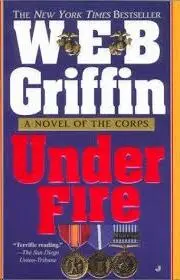
- Название:The Corps 09 - Under Fire
- Автор:
- Жанр:
- Год:0101
- ISBN:нет данных
- Рейтинг книги:5 / 5. Голосов: 1
-
Избранное:Добавить в избранное
- Отзывы:
-
Ваша оценка:
The Corps 09 - Under Fire: краткое содержание, описание и аннотация
Предлагаем к чтению аннотацию, описание, краткое содержание или предисловие (зависит от того, что написал сам автор книги «The Corps 09 - Under Fire»). Если вы не нашли необходимую информацию о книге — напишите в комментариях, мы постараемся отыскать её.
The Corps 09 - Under Fire — читать онлайн бесплатно полную книгу (весь текст) целиком
Ниже представлен текст книги, разбитый по страницам. Система сохранения места последней прочитанной страницы, позволяет с удобством читать онлайн бесплатно книгу «The Corps 09 - Under Fire», без необходимости каждый раз заново искать на чём Вы остановились. Поставьте закладку, и сможете в любой момент перейти на страницу, на которой закончили чтение.
Интервал:
Закладка:
The Marines are com-ing.
The question is, will they get here in time? And will they be able to do a better job than the Eighth Army has so far?
"What do you think, sir?" Lieutenant Peterson asked when Hart had finished reading the article.
"I know the two Marines she was with," Hart replied, thinking out loud. Then he looked at Peterson. "I don't know what to think, Paul."
"You know them, sir?"
"In the last war, they called people like that `the Old Breed,'" Hart said. "I wonder what they call them now."
[TWO]
OFFICE OF THE SENIOR INSPECTOR/INSTRUCTOR
EL TORO MARINE CORPS AIR STATION, CALIFORNIA
1025 21 JULY 1950
Brigadier General Lawrence C. Taylor, USMC, whose pro-motion to flag officer rank had occurred shortly before his graduation from the U.S. Army War College on 30 May, had elected to take thirty days' leave before reporting for duty at Headquarters, USMC.
For one thing, the year had been a rough one, and there hadn't been much time to spend with his family. For an-other, unless he took some leave, he was going to lose it, as regulations dictated the forfeiture of leave in excess of sixty days. Finally, he suspected that as a brand-new one-star, there would not be an opportunity to take much-if any-leave in the next year.
Both he and Margaret, his wife, had Scottish roots, and had always wanted to see Scotland, so they talked it over, decided that they could afford it, and that it was really now or never, and went.
It was not as easy for him as he first thought it would be. It was necessary for him, as a serving officer, to get per-mission to leave the country. There were forms to fill out, listing where he wanted to go and why, and permission didn't come when he expected it to, and he had to spend time on the phone to Eighth and Eye to make sure he would have permission in time to leave.
Permission came seventy-two hours before they were scheduled to leave. That just about gave them enough time to leave the kids with Margaret's mother in upstate New York and get to New York for the TWA flight to Scotland. They flew on a Trans-Global Airways Lockheed Constellation, which was really very nice, and on the way decided all the paperwork was worthwhile. It was going to be sort of like a second honeymoon.
On 28 June, when he learned of the North Korean inva-sion in the Glasgow newspaper, he had-with more than a little difficulty-managed to get through on the telephone to Eighth and Eye and asked if he should report for duty. He was told that would not be necessary.
And when he reported for duty, they didn't seem to know what to do with him, except to suggest that it might not be wise "in the present circumstances" to plan on spending two years at Eighth and Eye, which was the origi-nal plan.
General Taylor was thus able to consider the possibil-ity-slight but real-that, should there be a war and an ex-pansion of the Marine Corps, he might find himself serving with a Marine division in the field, or in command of a base-Parris Island, for example, while the incumbent there went off to a field command-instead of shuffling paper at Eighth and Eye.
That fascinating prospect was shattered when General Cates, on 13 July, summoned him to his office and told him (a) that on the fourteenth he was going to issue a confiden-tial order to the Corps to prepare for mobilization and (b) that he thought General Taylor could be of most use to the Corps by going to the West Coast and doing what he could to facilitate the mobilization of the Marine Corps Reserve.
General Taylor took a plane that night for Camp Pendleton, with Margaret and the kids to follow by auto. The West Coast assignment was temporary duty, which meant that their furniture would be stored, rather than shipped to California.
At Camp Pendleton, Brigadier General Clyde W. Dawkins, the deputy commanding general, told General Taylor he was glad he was there, as he expected there would be "administrative problems" in the mobilization of Marine Reserve Aviation, and anything that Taylor could do to "sort things out" would be a real contribution.
General Taylor had not met General Dawkins previ-ously, which he supposed was because Dawkins was wear-ing the golden wings of a Marine aviator, and Taylor had come up through artillery. He also wondered privately why Dawkins, an aviator, was deputy commander of Pendleton, which was not a Marine aviation facility. Logic would seem to dictate that a Marine aviator would be more suited to "sort out" the "administrative problems" involved in mobilizing Marine aviation, and someone such as himself, an experienced ground officer, would be better suited to be the deputy commander of Camp Pendleton.
General Dawkins said that it would probably be best that General Taylor "pitch his tent" at the El Toro Marine Corps Air Station, not far from Pendleton, rather than on the Pendleton Reservation.
"Pendleton is going to be one huge Chinese fire drill when the mobilization starts," Dawkins said. "You'll be more productive there than here. There's a light colonel there-John X. O'Halloran, good man-as inspector/in-structor. You can use his office and people."
At El Toro, General Taylor was given quarters in a small building set aside for visiting senior officers. As soon as he unpacked, he went into the small town of El Toro itself to find someplace for Margaret and the kids. He quickly learned that there was the opposite of an abundance of fur-nished rental houses or apartments in the area, and what was available was priced accordingly.
In desperation, he rented a small, unattractive apartment that cost 125 percent of his housing allowance, and one that he knew would disappoint Margaret and the kids. They'd had really nice quarters at the War College, and the apartment was a real comedown.
And then he went to work at El Toro to prepare for the mobilization, which was almost certain to happen.
Lieutenant Colonel O'Halloran, USMC, the inspector/instructor, was a muscular, red-haired Irishman. He wore an Annapolis ring, which immediately made General Tay-lor feel confident in him, even if he was also wearing the gold wings of a Marine aviator. Five minutes into their first conversation, they were agreed that calling an immediate meeting of the commanding officers of the three reserve squadrons on the West Coast to bring them up to speed on what was very likely going to happen was the first thing to do.
Two of the three squadron commanders showed up as ordered at 0800 19 July. The third-the commanding offi-cer of VMF-243-did not. His name was Major Malcolm S. Pickering.
Lieutenant Colonel O'Halloran was not at the meeting either. He sent word-which was not the same thing as re-questing permission to do so-that he was going to spend the morning checking on enlisted housing for the flood of reservists soon to arrive at El Toro.
Since he could not ask O'Halloran what he recom-mended should be done about the officer who had not, in Marine parlance, "been at the prescribed place at the pre-scribed time in the properly appointed uniform" and was thus technically absent without leave, General Taylor in-quired of Technical Sergeant Saul Cohen, the senior staff NCO of the I and I staff, if he had been able to contact Major Pickering.
"Not exactly, sir. I left word at his office to tell him as soon as he got back."
"Back from where?"
"No telling, sir. Major Pickering travels a lot."
"And the executive officer of VMF-243? Did you con-tact him?"
"Same story, sir. As I understand it, he's with Major Pickering. Permission to speak out of school, sir?"
"Go ahead."
"VMF-243's the best of our squadrons. They just about aced the annual inspection. And I'm sure Major Pickering will be here when he's really needed."
"Just to remove any possible misunderstanding, Sergeant," General Taylor said, "I have the authority to de-termine when the major's presence is really needed."
Читать дальшеИнтервал:
Закладка:
Похожие книги на «The Corps 09 - Under Fire»
Представляем Вашему вниманию похожие книги на «The Corps 09 - Under Fire» списком для выбора. Мы отобрали схожую по названию и смыслу литературу в надежде предоставить читателям больше вариантов отыскать новые, интересные, ещё непрочитанные произведения.




Обсуждение, отзывы о книге «The Corps 09 - Under Fire» и просто собственные мнения читателей. Оставьте ваши комментарии, напишите, что Вы думаете о произведении, его смысле или главных героях. Укажите что конкретно понравилось, а что нет, и почему Вы так считаете.