Mary Robb - Down the Rabbit Hole
Здесь есть возможность читать онлайн «Mary Robb - Down the Rabbit Hole» весь текст электронной книги совершенно бесплатно (целиком полную версию без сокращений). В некоторых случаях можно слушать аудио, скачать через торрент в формате fb2 и присутствует краткое содержание. Год выпуска: 2015, Издательство: Penguin Publishing Group, Жанр: Старинная литература, на английском языке. Описание произведения, (предисловие) а так же отзывы посетителей доступны на портале библиотеки ЛибКат.
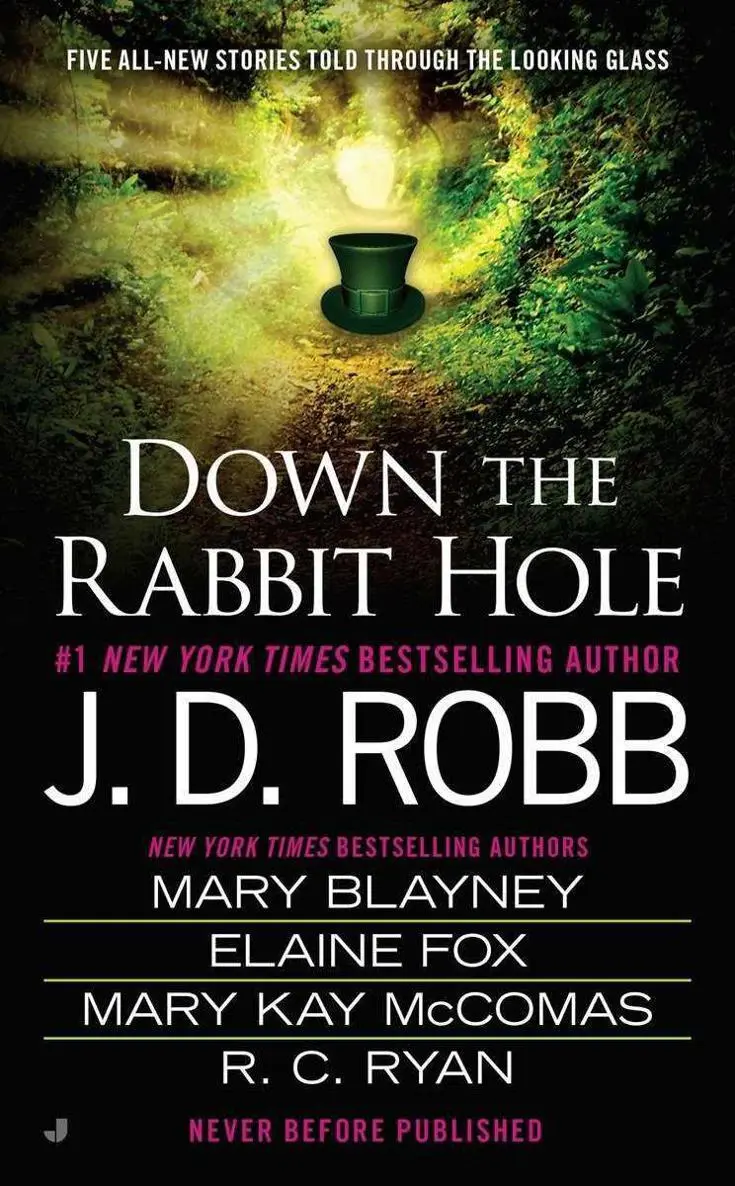
- Название:Down the Rabbit Hole
- Автор:
- Издательство:Penguin Publishing Group
- Жанр:
- Год:2015
- ISBN:нет данных
- Рейтинг книги:4 / 5. Голосов: 2
-
Избранное:Добавить в избранное
- Отзывы:
-
Ваша оценка:
Down the Rabbit Hole: краткое содержание, описание и аннотация
Предлагаем к чтению аннотацию, описание, краткое содержание или предисловие (зависит от того, что написал сам автор книги «Down the Rabbit Hole»). Если вы не нашли необходимую информацию о книге — напишите в комментариях, мы постараемся отыскать её.
Down the Rabbit Hole — читать онлайн бесплатно полную книгу (весь текст) целиком
Ниже представлен текст книги, разбитый по страницам. Система сохранения места последней прочитанной страницы, позволяет с удобством читать онлайн бесплатно книгу «Down the Rabbit Hole», без необходимости каждый раз заново искать на чём Вы остановились. Поставьте закладку, и сможете в любой момент перейти на страницу, на которой закончили чтение.
Интервал:
Закладка:
“Do you see the coin on the desk next to your hand?”
“Yes.” There was a coin, a small train and the locket that was in his pocket now. “But when was that coin added? I thought the painting was completed yesterday.”
“The man and woman who took your places were sent back in time for the sole purpose of bringing that coin to you.”
“Took our places?”
As Weston was about to toss out at least five more questions, Arbuckle raised his hand. “Yes, two people have traveled to your time from theirs. That is, from the time that you are in now. And, my lord, the space-time continuum demands that Miss Amy and Mr. West’s physical bodies be replaced while they are time traveling, um, that is, to maintain the balance of space and time.”
“That is ridiculous,” Weston insisted.
“Absurd it may sound, but truth it is. I want to assure you that this is only temporary. You will return to your own time and place. And when you do, you can only go back with . . .” Mr. Arbuckle stopped abruptly and asked, “Did you bring something with you, my lord? Miss Kemp? A belonging of some kind?”
Alice looked down at her new clothing and shook her head. Weston was about to do the same when he remembered the locket. He debated lying, as he was not at all sure that he wanted Alice to know that he still had it, but the situation they were in made such a lie seem petty. He nodded and drew the locket from his pocket. “This came with me, though I cannot precisely say that I brought it.”
“Wes,” Alice said, and he could not decide if she was touched or surprised until he looked at her. The softness in her eyes was his answer. Yes, Alice, I have kept it, and I always will, until I can convince you to wear it again and forever. He spoke with his eyes and knew she understood when she looked away and down.
Alice Kemp was no more his now than she had been a year ago. Or two hundred.
Mr. Arbuckle cleared his throat. “The item you carried, my lord, takes the physical place of the coin they carried. That is the only reason you were allowed to bring something that is not from this time period.”
Weston wanted to know why the coin chose that particular item, the locket, but feared the answer would be something to do with the absurdity of time and space continuity or whatever Arbuckle had called it.
Or, he would have feared it if he believed a word of this story. Still, there was the issue of his traveling by coach for hours only to magically arrive where he had started.
And what was so important about a damn coin? Questions. He had a hundred. Weston pressed his lips together and waited for an answer to the first one.
“If you will come with me now I will prove that you have moved through both space and time.”
“But I have a dozen more questions,” Alice insisted.
“I am sure you both do, Miss Kemp, and I will do my best to answer them, but first I want to establish the truth of what I say, if you please. The changes in London will convince you better than I ever could with words.”
Mr. Arbuckle walked toward the door. Weston followed him, anxious to see the proof.
“I cannot go out in public wearing this!” Alice had not moved from the spot.
Both men paused. Mr. Arbuckle did not open the door.
“Miss, I assure you that no one will be at all shocked. The jeans you are wearing are typical for all English women.”
“Jeans?” She looked down at the offending garment. “Do they now name their items of clothing?” Her tone indicated that her question was more sarcasm, the kind she had deplored in him.
“Alice. We have traveled two hundred years into the future and you choose to quibble over an item of dress?”
“Quibble!” Now she was insulted. “You know as well as I do that what people wear can seal their fate in society. Beau Brummell has proved that.”
“Miss Kemp, please do trust me in this,” Arbuckle urged. “No one will think it unusual for you to be out and about dressed as you are. You are wearing essentially what Miss Amy and Mr. West were wearing when they traveled back in time, as they are wearing what you wore. So you see it is perfectly normal.”
Weston could not control a burst of laughter. “‘Perfectly normal’ are the last words I would use to describe this situation.” He turned to Alice. “Come, my dear, have you not always wanted to experience the comfort of men’s dress? Now is your chance.”
“Dress as a gentleman? Never. No more than you have wanted to dress in skirts, my lord.” But with a sigh Alice moved toward the door. “Very well. But I will box the ears of anyone who dares insult me.”
“I know that you are entirely capable of taking care of yourself,” Weston said, “but I assure you, Alice, that I shall do more than box ears if anyone should insult you.”
Alice turned her head away quickly, but not before he saw the hint of a smile.
CHAPTER THREE
As they made their way into the passage toward the front door a woman was coming up the stairs. “Are you done with the tea things, then, sir?”
A servant. This woman was a servant of some kind, but dressed in a way that made it look as though she were trying to copy her betters.
“Yes. We are done.” She was looking at him, but it was Arbuckle who answered. “Mr. West and Miss Kemp will be back shortly.”
“Very well, sir.”
Weston gave a brief nod when the servant glanced at him for confirmation. As the housekeeper moved into the next room to clear the tea table, Arbuckle whispered, “I beg your pardon, my lord, but the housekeeper—Tandy is her name—knows nothing of what has happened. And since you look exactly like Mr. West and not at all like the current earl, I thought it best to address you as him.”
“Yes, I see,” the earl answered, and then looked at Alice.
She nodded. “We will have to be careful what we say when she is around.”
“Which is not that different from our day, is it?”
Alice nodded with a small smile that brought an inordinate amount of joy to his heart.
Turning his attention from Alice, he made his way to the front hall. As they walked down the stairs that circled the entry hall, Weston noted that, while the place looked the same, the decor was different.
“It looks familiar, but parts of it are not at all as I recall,” Alice whispered to him, and he smiled at the intimacy, nodding.
Yes, he had no doubt this was his town house. The Rembrandt hanging at the landing proved it. He knew it was the same place, but so much around it was different, and for the first time the earl wondered if Mr. Arbuckle might be telling the unholy truth.
Did he even need to say that the next few hours were the most amazing of his life thus far? He knew the memory of this terrifying, horrifying, incredible look at the future would astound him forever.
There was the obvious. Thousands of horse-free carriages, which Arbuckle called “cars,” some large and some small, filled the roads. Conveyances called lorries took the place of carts, but still managed to block traffic as much as the old horse-drawn drays had.
Buildings were tall, huge. The lifts they rode on made stairs unnecessary except for emergencies. There were still pockets of small homes. Mayfair retained much of its nineteenth-century look. Even Berkeley Square was still there, if marred by the hideous building that was the American Embassy.
“What surprises me as much as the change,” Alice said at one point, “is how much has remained the same.”
Indeed he had noticed that too. London remained a hub of the world. People of all nations were on the streets, some hurried and on business, others shopping at a leisurely pace. He was delighted to see that the Burlington Arcade remained, with some of the same shops he frequented.
Читать дальшеИнтервал:
Закладка:
Похожие книги на «Down the Rabbit Hole»
Представляем Вашему вниманию похожие книги на «Down the Rabbit Hole» списком для выбора. Мы отобрали схожую по названию и смыслу литературу в надежде предоставить читателям больше вариантов отыскать новые, интересные, ещё непрочитанные произведения.






Обсуждение, отзывы о книге «Down the Rabbit Hole» и просто собственные мнения читателей. Оставьте ваши комментарии, напишите, что Вы думаете о произведении, его смысле или главных героях. Укажите что конкретно понравилось, а что нет, и почему Вы так считаете.