Ed Gorman - Showdown
Здесь есть возможность читать онлайн «Ed Gorman - Showdown» весь текст электронной книги совершенно бесплатно (целиком полную версию без сокращений). В некоторых случаях можно слушать аудио, скачать через торрент в формате fb2 и присутствует краткое содержание. Год выпуска: 2012, Издательство: Crossroad Press, Жанр: Старинная литература, на английском языке. Описание произведения, (предисловие) а так же отзывы посетителей доступны на портале библиотеки ЛибКат.
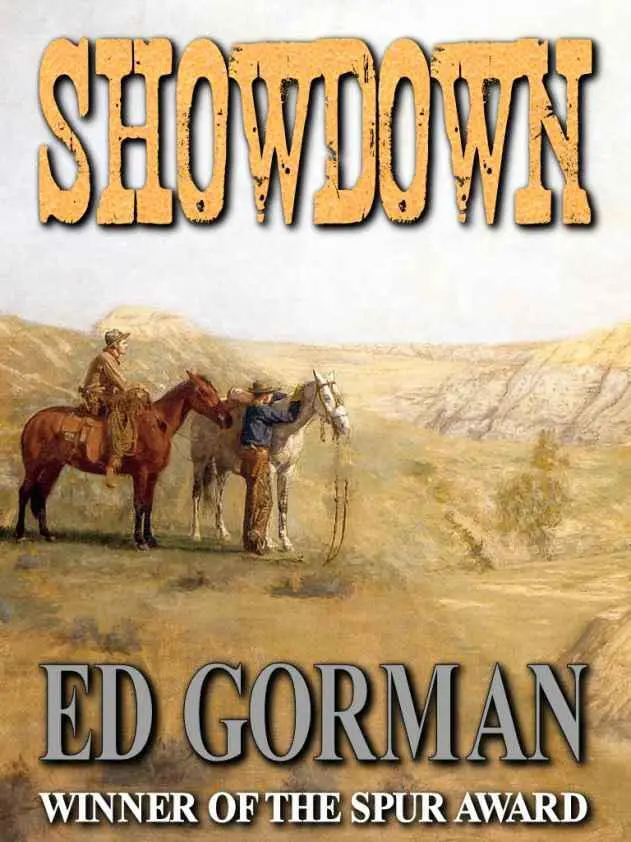
- Название:Showdown
- Автор:
- Издательство:Crossroad Press
- Жанр:
- Год:2012
- ISBN:нет данных
- Рейтинг книги:3 / 5. Голосов: 1
-
Избранное:Добавить в избранное
- Отзывы:
-
Ваша оценка:
Showdown: краткое содержание, описание и аннотация
Предлагаем к чтению аннотацию, описание, краткое содержание или предисловие (зависит от того, что написал сам автор книги «Showdown»). Если вы не нашли необходимую информацию о книге — напишите в комментариях, мы постараемся отыскать её.
A Spur Award-winning Author
Tom Prine figured that a stint as deputy in a backwash town like Claybank would give him a nice rest. Until, in the space of just a few days, arson, kidnapping and murder turn Claybank into a dangerous place Prine no longer recognizes. A lot of old secrets are being revealed and at their core is a single nagging question - is anybody in town who they pretend to be? Prine doesn't have long to find the answer...
Showdown — читать онлайн бесплатно полную книгу (весь текст) целиком
Ниже представлен текст книги, разбитый по страницам. Система сохранения места последней прочитанной страницы, позволяет с удобством читать онлайн бесплатно книгу «Showdown», без необходимости каждый раз заново искать на чём Вы остановились. Поставьте закладку, и сможете в любой момент перейти на страницу, на которой закончили чтение.
Интервал:
Закладка:
The varieties of feces beneath his boots were hard as bullets. He crunched and crushed and cracked them as he went about searching for the trapdoor that would take him to the root cellar.
He moved through moonlit shadow, kicking aside newspapers, animal shit, odds and ends of the clothing as he searched for the outline of the trapdoor. Once, he thought he heard something below him, but he couldn't be sure.
He returned to the kitchen. That seemed the most logical place for the trapdoor. The farm wife doing a lot of her canning work up here and then carrying it down the ladder to the root cellar.
He got down on all fours and began moving his gloved hands quickly over every inch of kitchen floor. But nothing.
He did the same thing in the dining room and the living room. But again, nothing.
He was just about to walk back to the kitchen when he saw the closet off the dining room. He hadn't looked in there. But when he thought about it, he remembered that some of the early settlers constructed root cellar–like places where they could hole up during Indian attacks. Such places were dangerous. They made the white folk prisoners in a very real way. And if the Indians decided to set fire to the house, the people in the cellar could die from smoke. But when you were outnumbered, as was so often the case—just as the blue uniforms would soon enough outnumber the Indians—a cellar like that was better than standing in the middle of your living room.
In the closet, he found the trapdoor.
Lantern light flickered around the edges where it didn't close flush. Somebody must be down there.
He shoved the barrel of his Winchester down the opening and said, "This is Tom Prine and I'm a deputy sheriff. If anybody's down there, come to the ladder with your hands up. And right now."
"Oh, Tom!"
The voice was unmistakable. And, moments later, the woman was standing at the bottom of the ladder, looking up at him.
"C'mon up, Cassie," Prine said. "I'm taking you home."
"But Tom—"
"C'mon up, Cassie. I want to get you outside before they come back."
She wore a white blouse and brown butternuts that were covered with dirt. Her blonde hair was mussed, but not so mussed that, even under these conditions, she'd lost her beauty. Her face, dirt-streaked, was still radiant.
He wasted no time when she emerged from the cellar, her lantern in hand. Beneath her the opening was dark.
He took her hand and guided her through the back half of the house to the sweet smell of the night and the bloom of moonlight on the entire landscape.
Only then did he relax enough to ask all the obvious questions.
"Did they hurt you?"
"No."
"Did they—touch you in any way?"
"No."
"Did they threaten to kill you?"
She didn't look right, didn't look as if she'd been under the frightening strain that went along with being held for ransom. She looked . . . uneasy—as if there were something she needed to tell him but couldn't quite form the words.
"Tom, listen," she said, taking his hand, jolting him with the thrill he'd experienced a few other times with her. "I have to tell you something and trust you to keep it secret."
My Lord, what was she going to tell him? He was perplexed and half afraid to hear it.
"This kidnapping, Tom. It was my idea. I set the whole thing up myself."
When he still hadn't spoken a full minute later, she once more took his hand and said, "Aren't you going to say anything, Tom?"
But there was nothing to say. And this time there was no thrill in holding her hand at all.
"Iever tell you how pretty you are?" the old miner said to Lucy.
"I seem to remember you saying somethin' like that a few times, Clem."
"I hate seein' you, because when I do I wanna be young again. And Lord knows that ain't gonna happen."
"You need to hold still, Clem. I need to check your heart."
"How come you ain't got one of them new ones?"
"Hospital can't afford it. They gave me the old-fashioned kind." Clem referred to the part-wood stethoscope she used. "Now, be quiet or I'll have to get tough with you."
He grinned toothlessly. "That'll be the day."
She checked his pulse, his heart rate, his temperature. Then she spent ten minutes trying to clean up the cabin. Clem could live in a latrine—which he came darned close to doing—and it wouldn't bother him. He'd had one glass window, but that was smashed; rain poured through the roof; and the dirt floor hadn't been worked on in years. His food was usually about to turn deadly by the time she threw it out, and his clothes were stiff with dirt. He had an ancient tomcat who was just as unwholesome as he was. The thing was so scabbed up, scarred up, cut up that she assumed it went out and fought mountain lions at night. And probably kicked the hell out of them.
She was just checking to see if the bread she'd brought Clem last time had started to turn green anywhere when he said, "You don't look happy tonight, Lucy. And I'll bet it's that darned boyfriend of yours."
The bread would do for a while yet. Not that it would matter to Clem Randall. She set it down on the small, cluttered, wobbly table where he seemed to pile everything—a simianlike man of no more than five-two and one hundred twenty pounds who moved with an elbow-cocked swagger that reminded her of a twelve-year-old pretending he was a gunfighter.
She came over and said, "He's just confused is all, Clem. Don't call him my 'darned' boyfriend, all right?"
His dark eyes gleamed. In the lamplight they looked like glass. "You're loyal after he broke your heart. You're a true-blue gal, Lucy. I'll say that for you."
She went over and sat next to him in the rocking chair by the kerosene stove. The fumes had darkened the walls years before. "I think he may be in trouble, Clem."
"Eh? What kind of trouble?"
"I'd better not say. He tried to explain it to me, but he was nervous. His voice had a tremble in it. He sounded sort of scared. I'm afraid for him, Clem, I really am. He's got these dreams—"
"What sort of dreams, youngster?"
"Oh, you know, the usual thing. Money and being somebody important and all that."
He had a crone's laugh, old Clem, almost a cackle. "Well, now, I'll tell you somethin', Lucy. If men didn't have dreams like that they'd never accomplish anything. They'd sit around on their lazy backsides and let somebody else do all the work. You think I woulda mined all them years if I didn't have a dream like that? I can't fault him for that, Lucy. And you shouldn't, either."
"I don't. It's just . . ."
"Just what?"
"Well, when you're a lawman you have certain temptations . . ."
He stared at her, not speaking for a time. "Maybe usin' his badge in a way he shouldn't ought to, you mean."
"Yes."
"I can see where it'd be temptin', have to say that. A lawman has a better chance of gettin' away with a crime than somebody like me does, that's for sure."
She checked her watch. She needed to be getting on home. She stood up. "Thanks for listening to me, Clem. And I'd appreciate it if you didn't tell anybody anything I said."
That high-pitched crone's laugh again. "You don't have to worry about me, youngster. Nobody ever comes out to see me anyway, 'ceptin' you and this old Pawnee fella I've known since I came out here. And all he wants to talk about is who's gonna get my cabin when I die. I guess he thinks since he spent so much time puttin' up with me, it's his by squatter's rights."
She kissed him on the forehead. The sticky forehead. Someday she planned to drop him into a tub of water and work on him head to toe with soap and a scrub brush until she raised welts.
"G'night, Clem."
"G'night, Lucy. You say a prayer for me and I'll say a prayer for you. How's that?"
Читать дальшеИнтервал:
Закладка:
Похожие книги на «Showdown»
Представляем Вашему вниманию похожие книги на «Showdown» списком для выбора. Мы отобрали схожую по названию и смыслу литературу в надежде предоставить читателям больше вариантов отыскать новые, интересные, ещё непрочитанные произведения.








Обсуждение, отзывы о книге «Showdown» и просто собственные мнения читателей. Оставьте ваши комментарии, напишите, что Вы думаете о произведении, его смысле или главных героях. Укажите что конкретно понравилось, а что нет, и почему Вы так считаете.