Дарон Аджемоглу - Why Nations Fail
Здесь есть возможность читать онлайн «Дарон Аджемоглу - Why Nations Fail» весь текст электронной книги совершенно бесплатно (целиком полную версию без сокращений). В некоторых случаях можно слушать аудио, скачать через торрент в формате fb2 и присутствует краткое содержание. Год выпуска: 2012, ISBN: 2012, Издательство: Crown Publishing Group, Жанр: Старинная литература, на английском языке. Описание произведения, (предисловие) а так же отзывы посетителей доступны на портале библиотеки ЛибКат.
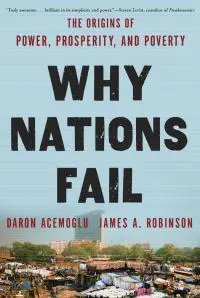
- Название:Why Nations Fail
- Автор:
- Издательство:Crown Publishing Group
- Жанр:
- Год:2012
- ISBN:978-0-307-71923-2
- Рейтинг книги:4 / 5. Голосов: 1
-
Избранное:Добавить в избранное
- Отзывы:
-
Ваша оценка:
Why Nations Fail: краткое содержание, описание и аннотация
Предлагаем к чтению аннотацию, описание, краткое содержание или предисловие (зависит от того, что написал сам автор книги «Why Nations Fail»). Если вы не нашли необходимую информацию о книге — напишите в комментариях, мы постараемся отыскать её.
*** Is it culture, the weather, geography? Perhaps ignorance of what the right policies are?
Simply, no. None of these factors is either definitive or destiny. Otherwise, how to explain why Botswana has become one of the fastest growing countries in the world, while other African nations, such as Zimbabwe, the Congo, and Sierra Leone, are mired in poverty and violence?
Daron Acemoglu and James Robinson conclusively show that it is man-made political and economic institutions that underlie economic success (or lack of it). Korea, to take just one of their fascinating examples, is a remarkably homogeneous nation, yet the people of North Korea are among the poorest on earth while their brothers and sisters in South...
Why Nations Fail — читать онлайн бесплатно полную книгу (весь текст) целиком
Ниже представлен текст книги, разбитый по страницам. Система сохранения места последней прочитанной страницы, позволяет с удобством читать онлайн бесплатно книгу «Why Nations Fail», без необходимости каждый раз заново искать на чём Вы остановились. Поставьте закладку, и сможете в любой момент перейти на страницу, на которой закончили чтение.
Интервал:
Закладка:
The Mayas were skilled builders who independently invented cement. Their buildings and their inscriptions provide vital information on the trajectories of the Maya cities, as they often recorded events dated according to the Long Count. Looking across all the Maya cities, archaeologists can thus count how many buildings were finished in particular years. Around AD 500 there are few dated monuments. For example, the Long Count date corresponding to AD 514 recorded just ten. There was then a steady increase, reaching twenty by AD 672 and forty by the middle of the eighth century. After this the number of dated monuments collapses. By the ninth century, it is down to ten per year, and by the tenth century, to zero. These dated inscriptions give us a clear picture of the expansion of Maya cities and their subsequent contraction from the late eighth century.
This analysis of dates can be complemented by examining the lists of kings the Mayas recorded. At the Maya city of Copán, now in western Honduras, there is a famous monument known as Altar Q. Altar Q records the names of all the kings, starting from the founder of the dynasty K’inich Yax K’uk’ Mo’, or “King Green-Sun First Quetzal Macaw,” named after not just the sun but also two of the exotic birds of the Central American forest whose feathers were greatly valued by the Mayas. K’inich Yax K’uk’ Mo’ came to power in Copán in AD 426, which we know from the Long Count date on Altar Q. He founded a dynasty that would reign for four hundred years. Some of K’inich Yax’s successors had equally graphic names. The thirteenth ruler’s glyph translates as “18 Rabbit,” who was followed by “Smoke Monkey” and then “Smoke Shell,” who died in AD 763. The last name on the altar is King Yax Pasaj Chan Yoaat, or “First Dawned Sky Lightening God,” who was the sixteenth ruler of this line and assumed the throne at the death of Smoke Shell. After him we know of only one more king, Ukit Took (“Patron of Flint”), from a fragment of an altar. After Yax Pasaj, the buildings and inscriptions stopped, and it seems that the dynasty was shortly overthrown. Ukit Took was probably not even the real claimant to the throne but a pretender.
There is a final way of looking at this evidence at Copán, one developed by the archaeologists AnnCorinne Freter, Nancy Gonlin, and David Webster. These researchers mapped the rise and fall of Copán by examining the spread of the settlement in the Copán Valley over a period of 850 years, from AD 400 to AD 1250, using a technique called obsidian hydration, which calculates the water content of obsidian on the date it was mined. Once mined, the water content falls at a known rate, allowing archaeologists to calculate the date a piece of obsidian was mined. Freter, Gonlin, and Webster were then able to map where pieces of dated obsidian were found in the Copán Valley and trace how the city expanded and then contracted. Since it is possible to make a reasonable guess about the number of houses and buildings in a particular area, the total population of the city can be estimated. In the period AD 400–449, the population was negligible, estimated at about six hundred people. It rose steadily to a peak of twenty-eight thousand in AD 750–799. Though this does not appear large by contemporary urban standards, it was massive for that period; these numbers imply that in this period, Copán had a larger population than London or Paris. Other Maya cities, such as Tikal and Calakmul, were undoubtedly much larger. In line with the evidence from the Long Count dates, AD 800 was the population peak for Copán. After this it began to decline, and by AD 900 it had fallen to around fifteen thousand people. From there the fall continued, and by AD 1200 the population had returned to what it was eight hundred years previously.
The basis for the economic development of the Maya Classical Era was the same as that for the Bushong and the Natufians: the creation of extractive institutions with some degree of state centralization. These institutions had several key elements. Around AD 100, in the city of Tikal in Guatemala, there emerged a new type of dynastic kingdom. A ruling class based on the ajaw (lord or ruler) took root with a king called the k’uhul ajaw (divine lord) and, underneath him, a hierarchy of aristocrats. The divine lord organized the society with the cooperation of these elites and also communicated with the gods. As far as we know, this new set of political institutions did not allow for any sort of popular participation, but it did bring stability. The k’uhul ajaw raised tribute from farmers and organized labor to build the great monuments, and the coalescence of these institutions created the basis for an impressive economic expansion. The Maya’s economy was based on extensive occupational specialization, with skilled potters, weavers, woodworkers, and tool and ornament makers. They also traded obsidian, jaguar pelts, marine shells, cacao, salt, and feathers among themselves and other polities over long distances in Mexico. They probably had money, too, and like the Aztecs, used cacao beans for currency.
The way in which the Maya Classical Era was founded on the creation of extractive political institutions was very similar to the situation among the Bushong, with Yax Ehb’ Xook at Tikal playing a role similar to that of King Shyaam. The new political institutions led to a significant increase in economic prosperity, much of which was then extracted by the new elite based around the k’uhul ajaw . Once this system had consolidated, by around AD 300, there was little further technological change, however. Though there is some evidence of improved irrigation and water management techniques, agricultural technology was rudimentary and appears not to have changed. Building and artistic techniques became much more sophisticated over time, but in total there was little innovation.
There was no creative destruction. But there were other forms of destruction as the wealth that the extractive institutions created for the k’uhul ajaw and the Maya elite led to constant warfare, which worsened over time. The sequence of conflicts is recorded in the Maya inscriptions, with special glyphs indicating that a war took place at a particular date in the Long Count. The planet Venus was the celestial patron of war, and the Mayas regarded some phases of the planet’s orbit as particularly auspicious for waging war. The glyph that indicated warfare, known as “star wars” by archaeologists, shows a star showering the earth with a liquid that could be water or blood. The inscriptions also reveal patterns of alliance and competition. There were long contests for power between the larger states, such as Tikal, Calakmul, Copán, and Palenque, and these subjugated smaller states into a vassal status. Evidence for this comes from glyphs marking royal accessions. During this period, they start indicating that the smaller states were now being dominated by another, outside ruler.
Map 10 (this page) shows the main Maya cities and the various patterns of contact between them as reconstructed by the archaeologists Nikolai Grube and Simon Martin. These patterns indicate that though the large cities such as Calakmul, Dos Pilas, Piedras Negras, and Yaxchilan had extensive diplomatic contacts, some were often dominated by others and they also fought each other.
The overwhelming fact about the Maya collapse is that it coincides with the overthrow of the political model based on the k’uhul ajaw . We saw in Copán that after Yax Pasaj’s death in AD 810 there were no more kings. At around this time the royal palaces were abandoned. Twenty miles to the north of Copán, in the city of Quiriguá, the last king, Jade Sky, ascended to the throne between AD 795 and 800. The last dated monument is from AD 810 by the Long Count, the same year that Yax Pasaj died. The city was abandoned soon after. Throughout the Maya area the story is the same; the political institutions that had provided the context for the expansion of trade, agriculture, and population vanished. Royal courts did not function, monuments and temples were not carved, and palaces were emptied. As political and social institutions unraveled, reversing the process of state centralization, the economy contracted and the population fell.
Читать дальшеИнтервал:
Закладка:
Похожие книги на «Why Nations Fail»
Представляем Вашему вниманию похожие книги на «Why Nations Fail» списком для выбора. Мы отобрали схожую по названию и смыслу литературу в надежде предоставить читателям больше вариантов отыскать новые, интересные, ещё непрочитанные произведения.







Обсуждение, отзывы о книге «Why Nations Fail» и просто собственные мнения читателей. Оставьте ваши комментарии, напишите, что Вы думаете о произведении, его смысле или главных героях. Укажите что конкретно понравилось, а что нет, и почему Вы так считаете.