David ed. - Face Off (2014) Anthology
Здесь есть возможность читать онлайн «David ed. - Face Off (2014) Anthology» весь текст электронной книги совершенно бесплатно (целиком полную версию без сокращений). В некоторых случаях можно слушать аудио, скачать через торрент в формате fb2 и присутствует краткое содержание. Год выпуска: 2014, ISBN: 2014, Издательство: Simon & Schuster, Жанр: Старинная литература, на английском языке. Описание произведения, (предисловие) а так же отзывы посетителей доступны на портале библиотеки ЛибКат.
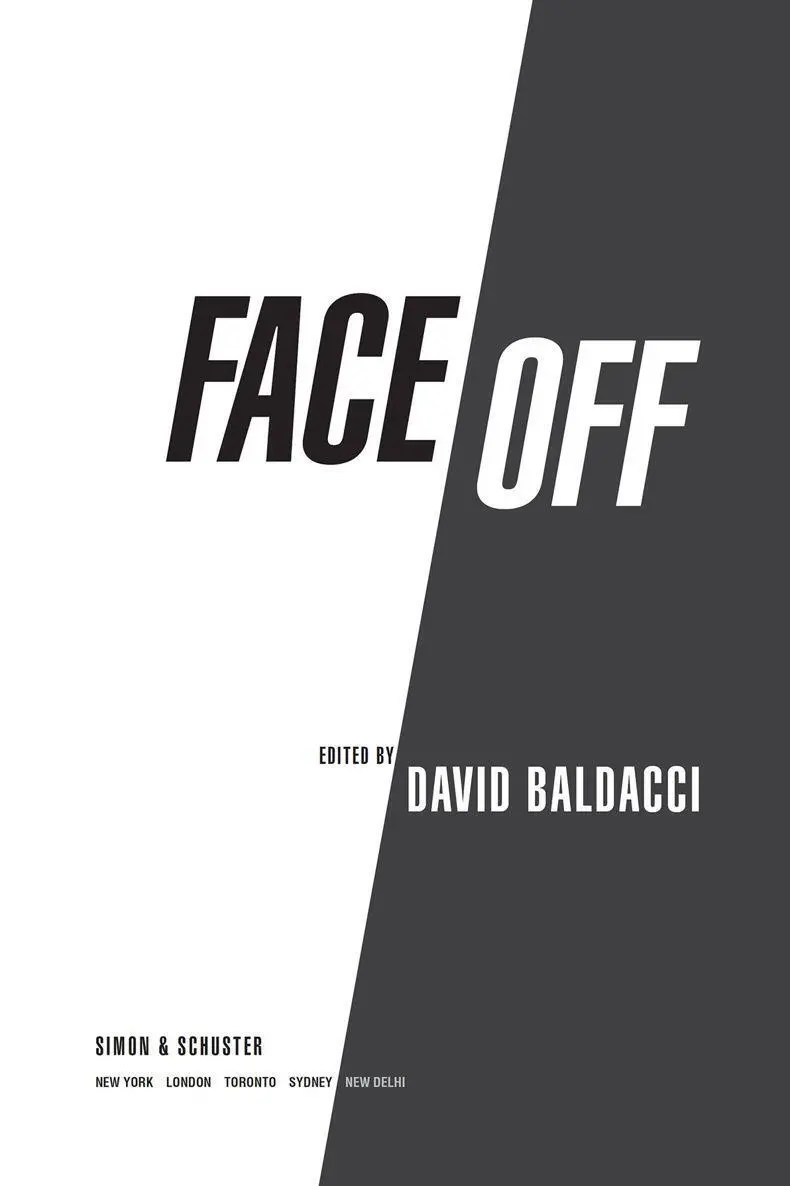
- Название:Face Off (2014) Anthology
- Автор:
- Издательство:Simon & Schuster
- Жанр:
- Год:2014
- ISBN:9781476762067
- Рейтинг книги:4 / 5. Голосов: 1
-
Избранное:Добавить в избранное
- Отзывы:
-
Ваша оценка:
Face Off (2014) Anthology: краткое содержание, описание и аннотация
Предлагаем к чтению аннотацию, описание, краткое содержание или предисловие (зависит от того, что написал сам автор книги «Face Off (2014) Anthology»). Если вы не нашли необходимую информацию о книге — напишите в комментариях, мы постараемся отыскать её.
Face Off (2014) Anthology — читать онлайн бесплатно полную книгу (весь текст) целиком
Ниже представлен текст книги, разбитый по страницам. Система сохранения места последней прочитанной страницы, позволяет с удобством читать онлайн бесплатно книгу «Face Off (2014) Anthology», без необходимости каждый раз заново искать на чём Вы остановились. Поставьте закладку, и сможете в любой момент перейти на страницу, на которой закончили чтение.
Интервал:
Закладка:
“Interesting,” Lincoln said.
“After the accident, did you think about suicide?”
“Yes. Quite considerably,” Lincoln said. “Sometimes, I’m not sure I made the right choice, staying alive. But my curiosity keeps me going; I always seem to have work.” He smiled. “God bless all the little criminals.”
“And then there’s Amelia,” Lucas said.
“Yes. Then there’s Amelia.”
“You’re a lucky man, Lincoln,” Lucas said.
Lincoln laughed and said, “It’s been a while since anyone told me that.”
· · ·
After an hour on the stoop, Lucas decided that he’d either have to make a move on the building, or go away. He stood up, dusted off the seat of his jeans, and saw a man walking along the sidewalk toward him, alone. The man spit in the gutter and came on. When he got to Lucas, he stopped and said, “You got an extra twenty?”
“No.”
“I’m not really asking,” the man said.
“Take a close look at me,” Lucas said.
The man took a closer look, then said, “Fuck you,” and went on down the street. He looked back once, then turned the corner and was gone. Lucas waited another few minutes, to see if the man came back, then crossed the street and, using his cell phone as a flashlight, looked at the lock. An old one—a good one, when it was made, but now old. With a last look around, Lucas took the rake out of his pocket, slipped the pick-arm into the lock. The rake chattered for a moment, as Lucas kept the turning pressure on, and then the lock went.
He stepped inside, closed the door, and called, “Anybody home?”
He listened, got no response, except a scrabbling sound in the ceiling—a rat.
“Hey, anybody? Anybody here?”
Nobody answered. He took a flashlight from his pocket, turned it on. He was in a wide hallway, with steps going up to his right, and with a double door to the left. The hallway smelled of burned metal, as though somebody had been working with a welding torch. He was in the right place.
He tried the double door and found it open, with a bank of light switches on the wall to the left. He closed the door behind him and turned on the lights. He was in a wide-open studio with several two-foot-tall bronze sculptures sitting on heavy wooden tables, with a variety of metalworking tools—files, electric grinders, polishers, hand scribes. The air inside smelled of burned metal and polishing compound.
The sculptures were all on sadomasochistic themes: nude women being whipped, bound, beaten. Just what you need to add that extra spark to your living room, Lucas thought.
At the far edge of the studio was a low, wooden wall, perhaps ten feet high, which was two or three feet short of the ceiling. Behind it, Lucas found a queen-sized bed, a chest of drawers, a large closet stuffed with clothing, a bathroom, a second closet with an apartment-sized washer and dryer stacked one on top of the other, a kitchenette, and a small breakfast table with two chairs. A television was mounted on a swing arm at the foot of the bed. He poked through the living area for a moment, found nothing of particular interest, and continued his tour of the studio. And found, at the back, an internal door, sheathed in metal, that was set in a frame a step below the rest of the floor—a door that most likely led to a basement, Lucas thought. He looked at the lock, and realized that the rake wouldn’t work: the thing was probably a year old, a Medeco.
After the quick tour of the lower floor, he turned out the lights, stepped back in the hallway, and used the flashlight to climb the stairs to the second floor. The second floor was a trash heap: a line of single rooms that had apparently last been used as a flophouse, each with a wrecked cot or a stained mattress, various pieces of mostly broken furniture. More rats: he never saw one, but he could hear them.
Nothing for him there.
He went back down to the studio, closed the door, turned the lights on, went to look at the cellar door again. No way to open it: it was impossible. He pounded on it a few times and listened, heard nothing. What they really needed, he thought, was behind that door, and he had no way to get there.
He’d been inside for five or six minutes, and time was wearing on him.
He took a plastic bag out of his pocket, and from the bag, several more Ziploc-style bags, each with a white spongelike pad in it. Lincoln’s instructions had been simple enough: press the pad into anything you’d like to pick up, then put the pad back in the plastic bag, and seal it. Lucas worked his way through the studio, doing just that: sampling bronze filings from the floor, off a workbench, and out of the teeth of a metal file. Moving to the welding area, he found a selection of welding rods, and stuck one of each kind in his pocket, and, from a trash bin, several used rods.
He sampled several stains that might possibly have been blood, but there were enough stains around the place, oil and lubricants, that he had his doubts. He was taking a sample when he saw, in a small niche off the main working space, a half dozen crucifixes on neck chains, along with a necklace of cheap aqua-colored stones, a thin string of seed pearls, a ring on a chain, and three sets of earrings, all pinned to the wall with tacks. And he thought, Trophies? If they were, there were twelve of them. There was nothing else like them in the room: he took a half dozen photos with his cell phone.
Time to leave. On his way out, he looked at each of the bronze sculptures, and a clay maquette for another, and noticed that each of the women portrayed in the sculptures was wearing a single piece of jewelry of some kind, apparently to emphasize her nakedness. Was it possible that the jewelry collection did not represent trophies, but was for use with models?
He was thinking about that when Lily called. “He’s moving.”
“And I’m gone,” Lucas said. And he thought, Not for models. They were trophies, and there were twelve of them.
· · ·
“You believe it?” Lucas Davenport said, walking into the town house. He held up the plastic bags. “This shit fell out the window when I was walking by Verlaine’s apartment.”
Lincoln spun the motorized wheelchair around, noting eagerly—almost hungrily—the evidence in the Minnesotan’s hand.
“Sometimes you catch a break. Anything obvious?”
“No piles of bones or bloody shackles. There’s a steel door leads somewhere—the cellar, I think. Love to see what’s behind that.” He explained that the lock rake wasn’t up to the task, though. They’d need a warrant and a sledgehammer.
Lincoln turned his attention to the evidence.
Lucas dropped down into one of the wicker chairs near one of the large high-definition monitors that glowed like a billboard in Times Square.
“Lucas?” Thom Reston, Lincoln’s aide, stood in the doorway. He was a slim, young man, dressed in a lavender shirt, dark tie, and beige slacks. “Tempt you? Beer? Anything else?”
“Later, thanks.”
Lincoln said, “Whiskey for me.”
“You’ve had two already,” Thom countered.
“I’m so pleased at your sterling memory. Could I have a whiskey? Please and thank you?”
“No.”
“Get me—” But he was speaking to an empty doorway. He grimaced. “All right. Let’s get to work. Mel, what’s in the haul?”
Mel Cooper looked like a geek, which he probably was since he was the Mr. Wizard of forensic science on the East Coast, if not the country. The man was pale and trim and had thin hair and Harry Potter glasses that invariably slid down his nose.
Pulling on gloves, a surgeon’s cap, and a disposable jacket, Cooper took the bag and set the contents out on an examination pad—large sheets of sterile newsprint.
Читать дальшеИнтервал:
Закладка:
Похожие книги на «Face Off (2014) Anthology»
Представляем Вашему вниманию похожие книги на «Face Off (2014) Anthology» списком для выбора. Мы отобрали схожую по названию и смыслу литературу в надежде предоставить читателям больше вариантов отыскать новые, интересные, ещё непрочитанные произведения.









Обсуждение, отзывы о книге «Face Off (2014) Anthology» и просто собственные мнения читателей. Оставьте ваши комментарии, напишите, что Вы думаете о произведении, его смысле или главных героях. Укажите что конкретно понравилось, а что нет, и почему Вы так считаете.