Penny, Louise - All the Devils Are Here
Здесь есть возможность читать онлайн «Penny, Louise - All the Devils Are Here» весь текст электронной книги совершенно бесплатно (целиком полную версию без сокращений). В некоторых случаях можно слушать аудио, скачать через торрент в формате fb2 и присутствует краткое содержание. Год выпуска: 2020, ISBN: 2020, Издательство: Hachette UK, Жанр: Старинная литература, на английском языке. Описание произведения, (предисловие) а так же отзывы посетителей доступны на портале библиотеки ЛибКат.
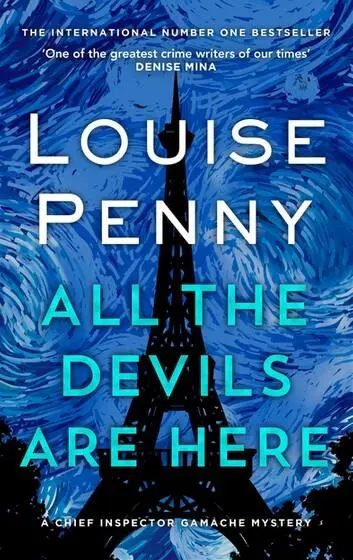
- Название:All the Devils Are Here
- Автор:
- Издательство:Hachette UK
- Жанр:
- Год:2020
- ISBN:9780751579253
- Рейтинг книги:4 / 5. Голосов: 2
-
Избранное:Добавить в избранное
- Отзывы:
-
Ваша оценка:
All the Devils Are Here: краткое содержание, описание и аннотация
Предлагаем к чтению аннотацию, описание, краткое содержание или предисловие (зависит от того, что написал сам автор книги «All the Devils Are Here»). Если вы не нашли необходимую информацию о книге — напишите в комментариях, мы постараемся отыскать её.
All the Devils Are Here — читать онлайн бесплатно полную книгу (весь текст) целиком
Ниже представлен текст книги, разбитый по страницам. Система сохранения места последней прочитанной страницы, позволяет с удобством читать онлайн бесплатно книгу «All the Devils Are Here», без необходимости каждый раз заново искать на чём Вы остановились. Поставьте закладку, и сможете в любой момент перейти на страницу, на которой закончили чтение.
Интервал:
Закладка:
Girard followed her gaze, to Alain Pinot. “As you know, journalists, and the head of media organizations, are often targets, too. Loiselle—”
Madame Roquebrune held up her hand. “Merci.”
Girard was dismissed, and the board chair, after taking a long sip of fresh-squeezed orange juice and rearranging the papers in front of her, called the meeting to order.
The luminaries took their seats around the table once used by Louis XIV to sign official documents.
“I don’t think this will take long,” said Madame Roquebrune. “Some of you clearly need to catch up on your sleep.”
There was a rumble of amusement as all eyes went to Pinot, who lifted his coffee cup in acknowledgment.
After going through the usual business, the board chair said, “I’m sure you’ve had time to study the annual report. If you’d like I can read it out loud—”
There was an immediate protest. Not necessary.
“Then we’ll need a motion to take it as accepted.”
It was motioned, seconded, voted on, and unanimously passed.
There was a tap on the door, and two waiters brought in more refreshments including fresh fruit, croissants, cheeses, and smoked salmon.
If the other board members noticed the slightly stained file in front of the board chair, they didn’t mention it.
She’d opened it briefly, but hadn’t studied it. Hadn’t needed to. Girard’s murmured “It’s all here” was enough.
The servers left, but the door to the suite remained open.
One of the board members turned and asked politely that it be closed. When there was no response, no soft click of the door closing, first one, then others looked over.
“I believe,” said a young man, stepping into the room, “that you’re in my seat.”
He was talking to Alain Pinot. The other board members turned to the head of AFP, as Pinot’s eyes widened.
“Who are you?” the chair demanded.
“My name’s Daniel Gamache, and I’m the new member of your board.”
“The hell you are,” said Madame Roquebrune. “Call security. Get the police if necessary.”
“Already here,” said Claude Dussault, stepping into the room. He stared at Pinot, who looked like he was having a stroke. While Eugénie Roquebrune, at the head of the table, had turned as gray as her hair.
Then the Prefect surveyed the room.
Not with any triumph, not even with disgust.
With resignation.
This was what modern devils looked like. Not the writhing creatures captured by Rodin, but good, decent, silent people.
Walking over to the CEO, he placed the pages, retrieved from beneath an Aubusson carpet in the Musée des archives, in the dossier.
“Now it’s all here,” he said.
Her father kissed Annie lightly on the forehead, so as not to wake her up.
But still, she stirred.
“Dad? Have you seen her?”
“She’s beautiful, Annie.”
As soon as Girard and Pinot had left the apartment, Loiselle had shifted his rifle.
“What the fuck are you doing?” demanded the other SecurForte guard.
“Drop it,” said Loiselle.
“What?”
“Now.”
Claude Dussault got up. “Fire your weapon,” he ordered Loiselle. “They need to hear it.”
“Dad?” said Daniel, staring as his father groaned and stirred, his eyes fluttering open as he struggled for consciousness.
Loiselle swung his rifle over to the empty sofa and fired.
Armand opened his eyes wide. “Daniel? Oh, God, Daniel.” He grabbed his son to him, and held him tight. Then, releasing him, he ran his hands over Daniel’s head and chest. “Are you all right?”
“Are you?” He placed his open palm on his father’s bloody chest. His eyes wide with shock.
“Oh, thank God,” Armand whispered. “I’m so sorry. I couldn’t tell you.”
“Tell me what? I don’t understand. You’re not hurt? Neither of you?”
He looked at Claude Dussault, who’d gone to the guard on the floor and was checking for a pulse. He found none.
“Hurt is relative,” said the Prefect as he kicked the guard’s rifle away. “We’re not dead. You okay?” he said to Gamache, who was now kneeling.
“Not dead,” he said, though his voice was strained.
“I thought—” Loiselle began, clearly as confused as Daniel. He looked from Dussault to Gamache. “How?”
Daniel doubled over and threw up.
Armand rubbed Daniel’s back, murmuring, “We’re safe. It’s over. We’re safe.”
“I thought you were dead. I thought I was about to die.” Daniel sobbed, coughing and spitting.
“Shhhh,” said his father. Not to stop his tears, but to comfort him.
“How?” Loiselle repeated, staring at the great red stains on Dussault’s chest, then over to the stains on Gamache’s chest, head, and back. “Dye?”
“No.” Dussault shoved up his sleeve and showed the puncture where his blood had been taken. “Girard would know fake blood. I loaded his gun with cartridges filled with real blood.”
“Girard’s gun?” Loiselle asked.
“No, his.” Dussault pointed to Armand, who had struggled to his feet and was bending over in pain. “I left it in your apartment, hoping you’d find it, Armand, and have it with you. When you didn’t—”
“When I first met you last night? No,” he said, straightening up. “It took me a while to work out what you were doing. Whose side you were on. Did you know about the attacks on Stephen and Monsieur Plessner?”
“ Oui. But I couldn’t stop them.” The two men, who’d both had to make horrific choices in their lives, stared at each other. “I’m sorry, Armand.”
“You could see why I’d doubt,” said Armand.
“When did you know what I was really doing?” Dussault asked. “When I found the coins in the fountain, I began to suspect you threw them there to get them away from Daniel and to keep them safe, as evidence. I couldn’t think of any other reason for you to not only do it, but do it in front of me. So I’d see. But it wasn’t really until you started reading the file that I was certain.”
“As late as that?” asked Dussault.
“ Oui. There was almost no evidence in there. I’d taken most of it out and hidden it in the Musée. When you didn’t say anything, I knew. All the way over here I’d tried to figure out how this could possibly work. The only way I could see was if Girard frisked me and took the gun. Then used it to shoot me and Daniel. When he didn’t, I had to improvise.”
“By shooting me,” said Dussault.
“By pretending to, yes.”
“How did you know he was on our side?” asked Daniel, looking at Loiselle.
“When he hit me in the stomach, he’d obviously pulled the punch. I was pretty sure then. And even this”—he touched the side of his head—“was glancing, designed to draw blood but nothing more. But by then I knew.”
“How?” asked Loiselle.
“At the archives, when I was running to the street, you were shooting and missing. Believe me, no special-forces-trained commando would miss. I take it Arbour, Lenoir, and de la Granger are safe?”
“Yes,” said Loiselle. “Before I left, I arrested the commander. The others quickly gave up, as I knew they would. Their hearts aren’t in the job. There’s no loyalty.”
“Well,” said Dussault, looking at the young man. “There is some.”
“Yessir.”
“If you knew these two were on our side,” Daniel asked his father, “why not just end it then? Why take the risk Girard and the other guards would kill us?”
“They almost did,” said Gamache. “I think Girard would’ve killed me if you hadn’t come out. That distracted them. Gave me a chance. You saved my life.”
“We couldn’t stop them yet,” said Dussault. “We had evidence against Girard and Pinot, but not against GHS. They were setting up Carole Gossette to take the blame. We need Girard and Pinot to take the file to the CEO. We need her to accept it. We have to prove it goes much higher, much further. And we need Pinot to sit down at that table. Speaking of which, we have to go. The board meeting’s about to start.”
Читать дальшеИнтервал:
Закладка:
Похожие книги на «All the Devils Are Here»
Представляем Вашему вниманию похожие книги на «All the Devils Are Here» списком для выбора. Мы отобрали схожую по названию и смыслу литературу в надежде предоставить читателям больше вариантов отыскать новые, интересные, ещё непрочитанные произведения.












Обсуждение, отзывы о книге «All the Devils Are Here» и просто собственные мнения читателей. Оставьте ваши комментарии, напишите, что Вы думаете о произведении, его смысле или главных героях. Укажите что конкретно понравилось, а что нет, и почему Вы так считаете.