Julian Stockwin - Seaflower
Здесь есть возможность читать онлайн «Julian Stockwin - Seaflower» весь текст электронной книги совершенно бесплатно (целиком полную версию без сокращений). В некоторых случаях можно слушать аудио, скачать через торрент в формате fb2 и присутствует краткое содержание. Жанр: Старинная литература, на английском языке. Описание произведения, (предисловие) а так же отзывы посетителей доступны на портале библиотеки ЛибКат.
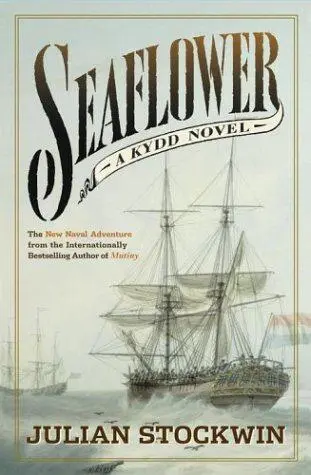
- Название:Seaflower
- Автор:
- Жанр:
- Год:неизвестен
- ISBN:нет данных
- Рейтинг книги:3 / 5. Голосов: 1
-
Избранное:Добавить в избранное
- Отзывы:
-
Ваша оценка:
Seaflower: краткое содержание, описание и аннотация
Предлагаем к чтению аннотацию, описание, краткое содержание или предисловие (зависит от того, что написал сам автор книги «Seaflower»). Если вы не нашли необходимую информацию о книге — напишите в комментариях, мы постараемся отыскать её.
Seaflower — читать онлайн бесплатно полную книгу (весь текст) целиком
Ниже представлен текст книги, разбитый по страницам. Система сохранения места последней прочитанной страницы, позволяет с удобством читать онлайн бесплатно книгу «Seaflower», без необходимости каждый раз заново искать на чём Вы остановились. Поставьте закладку, и сможете в любой момент перейти на страницу, на которой закончили чтение.
Интервал:
Закладка:
Without thinking, Renzi fell into step beside the man, but was swiftly told, 'Fall in astern, if you please.' The officer's look of disdain caused Renzi nothing but secret amusement. A short walk took them to an imposing stone building: a blue ensign and marine sentry at the door proclaimed it a naval establishment. The marine slapped his musket to the present as the officer entered, then winked at Renzi.
The lieutenant paused. 'Play your cards right, my man, and your days as a foremast hand may well be at an end.' Mystified, Renzi followed him down the passageway.
They stopped at a door; the lieutenant knocked and leaned inside. 'The man Renzi, sir,' he said.
'Send 'im in!' roared the unseen personage within.
'Rear Admiral Edgcumbe,' said the lieutenant softly, and ushered Renzi in.
The Admiral sat behind a massive dark-polished desk, his expression more curious than fierce. 'So you has the French, an' a manner to go with it, I'm told,' he mused, looking keenly at Renzi.
He slid across a piece of paper and quill. 'Write "Render to me your return affecting stores that are rotten.'"
Renzi complied, his hand flying across the page, sure and fluent.
'Damme, that's a splendid hand for a sailor,' grunted the Admiral, and looked up sharply. 'Are ye a forger?' 'Er, no, sir.'
'Pity. First class with a pen, y' forger.' His head snapped up. 'What's the county town o' Wiltshire?'
'Sarum — which is Salisbury,' said Renzi immediately. It was a little too close for comfort: his family were prominent in the next county and he had reason to remember the spires of old Salisbury.
Admiral Edgcumbe smiled. 'Ah, quick an' sharp with it,' he said, with satisfaction, and leaned back in his chair.
'Flags!' he roared.
The lieutenant instantly poked his head inside the room. 'This one'll do. Get 'im in a decent rig an' on the staff.'
'Aye-aye, sir.'
'See he doesn't run, an' have him aboard the packet in good time.' He bent his head again to his work, thus dismissing both men.
By the evening it had become clear what was going on. The Admiral was newly promoted commander-in-chief designate to the Jamaica station and was due to sail shortly with his staff to take up the appointment. He had been unlucky in the matter of fever — it was damnably difficult to find good replacement staff at short notice - and word about Renzi had reached him just in time. Renzi would be a writer, a form of clerk entrusted only with duplication of orders and unimportant matters, but would prove useful with his good knowledge of the language of the enemy. The lieutenant clearly felt that Renzi had been plucked from an existence as a sea menial to a prestigious position with real prospects, and should be grateful.
For himself, Renzi felt a lurch of premonition at the mention of Jamaica, but perhaps in the naval headquarters there would be no exposure and therefore little risk of confrontation. A new life of petty politics at headquarters was not to his liking, for he had deliberately chosen the sea life as the purest form of exile.
Next day the packet swarmed with the Admiral's retinue. Renzi, as a seaman, knew precisely where to keep out of the way and watched with wry amusement the fluster and confusion as the pretty little topsail cutter put to sea. A small frigate accompanied them as escort, the pair foaming along in the freshness after the hurricane, heading westward deep into the glittering blue of the Caribbean sea.
The island of Jamaica was raised five days later without incident, an impressive blue-grey monolith appearing out of the morning on the distant horizon. They had passed St Kitts during the night and Hispaniola was a disappointing low scrubby headland, approaching then receding as, with the favourable north-easterlies, they headed direct for the southern coast of Jamaica.
Off Morant Bay they hove to, a pilot schooner plunging and rolling as she sent across the Kingston pilot, and in turn took aboard the Admiral's flag lieutenant. They would remain there for the night while warning of the arrival of their august passenger reached the capital overland.
It had been a pleasant, if crowded passage; the tedium of a sea voyage without duties brought Renzi an unexpected pang of sympathy for the passengers he had previously scorned. More immediately useful was the information he had gleaned from casual talking with the Admiral's staff. In the West Indies there was wealth, more millions than he had ever suspected, a river of silver and gold heading back to England from trade and its support, but above all from sugar. The plantation society, the plantocracy, had high political significance in London and lived like lords, if the tales of high living were to be believed, but with the great wealth there was another of corrupt and unscrupulous conspirators who infested every class.
He had met the First Clerk, Mr Jacobs, a dry but astute man who weighed and measured each word before it was uttered. From him Renzi learned that they would be going not to the capital, Kingston, but further inland to Spanish Town, the administrative centre of Jamaica, and would be involved primarily in the necessary dealings of the navy with the civil administration. It was not a prospect that pleased Renzi.
Morning saw the two ships proceeding sedately westward to the entrance of Kingston harbour. On the sheltered inner side of a low encircling spit of land miles long was the Jamaica station of the Royal Navy: a mighty 74-gun ship-of-the-line, four frigates, sloops of war, and countless brigs and schooners.
The Admiral had transferred to the frigate during the night in order to make his arrival with all appropriate ceremony, and in the light airs of the morning, clouds of smoke eddied about the anchored 74 as her salute crashed out at the sight of the frigate's bunting.
The packet followed humbly in the wake of the frigate, but when the bigger ship went to meet her brethren, it passed across the bay to bring up noisily into the wind opposite a wharf at the end of a street in Kingston town. A heaving line sailed across and they were pulled alongside.
The hot, sandy streets were alive: drays filled with the trade goods of two continents, merchants concluding deals in the broad piazzas, processions of traders with their slaves following behind. The cheery green and white of the houses was complemented by the gardens, which differed wildly from the calm neatness of English cultivation: here there were fruit-trees, coconuts, tall palms and a riot of colour from vines.
There was little time for Renzi to stand and stare. Mr Jacobs was clearly discontented with the arrangements for transport. The ketureens — the ubiquitous Jamaican gig sporting a gay raised sunroof on rods — offered insufficient security against possible rain for the two chests of correspondence. When this had been settled, with dozens of negroes walking beside and an overseer riding ahead to clear the way of wagons and carts, they set out on the flat road to Spanish Town. After passing a great lagoon with vast reed beds, they stopped at the Ferry Inn to refresh and change horses before the final run to the old town.
'It is of an age, I believe,' Renzi said to Jacobs, as they wound along among the outer streets of Spanish Town.
'It is. Founded by Christopher Columbus, and settled by the Dons. Captured by us in 1655.'
Renzi would have to be content with that bare information, but his mind expanded upon it: two centuries of Spanish indolence and fixed ways, eventless years that were in stark contrast to the tumults in Europe. Then the English had flooded in, upsetting the staid times with their thrusting, mercantile rudeness, turning the old, comfortable social certainties on their head.
The procession ground into a large square with imposing buildings that would not have been out of place in far Castile. One notable exception was a distinguished white marble edifice set between the two largest structures. They disembarked in its shadow and, to his surprise, Renzi saw that it was a splendid colonnaded statue of an undeniable sea flavour — cannons, rope and the sterns of fleeing enemy ships.
Читать дальшеИнтервал:
Закладка:
Похожие книги на «Seaflower»
Представляем Вашему вниманию похожие книги на «Seaflower» списком для выбора. Мы отобрали схожую по названию и смыслу литературу в надежде предоставить читателям больше вариантов отыскать новые, интересные, ещё непрочитанные произведения.







Обсуждение, отзывы о книге «Seaflower» и просто собственные мнения читателей. Оставьте ваши комментарии, напишите, что Вы думаете о произведении, его смысле или главных героях. Укажите что конкретно понравилось, а что нет, и почему Вы так считаете.