Julian Stockwin - Mutiny
Здесь есть возможность читать онлайн «Julian Stockwin - Mutiny» весь текст электронной книги совершенно бесплатно (целиком полную версию без сокращений). В некоторых случаях можно слушать аудио, скачать через торрент в формате fb2 и присутствует краткое содержание. Жанр: Старинная литература, на английском языке. Описание произведения, (предисловие) а так же отзывы посетителей доступны на портале библиотеки ЛибКат.
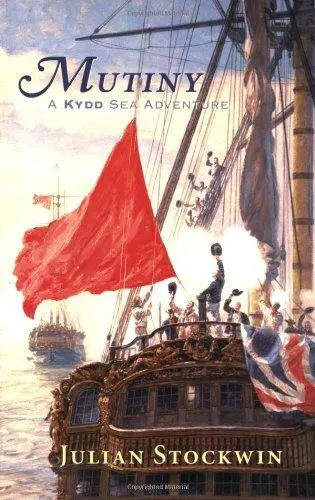
- Название:Mutiny
- Автор:
- Жанр:
- Год:неизвестен
- ISBN:нет данных
- Рейтинг книги:3 / 5. Голосов: 1
-
Избранное:Добавить в избранное
- Отзывы:
-
Ваша оценка:
Mutiny: краткое содержание, описание и аннотация
Предлагаем к чтению аннотацию, описание, краткое содержание или предисловие (зависит от того, что написал сам автор книги «Mutiny»). Если вы не нашли необходимую информацию о книге — напишите в комментариях, мы постараемся отыскать её.
Mutiny — читать онлайн бесплатно полную книгу (весь текст) целиком
Ниже представлен текст книги, разбитый по страницам. Система сохранения места последней прочитанной страницы, позволяет с удобством читать онлайн бесплатно книгу «Mutiny», без необходимости каждый раз заново искать на чём Вы остановились. Поставьте закладку, и сможете в любой момент перейти на страницу, на которой закончили чтение.
Интервал:
Закладка:
Renzi slowly laid down the newspaper. This was the worst news possible. For some reason the mutineers had rejected their last hope; they had nowhere else to go. Pitt would never forgive them now, not after the inevitable spectacle of the army or the loyal remnant of the navy ending the mutiny in a welter of ignominious bloodshed..
He couldn't face breakfast with the knowledge that his dearest friend was now beyond mercy, the pardon withdrawn. He left the lodging, striding fiercely in a rage of hopelessness, past the curious medieval streets and shops, up steep cobbled roads.
Logic said that there were only two courses: that Kydd could be miraculously saved, or that Renzi should resign himself to his friend's fate and spare himself the hurt. The former was for all practical purposes impossible, the latter he could not face.
That left the ludicrous prospect of trying to find a miracle. The path turned into a grassy lane down to the river crossing, and the soft and ancient grey stone of a Norman castle. His hand reached out to touch its timeless strength, willing an inspiration, but none came.
All Renzi knew was that he had to do something, try something . .. He came to a resolution: he would go to London.
The coach was uncomfortable and smelly, but he made the capital and the White Hart Inn well before dark. Restless and brooding, he left his bag at the inn and braved the streets. London was the same riotous mix of noise and squalor, carriages and drays, horses and hawkers, exquisites and flower-girls. Instinctively he turned into Castle Street and south past the Royal Mews — time was pressing, and it could all come to a conclusion very soon.
He trudged through the chaos of Charing Cross, then entered the broad avenue of White Hall. Past the Treasury was Downing Street, where he knew behind the bland frontage of Number Ten the Prime Minister was probably in cabinet, certainly taking swift and savage measures.
Renzi stopped and looked despondently down the street. His father had powerful connections in Parliament, a rotten borough and friends aplenty, but he knew he could be baying at the moon for all the help they would give him now.
He retraced his steps. This was the seat of power, the centre of empire. Rulers of strange lands around the globe, the King himself, but not one could he think to approach.
On past Horseguards he continued, and then to the Admiralty itself. Staring at the smoke-grimed columns, the stream of officers and bewigged civilians coming and going, he cudgelled his brain but could think of nothing that might break the iron logic of the situation: Kydd was a mutineer who had publicly declared for the insurrection — there could be no reasoning with this.
Black thoughts came. Would Kydd want to see Renzi at the gallows for his execution, or brave it out alone? Was there any service he could do for him, such as ensure his corpse was not taken down for dissection?
The lamplighters came out as the dusk drew in, and Renzi's mind ached. As he waited for a grossly overloaded wagon to cajole and threaten its way round Charing Cross, he concluded that there was no possible answer he could find. Perhaps there was someone who could tell him of one — but who, in his whole experience, would know both naval imperatives and political expediencies?
From somewhere within his febrile brain came memories of a quite different time and place: the sun-blessed waters of the Caribbean, a hurricane, and a fearful open-boat voyage. It was a slim chance, but he had no other: he would seek out Lord Stanhope, whose life and mission he and Kydd had secured together.
Stanhope would never stoop to using his standing with the government for such a cause, but he could give Renzi valuable inside knowledge of the wheels of power, perhaps an insight into how... But Stanhope was beyond reach for a mere mortal. Dejection returned as Renzi thought through the impossibility of gaining access to a senior government figure in a wartime crisis.
Then another flood of recollection: a crude palm hut on a Caribbean beach, an injured Stanhope and a promise exacted from Renzi that if Stanhope were not to survive, he should at all costs transmit his intelligence to a Mr Congalton, at the Foreign Office.
Renzi hurried back to the White Hart. The landlord provided writing materials, and in his tiny room he set to. It was the height of gall, but nothing could stop him now. The form of the letter was unimportant: it was simply a request for a hearing, through Congalton to Stanhope, shamelessly implying a matter of discreet intelligence.
He folded the letter and plunged out into the night, scorning the offer of a link-boy. Without a long coat and sword he would not be worth the attention of robbers. The Foreign Office was well used to late-night messages passed by questionable figures, and he slipped away well satisfied.
A reply arrived even while he was at an early breakfast - 'Hatchard's, 173 Piccadilly, at 10 a.m.' He forced his brain to an icy calm while he rehearsed what he intended to say, and in good time he made the most of his attire, clapped on a borrowed hat and appeared at the appointed place.
It turned out to be a bookseller recently opened for business, well placed in a quality district and just down from Debrett's. No stranger to books, Renzi eyed the packed shelves with avarice. Bold tides on political economy and contemporary analysis tempted, as well as tracts by serious thinkers and pamphlets by parliamentary names. Engrossed, he missed the activity around the carriage that drew up outside.
'You would oblige me by the use of your back room, Mr Hatchard.'
Renzi wheeled round. It was Stanhope, the lines in his face a little deeper, the expression more flinty. Renzi bowed and was favoured by a brief smile.
'If you please, my lord.' An assistant took Stanhope's cloak, then led the party up a spiral staircase to a comfortable upper room at the rear, where they were ushered to the high-backed chairs before the fire.
'Coffee, my lord?'
"Thank you, John, that would be welcome. Renzi?' The interval, as the assistant served, allowed time for Renzi to compose himself.
'A long time, my lord,' Renzi said, his heart hammering. There was now no one else in the room. The chandelier threw a bright, pleasing light over several reading desks arranged to one side.
'You have not asked me here on a matter of intelligence,' Stanhope said shortly, his voice just loud enough to be heard.
'Er, no, my lord,' Renzi said. He knew enough of Stanhope to refrain from dissimulation: it would help nobody to delay.
'Then ... ?'
Renzi took a deep breath. 'Your advice is solicited, my lord, in a matter which touches me deeply.' 'Go on.'
'A very dear friend has been unfortunate enough to be caught up in the recent mutiny, and I am concerned how to extricate him.'
'The Nore?'
'Just so.'
'Therefore he has chosen not to avail himself of the King's gracious pardon?'
'It would seem that is the case.'
Expressionless, Stanhope steepled his fingers and said, 'You realise, of course, I can have no influence on the course of this unhappy affair once it has reached its climax. It is completely within the jurisdiction of the Admiralty courts, his only hope of mercy lying in the King's express forgiveness. I rather suggest that in the circumstances of the King's known hostility to the mutineers' actions this will not be a likely prospect. I advise you, Renzi, to resign yourself. Your friend unhappily has nothing but the gallows to reflect upon.'
'Nothing?'
'I think I made myself clear?' Stanhope frowned.
'Yes, my lord, but—'
'There is no hope, either at law or in the machinations of politics — no one would be fool enough to put himself forward in the cause of a mutinous seaman at these times, no one.'
Читать дальшеИнтервал:
Закладка:
Похожие книги на «Mutiny»
Представляем Вашему вниманию похожие книги на «Mutiny» списком для выбора. Мы отобрали схожую по названию и смыслу литературу в надежде предоставить читателям больше вариантов отыскать новые, интересные, ещё непрочитанные произведения.








Обсуждение, отзывы о книге «Mutiny» и просто собственные мнения читателей. Оставьте ваши комментарии, напишите, что Вы думаете о произведении, его смысле или главных героях. Укажите что конкретно понравилось, а что нет, и почему Вы так считаете.