Julian Stockwin - Victory
Здесь есть возможность читать онлайн «Julian Stockwin - Victory» весь текст электронной книги совершенно бесплатно (целиком полную версию без сокращений). В некоторых случаях можно слушать аудио, скачать через торрент в формате fb2 и присутствует краткое содержание. Жанр: Старинная литература, на английском языке. Описание произведения, (предисловие) а так же отзывы посетителей доступны на портале библиотеки ЛибКат.
- Название:Victory
- Автор:
- Жанр:
- Год:неизвестен
- ISBN:нет данных
- Рейтинг книги:4 / 5. Голосов: 1
-
Избранное:Добавить в избранное
- Отзывы:
-
Ваша оценка:
Victory: краткое содержание, описание и аннотация
Предлагаем к чтению аннотацию, описание, краткое содержание или предисловие (зависит от того, что написал сам автор книги «Victory»). Если вы не нашли необходимую информацию о книге — напишите в комментариях, мы постараемся отыскать её.
Victory — читать онлайн бесплатно полную книгу (весь текст) целиком
Ниже представлен текст книги, разбитый по страницам. Система сохранения места последней прочитанной страницы, позволяет с удобством читать онлайн бесплатно книгу «Victory», без необходимости каждый раз заново искать на чём Вы остановились. Поставьте закладку, и сможете в любой момент перейти на страницу, на которой закончили чтение.
Интервал:
Закладка:
A roar of agreement arose – and Kydd knew what it was to be one of that band of brothers.
The following day was spent bringing together the fleet that the ships had joined. The men-o’-war lay to as orders criss-crossed by boat: there was much to arrange. This far into hostile waters it was not practical to hazard supply by store-ships and therefore the commander-in-chief had no option other than to send parts of his fleet to Gibraltar for provisions and Tetuan for water.
The first detachment set out, and with Rear Admiral Calder recalled to England, and five away on replenishment, an expectation of forty sail was looking less and less likely. However, this was Nelson’s command and a rising charge of pride was bringing the fleet together in a way that mere orders could not. Almost immediately, those who had not done so began painting ship in the distinctive ‘Nelson chequer’, which had a warlike black hull with vivid yellow along the line of the guns, the gun-ports themselves deadly black squares.
Captain Blackwood called his frigate captains aboard Euryalus . A bluff, energetic officer, he wasted no time. ‘We have our orders: the watch on Cadiz – others will get the observations to the admiral.’
He went on, ‘An inshore squadron of three sail-of-the-line lies ten or twelve miles in the offing, there to tempt Villeneuve, and more are spaced along out to where the fleet cruises, fifty miles or more to the west. It’s our duty to let Nelson know every movement of the enemy. For this we’ll be using your usual Admiralty signals but as well, Captain Popham’s telegraph code.’
It was nothing short of fantastical: Nelson was going to shape the battle in person but over lines of communication at the same distance as from London to Brighton, receiving priceless intelligence in minutes that would enable him to make his approach to the unsuspecting enemy precisely as he chose.
Other details concerned signals to be made at night or in fog, and Blackwood closed with handing a hastily sketched Pennant Board to each that detailed the distinguishing pennants of each ship in the fleet, necessary for the addressing of signals to individual vessels.
‘Then to our station, gentlemen!’
L’Aurore left the fleet in company with the other frigates and, during the night, closed with the moon-cast Spanish coast. At dawn they began their watch, cruising slowly three or four miles offshore, the tiny handful of frigates endlessly passing each other off the ancient city.
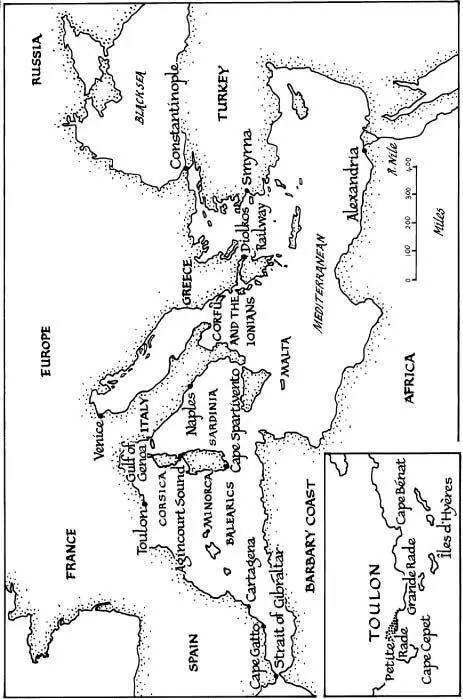
Cadiz was well-known to English sailors: here it was that Francis Drake had ‘singed the King of Spain’s beard’ more than two hundred years previously and blockades had been frequent since. The port was within a rocky peninsula on which stood a city of white stone, surrounded by vicious half-tide rocks but low enough to reveal an ominous forest of naked masts within the inner harbour.
Navigation was perilous in these shallow seas, which allowed entire blockading fleets to anchor offshore with impunity but at the same time hid a chain of sprawling reefs as much as three or four miles out to sea.
In the days that followed there was no sparing the ships, for missing the enemy putting to sea would be a catastrophe beyond imagination. Each morning, as the fragrance of the sun-kissed land came out to them, one or other of the frigates would close with the entrance at the fort of San Sebastian and look in. Oared gunboats once issued out to exchange shots but otherwise there was no disputing their presence.
This close, the tall, square Tavira Tower was in plain sight, the mirador that gave the Spaniards a sweeping vista some twenty miles out to sea.
Day by day the watch continued.
A blustery autumnal north-westerly forced the frigates seaward for a time, but also made it dead foul for leaving Cadiz. As the weather moderated they quickly closed again with the white-fringed shore.
A Swedish merchantman put to sea and was intercepted by L’Aurore . The affable master made no bones about what he had seen: deep within the harbour in the inner roads he had noted soldiers embarking in the Combined Fleet and talk alongshore had it that they were merely waiting for an easterly and would be putting to sea.
Kydd lost no time in setting in motion the communications line. They were equipped with monster signal flags fourteen feet across to be perceived a full ten miles distant. The new telegraph code proved its worth in detailing his intelligence but it took skill to handle the huge flags among the entangling lines of rigging.
It was becoming clear that a move was imminent: sharp eyes had spotted that sails had been bent to the yards and signal towers up and down the coast were unusually busy. Had they succeeded in deceiving Villeneuve that he faced only the handful of ships of the Inshore Squadron instead of Nelson, with his fleet being quietly reinforced out of sight? Were they misled by reports from Spanish watchers of Gibraltar that the five detached to store and water had, in fact, seriously weakened the British Fleet?
With thirty-five ships-of-the-line available to him, Villeneuve must have realised that if he was going to break out then it must be now – and when the north-westerly died and was replaced by the whisper of a variable easterly towards evening, even the humblest landman aboard L’Aurore knew what to expect the following day.
With the first delicate light of morning came the electrifying sight of the ships deep in the harbour rigged for sea. Sail to topgallants, fighting topsails, all were bent to the yards ready to set in a trice. And the dense pattern of masts was changing: they were opening up, separating. The ships were warping – the Combined Fleet was coming out.
Kydd’s signal flags – the longed for number 370, ‘Enemy’s ships are leaving port’ – soared up. Five miles away Euryalus acknowledged and relayed it on to the Inshore Squadron. Soon, fifty miles away, Lord Nelson would at long last be receiving the dramatic news he craved.
The winds were light but still in the east. It was taking a long time for Villeneuve’s fleet to reach open water and tension grew. Everything now depended on the frigates: if the French disappeared into the vastness of the ocean once again, it would be a calamity beyond bearing.
Blackwood sent the sloop Weazle flying for Gibraltar to alert the storing battleships while the little schooner Pickle went north to spread the word. The first French frigates were emerging, their mission only too obvious – to destroy the impudent English watchers and allow the battle-fleet to slip away.
L’Aurore was long cleared for action; now she went to quarters, her men standing resolutely by her guns. Blackwood had divided his forces in the light winds, two luring the frigates away while the rest stood out ready to shadow the rest of the enemy.
L’Aurore was given new orders. It was vital that the commander-in-chief received negative intelligence – that the seas north and south did not contain an enemy squadron summoned by shore telegraph on its way to reinforce Villeneuve. Thus one of the precious frigates was dispatched north while L’Aurore hauled to the wind for the run south.
It would be the harshest of luck to miss the coming contest, but Kydd’s mission was to go no further than the entrance to the Strait of Gibraltar and then return by the shortest possible route, assuming any reinforcements sent for from Cartagena would not delay.
They hugged the land up to the one promontory and turning point between Cadiz and the strait, a fearful journey with the scattered reefs. L’Aurore showed true breeding, though, and they raised the bleak sand-spit within a few hours; further inland there was a bluff cliff with a tower. This was marked on the chart as Torre de Meca and the turning point – Cabo Taraf-al-Gar, Trafalgar on Kydd’s chart.
Читать дальшеИнтервал:
Закладка:
Похожие книги на «Victory»
Представляем Вашему вниманию похожие книги на «Victory» списком для выбора. Мы отобрали схожую по названию и смыслу литературу в надежде предоставить читателям больше вариантов отыскать новые, интересные, ещё непрочитанные произведения.





Обсуждение, отзывы о книге «Victory» и просто собственные мнения читателей. Оставьте ваши комментарии, напишите, что Вы думаете о произведении, его смысле или главных героях. Укажите что конкретно понравилось, а что нет, и почему Вы так считаете.