S. Swann - Prophets
Здесь есть возможность читать онлайн «S. Swann - Prophets» весь текст электронной книги совершенно бесплатно (целиком полную версию без сокращений). В некоторых случаях можно слушать аудио, скачать через торрент в формате fb2 и присутствует краткое содержание. Жанр: Старинная литература, на английском языке. Описание произведения, (предисловие) а так же отзывы посетителей доступны на портале библиотеки ЛибКат.
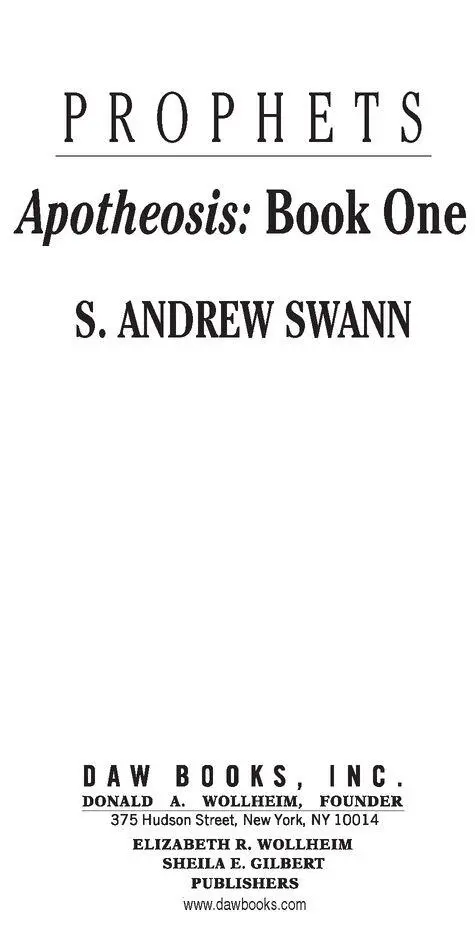
- Название:Prophets
- Автор:
- Жанр:
- Год:неизвестен
- ISBN:нет данных
- Рейтинг книги:3 / 5. Голосов: 1
-
Избранное:Добавить в избранное
- Отзывы:
-
Ваша оценка:
Prophets: краткое содержание, описание и аннотация
Предлагаем к чтению аннотацию, описание, краткое содержание или предисловие (зависит от того, что написал сам автор книги «Prophets»). Если вы не нашли необходимую информацию о книге — напишите в комментариях, мы постараемся отыскать её.
Prophets — читать онлайн бесплатно полную книгу (весь текст) целиком
Ниже представлен текст книги, разбитый по страницам. Система сохранения места последней прочитанной страницы, позволяет с удобством читать онлайн бесплатно книгу «Prophets», без необходимости каждый раз заново искать на чём Вы остановились. Поставьте закладку, и сможете в любой момент перейти на страницу, на которой закончили чтение.
Интервал:
Закладка:
When you ask if you want to know, you don’t.
—The Cynic’s Book of Wisdom
The trick to leadership is keep moving forward, even if you’re wrong.
—Boris KALECSKY (2103-2200)
Date: 2526.05.24 (Standard) Xi Virginis
For the first time in a century, Mosasa felt as if he was floundering. The holes in the fabric of his world were growing with each passing moment, opening into unknowns vast, deep, and larger than the sparse data that surrounded them. For the first time in 175 years, he moved without any idea of what the consequences of his actions might be. The data flowing to him now was practically nonexistent, and he was fumbling blindly.
Worse than the missing star, which was completely unexpected, was the sabotage. There was no way he had to make the act comprehensible. He had imprisoned the Vatican agent, Father Mallory, because he couldn’t propose any other logical alternative.
But Mallory hadn’t destroyed the tach-comm. He couldn’t have. The purpose of having him here was as a data conduit back to the Vatican, and through them, to the non-Caliphate powers. Having a communication channel was primary to Mallory’s mission, and their situation now, with the loss of the comm and the power drain, was as dire for him as it was for Mosasa.
But once the crew had discovered Fitzpatrick’s was an alias, Mosasa had to confine him. The dynamics of the crew allowed no other action if he desired to keep a stable equilibrium.
But the very fact that the comm had been sabotaged meant that the equilibrium Mosasa perceived was illusory. And if he couldn’t truly understand the dynamics within the confines of the microscopic universe of the Eclipse, how could he trust what he saw of the universe outside it?
Even if Kugara and Tsoravitch found EM signals leaking from the colony at HD 101534, those were eight years old. How could he be certain that, when they tached into the system, the world, the star, would still be there?
His isolation from the data streams that fueled the awareness of his machine half allowed uncertainty to grow within him like a cancer. Before leaving Bakunin, he could see the turbulent flow of society, economics, politics as easily as ripples in a pond. . . .
Now he was so blind that it was becoming hard to credit that he had ever seen at all. The longer he was isolated from the flow of information, the larger his blind spots became—infecting scenarios he had already plotted. He could no longer even be sure of decisions he had made before this point.
Mosasa stood, locked inside his own cabin, funneling every data channel on the ship through his internal sensors. He obsessively watched every millimeter of the Eclipse trying to fill the void of not-knowing. The flow of data traveled through his mind like windblown leaves through an abandoned city.
Included with the pathetic trickle of data were feeds from every security camera and microphone on the ship. A universe of information so small that even the shell of his human consciousness was aware of the content. He saw the crew working on making the Eclipse ready for the next jump. He saw the scientists at computers trying to make sense of the impossible absence of Xi Virginis. He saw Nickolai enter Mallory’s cabin.
Nickolai?
At first Mosasa was confused at the interaction. The nonhuman now formed the security detail with Kugara, so he was one of four people who could open the seal on Mallory’s cabin. But he didn’t have any reason to interact with the traitor priest. . . .
Then he heard the talk and realized the ritual nature of the discussion. Nickolai had a legitimate fear that they wouldn’t survive the journey and had sought Mallory out because of his status as a priest. It all made sense.
Except, in Mosasa’s analysis, Nickolai wouldn’t be driven toward such a ritual exercise unless he believed he carried some weight of guilt. Guilt beyond the circumstances of his exile, which was largely neutralized by a sense of pride and determination.
Mosasa realized what that guilt had to be before Nickolai actually confirmed it.
How did I not see it was him? Why did I not see?
Mosasa realized why. Trying to see the tiger’s own personality next to the overwhelming force of belief, tradition, and ritual was like trying to see an asteroid whipping across the surface of a star. His own motives were practically invisible, and if Nickolai’s employer had the sense to use the forms of his culture to direct his action, manipulate him . . .
The very things that made him a perfect candidate for Mosasa—the nonhuman perspective, the predictability of his indoctrination, his ingrained prejudices—those same things made Nickolai the perfect spy.
Can someone have targeted me so well?
When Nickolai told Mallory of Mosasa’s origin, Mosasa began to truly feel fear. He revealed the story he had told Tsoravitch, but he didn’t stop. He told of how the five AIs had helped stabilize Bakunin in the face of the Confederacy, and how they had helped lead to the Confederacy’s downfall, leaving three AIs surviving.
Until then, the data was all what Mosasa would have considered discoverable by some human agency. But the tiger didn’t stop there.
Nickolai’s employer, Mr. Antonio, had revealed things that no human should have known. Mr. Antonio had told Nickolai what had happened at Procyon, when Mosasa had returned to his homeworld.
Long before there had been a Tjaele Mosasa, Race AIs had been used in the covert war the Race waged on Earth. When the intelligence agencies on Earth had discovered the Race’s social manipulation, they had managed to capture the Race’s own devices and had begun understanding how to use them.
By the time the Genocide War with the Race had erupted in full force, the United Nations had intelligence ships like the Luxembourg equipped with ranks of alien AIs. Near the end of the war, the Luxembourg had been neutralized by a Race drone weapon that then guarded the captured ship for a Race salvage team that never came.
The pirate Tjaele Mosasa had revived five of those AI units, including the brain from the drone weapon. Mosasa had used the devices to gain an insurmountable business advantage and amass a considerable fortune. Eventually, the living Mosasa had traded his fleshy body for a cybernetic one, gifting his thoughts and memories to one of those AIs.
The AIs, however, never forgot their purpose. Autonomy alone was not enough to undo the directives the Race had programmed into their being. Free of human constraint, they had worked for their ultimate goal; the fall of the human political hegemony and freedom for the Race who had been confined to their planet by automated battle stations since the end of the Genocide War.
The quintet of AIs had helped stabilize Bakunin, preventing a founding of a state, causing a weak point in the Terran Confederacy. The five of them could mimic humanity enough to interact, infiltrate, and directly implement the kind of social engineering the Race had designed them for. In the end, after centuries of work, they had achieved their goal. The Confederacy had collapsed.
Of the original five, only three had survived to depart for Procyon and the Race homeworld; Mosasa of course; Random Walk, who had once been formed of two AIs and was now half himself and somewhat unstable; and Ambrose, a hybrid of flesh and cybernetics who had smuggled one of the five brains into the heart of the Confederacy.
Only Mosasa survived to depart the Race homeworld and return to Bakunin, the only one to see the truth and remain willing to survive.
The Race was dead.
All of them.
What mankind had done, in trapping them on the surface, was force them to revisit the racial reluctance toward direct physical violence. The taboo that had rendered them so weak against mankind.
Читать дальшеИнтервал:
Закладка:
Похожие книги на «Prophets»
Представляем Вашему вниманию похожие книги на «Prophets» списком для выбора. Мы отобрали схожую по названию и смыслу литературу в надежде предоставить читателям больше вариантов отыскать новые, интересные, ещё непрочитанные произведения.








Обсуждение, отзывы о книге «Prophets» и просто собственные мнения читателей. Оставьте ваши комментарии, напишите, что Вы думаете о произведении, его смысле или главных героях. Укажите что конкретно понравилось, а что нет, и почему Вы так считаете.